
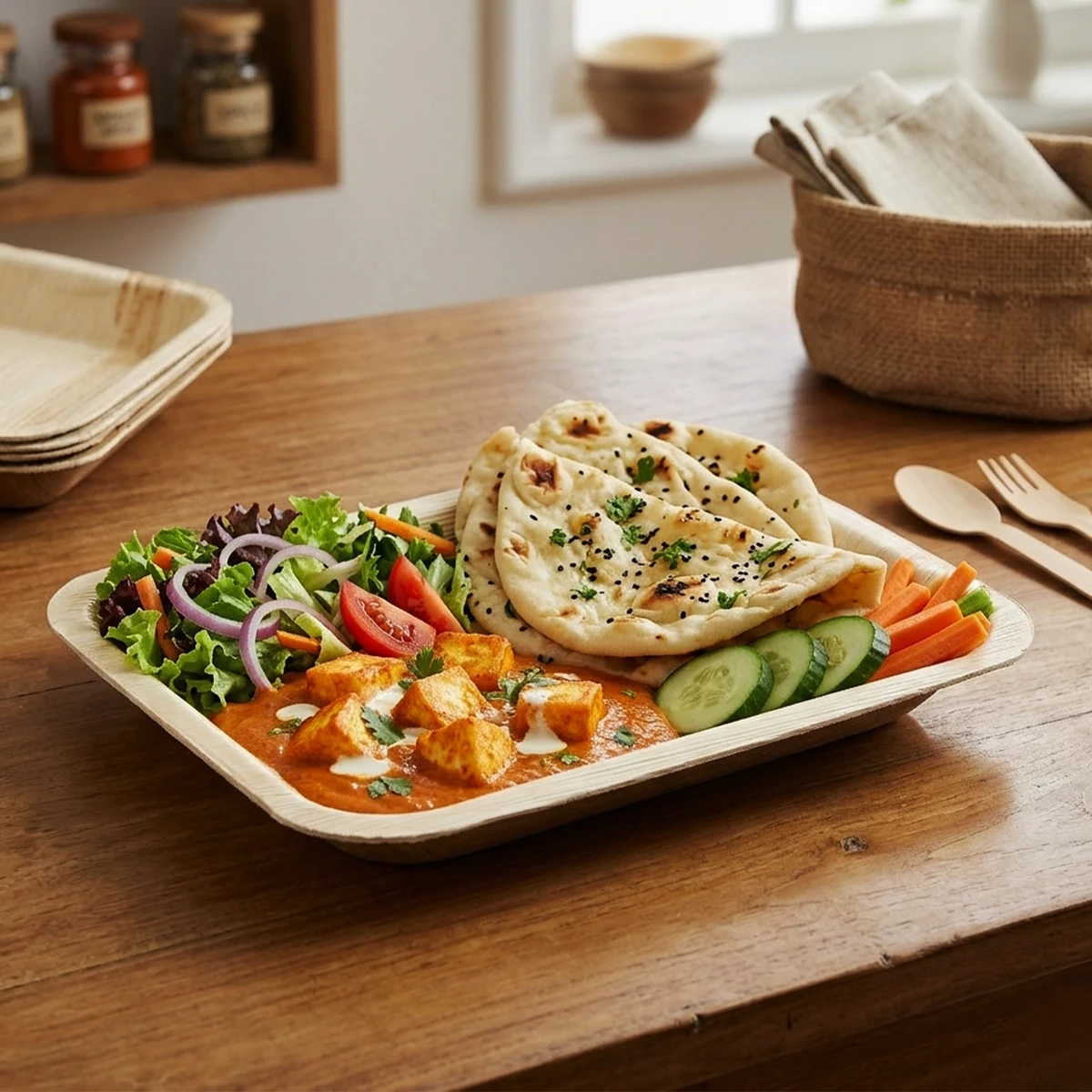
Start with a Trial Order 📦
Experience Foliware's premium areca palm leaf tableware with a minimum order of just 1 carton. Ideal for first-time buyers, distributors, HoReCa businesses, and institutional procurement.
Experience Foliware's premium areca palm leaf tableware with a minimum order of just 1 carton. Ideal for first-time buyers, distributors, HoReCa businesses, and institutional procurement.
Government e Marketplace, the Government of India’s public procurement platform, is the mandatory route for central ministries and departments buying common use goods under Rule 149 of the General Financial Rules, 2017. Three value bands decide the method: direct purchase up to Rs 50,000, lowest price among at least three manufacturers up to Rs 10,00,000, and a compulsory bid or reverse auction above that. Tableware is bought in all three.
The single biggest mistake a supplier makes on Government e Marketplace is treating every opportunity as a tender. Most tableware purchases are not tenders. They are catalogue transactions, and the ones that are tenders behave differently.
Rule 149 of the General Financial Rules, 2017, as amended by Department of Expenditure Office Memorandum F.1/3/2024-PPD of 10 July 2024, sets the structure. Procurement of goods by ministries and departments is mandatory for goods available on GeM. The portal is then used for direct online purchase as follows.
| Order value | Method under Rule 149 | What the buyer does | What the seller needs in place |
|---|---|---|---|
| Up to Rs 50,000 | Direct purchase | Buys from any available supplier meeting the requisite quality, specification and delivery period | A live, correctly categorised catalogue entry at a defensible price |
| Above Rs 50,000 up to Rs 10,00,000 | L1 buying | Buys from the seller with the lowest price among available sellers of at least three different manufacturers | To be one of the three manufacturers the buyer can see, at a competitive listed price |
| Above Rs 10,00,000 | Bid or reverse auction | Must obtain bids through the online bidding or reverse auction tool before ordering | Bid capability, EMD and ePBG readiness, compliance with every additional term |
Rule 149 also allows the buyer to use the bidding and reverse auction tools below Rs 10,00,000 if they choose. And it forbids splitting: a demand for goods shall not be divided into small quantities to make piecemeal purchases so as to avoid L1 buying, bidding or reverse auction on GeM, or to avoid a higher sanction.
Two further points from Rule 149 shape a tableware seller’s year. Ministries and departments must project their annual procurement plan on GeM within 30 days of budget approval, so the demand is visible before the order. And buyers test price reasonableness using the portal’s business analytics tools including the last purchase price on GeM, so your listed price is compared against what the government last paid, not against your own quotation history.
Government e Marketplace publishes its seller requirements in its own seller FAQs, and the sequence below reflects what those state.
Registration. A seller registers against a constitution type such as proprietorship, firm, company, trust, society or government body. Identity verification is by Aadhaar or personal PAN, with Aadhaar no longer mandatory. Organisation address, bank details, an active email and tax documents appropriate to the constitution are required, which may include CIN, PAN, DIPP and Udyam registration details.
Manufacturer or reseller. GeM distinguishes an Original Equipment Manufacturer, described as a vendor with proper manufacturing facilities following proper manufacturing processes and quality check parameters, from a reseller. A company without its own plant can be treated as an OEM through a contract manufacturing arrangement if it produces the contract agreement during assessment. In categories where OEMs already list products, resellers must map themselves to the OEM and upload authorisation documents. The distinction matters commercially too, for reasons set out in buying direct from the factory or through a distributor in India.
Catalogue. Products are added under a category with specifications, images, quantity and price. GeM states a turnaround time of 96 hours for product approval, requires an actual product image on a clean white background without watermark at a maximum of 300 kilobytes, and states that once a product is published the catalogue cannot be edited except for stock and price. That last point costs time: proof the entry before publishing.
Brand. If your brand is not on GeM you request its addition. Brands are rejected where the representation of the brand name is not consistent with the trademark, authorisation letter or website for the category.
Vendor assessment. Mandatory for OEMs and resellers in selected categories, with exemptions including central and state public sector undertakings, sellers above a stated annual turnover, BIS licensed OEMs, KVIC, the Coir Board and TRIFED. GeM states the assessment report is made available within 15 working days of the request, with disputes settled between the fifteenth and twentieth day.
Budget six to ten weeks from a standing start to a live, bid capable catalogue entry, most of it spent on assessment and on getting specification fields right rather than on the registration form.
Price alone does not determine the award on GeM. Two policy instruments sit over it, and a supplier who does not know which one applies loses orders they had already won on price.
Micro and small enterprise preference. Under the Public Procurement Policy for Micro and Small Enterprises Order, 2012, made under the Micro, Small and Medium Enterprises Development Act, 2006, central ministries, departments and central public sector undertakings must procure a minimum of 25 per cent of their annual value of goods and services from micro and small enterprises, with 4 per cent earmarked for enterprises owned by scheduled caste and scheduled tribe entrepreneurs and 3 per cent for those owned by women entrepreneurs. In a tender where the lowest price is from a party other than a micro or small enterprise, an MSE quoting within a band of L1 plus 15 per cent is allowed to supply up to 25 per cent of the total tendered value by bringing its price down to L1. GeM’s own seller FAQs describe a further position under which the full bid quantity can be awarded to an L1 MSE seller.
Make in India local content preference. The Public Procurement (Preference to Make in India) Order, 2017, most recently revised by the Department for Promotion of Industry and Internal Trade on 19 July 2024, classifies suppliers by local content. A Class-I local supplier meets a minimum of 50 per cent local content. A Class-II local supplier meets a minimum of 20 per cent but less than 50 per cent. Where the nodal ministry has notified sufficient local capacity and competition for an item, only Class-I local suppliers may bid, irrespective of value. Otherwise, only Class-I and Class-II local suppliers may bid unless a global tender enquiry has been issued.
The purchase preference mechanics decide whether you can recover an order you did not win outright. Where the goods are divisible and L1 is not a Class-I local supplier, 50 per cent of the order goes to L1 and the lowest Class-I local supplier within the margin of purchase preference is invited to match L1 for the remaining 50 per cent. Where the goods are not divisible, the lowest Class-I local supplier within the margin is invited to match L1 for the whole contract. The margin is 20 per cent. Class-II local suppliers get no purchase preference at all.
Local content is self-certified at bid stage, with the percentage stated and the locations of local value addition given. Above Rs 10 crore a certificate from a statutory auditor, cost auditor, practising cost accountant or practising chartered accountant is required, and a supplier whose category drops on verification can face a penalty of up to 10 per cent of contract value.
For a domestically manufactured areca leaf product both regimes are usually favourable, because the leaf is collected in India, the forming is done in India and the value added is Indian. That does not entitle you to assume a figure. Calculate local content as the order defines it and be ready to evidence it.
Beyond price, a GeM bid for disposable tableware typically turns on the following, and a submission that misses any one of them is scored out before the rate is read.
GeM suits a supplier who can hold a published price, deliver to dispersed consignees on a fixed period, and carry the administrative load of assessment, EMD and ePBG. It suits a supplier with seasonal capacity and a preference for larger consolidated orders much less well.
If your business is built on a small number of large annual contracts, an annual rate contract with an institution, or a distributor relationship, GeM may be the wrong first door. Rate contracts and annual tenders for disposable tableware in India covers the alternative, and appointing a distributor in India covers the case where someone else carries the portal overhead. There is no shame in letting an established GeM seller list your product and taking the manufacturing margin.
Is GeM compulsory for government buyers? Rule 149 of the General Financial Rules, 2017 makes procurement of goods and services by ministries and departments mandatory for goods and services available on GeM. Ministries and departments retain full powers to make their own arrangements for goods and services that are not available on GeM.
What are the current GeM purchase limits? Following the Department of Expenditure amendment of 10 July 2024, direct purchase runs up to Rs 50,000, L1 buying among at least three different manufacturers runs above Rs 50,000 up to Rs 10,00,000, and above Rs 10,00,000 the buyer must obtain bids through online bidding or reverse auction. Buyers may use the bidding tools below Rs 10,00,000 if they wish.
Do I have to be a manufacturer to sell tableware on GeM? No. GeM registers both OEMs and resellers. In categories where OEMs already list products, resellers must map to the OEM and upload authorisation documents. A company without its own plant can be treated as an OEM if it holds a contract manufacturing agreement and produces it during vendor assessment.
What does MSE preference actually give me? Under the Public Procurement Policy for MSEs Order, 2012, an MSE quoting within L1 plus 15 per cent may supply up to 25 per cent of the total tendered value by matching L1, where L1 is not itself an MSE. There is also an annual procurement target of 25 per cent from MSEs across central ministries, departments and CPSUs.
How is local content calculated for Make in India preference? Local content is the total value of the item procured, excluding net domestic indirect taxes, minus the value of imported content including all customs duties, as a proportion of total value. Imported items sourced from local resellers are excluded, as are licence fees, royalties and technical charges paid outside India.
How long does it take to get a product live on GeM? GeM states a 96 hour turnaround for product approval once a catalogue entry is submitted. The longer items are registration, brand approval and vendor assessment, where the assessment report is made available within 15 working days of the request and disputes are settled between the fifteenth and twentieth day.
Can a bid quantity be split between suppliers? Yes. Under the Make in India order, where goods are divisible and L1 is not a Class-I local supplier, 50 per cent of the quantity goes to L1 and the remainder is offered to the lowest Class-I local supplier within the 20 per cent margin of purchase preference on matching L1. Buyers may also split across consignees for delivery reasons.
Lane, documentation and destination rules for the markets this article applies to. Each page carries the route, the paperwork set and the quotation route for that destination.
Each link below answers the question this article raises next, whether that is the rule behind a decision, the same question in another destination, or the commercial step that follows.
Send the product, the annual volume, the consignee locations and the GeM category you are bidding into. For example, 12 inch Reinforced Round Traditional Patravali Meal Plates, 400,000 pieces over a twelve month contract, delivered to four consignees across Delhi NCR. Say whether you need the material declaration and laboratory reports attached to the bid document and whether the buyer has asked for local content certification, because those change what comes back with the quotation. See supply into the Indian market or send the enquiry .