
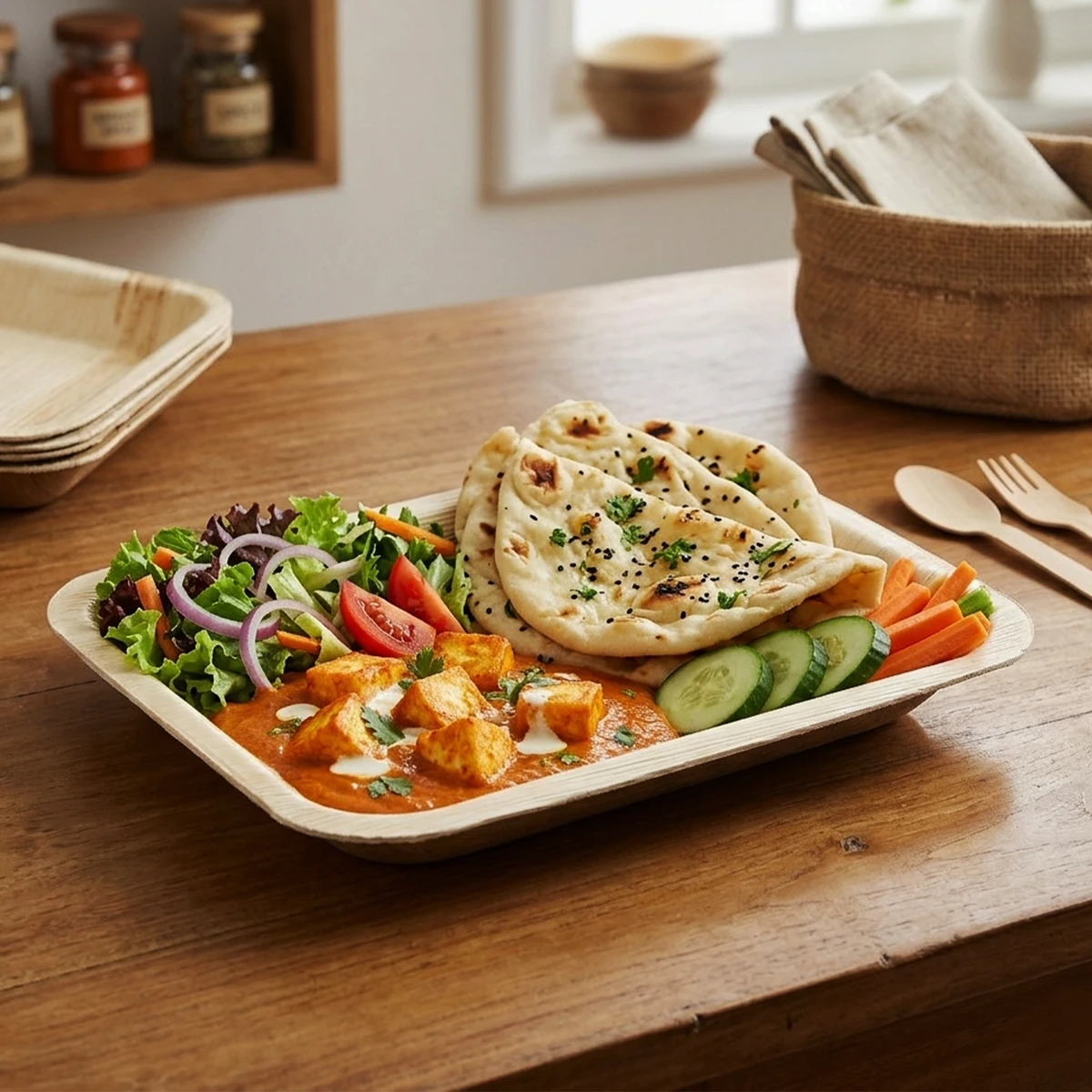
Start with a Trial Order 📦
Experience Foliware's premium areca palm leaf tableware with a minimum order of just 1 carton. Ideal for first-time buyers, distributors, HoReCa businesses, and institutional procurement.
Experience Foliware's premium areca palm leaf tableware with a minimum order of just 1 carton. Ideal for first-time buyers, distributors, HoReCa businesses, and institutional procurement.
A complete, research-backed explanation of what areca palm leaf tableware is made of, how it is manufactured, what Foliware tests for, and the current international regulatory landscape, covering India, UAE, EU, UK, US, and ANZ. Written for buyers, procurement teams, and institutions who need the full picture before purchasing.
Areca palm leaf tableware is manufactured from a single, specific part of the Areca catechu L. palm: the leaf sheath, the broad, protective casing that wraps around the base of each leaf stem. This is not the nut. It is not the fruit. It is not any part of the plant consumed as food or in any traditional preparation.
| Plant Part | Traditional Use | Role in Foliware Tableware |
|---|---|---|
| Nut / Seed (Semen Arecae) | Chewed as betel nut (paan/supari); Ayurvedic use; cultural ceremonies | NOT USED |
| Husk / Mesocarp | Composting, rope, coir fibre | NOT USED |
| Leaf Blade (pinnate frond leaflets) | Thatching, decoration | NOT USED |
| Leaf Sheath (Spatha / Spathe) | Historically used for wrapping, bowls, agricultural tools; tableware | THE ONLY PART USED |
| Root / Stem (Rachis; basal stem) | Traditional medicine (limited use) | NOT USED |
The leaf sheath is the naturally fallen outer casing of each leaf petiole. Areca palms shed these sheaths spontaneously and continuously throughout their life cycle. Each adult tree sheds 7 to 8 sheaths per year without any cutting, harvesting, or harm to the palm. Collection requires no deforestation and no damage to the productive capacity of the tree. India produces an estimated 1,000 million areca leaf sheaths , approximately 2.33 lakh tonnes, a vast renewable agricultural by-product recovered at zero environmental cost.
The areca leaf sheath is a lignocellulosic biomaterial , structurally similar to wood, bamboo, and sugarcane bagasse. It is composed primarily of three naturally occurring polymers that form the structural framework of most plant cell walls: cellulose, hemicellulose, and lignin.
Foliware's manufacturing process uses no dyes, bleaches, binders, adhesives, waxes, coatings, or chemical treatments of any kind. The structural integrity of the plate comes entirely from the natural lignocellulosic architecture of the sheath material, activated by heat and mechanical pressure. Verifiable through our ISO 22000 HACCP process input documentation , only water and heat are applied.
This is the most scientifically nuanced aspect of areca leaf tableware, and the area where complete transparency is most important. Foliware provides the following information exactly as the published science and regulatory record stands , including findings that have created regulatory action in some markets.
Alkaloids are naturally occurring nitrogen-containing organic compounds produced by many plants, including tea, coffee, cacao, potatoes, and tomatoes. The Areca catechu palm produces four main alkaloids: arecoline, arecaidine, guvacoline, and guvacine.
The International Agency for Research on Cancer (IARC) classifies the chewing of areca nut , the seed/kernel of the Areca catechu fruit , as a Group 1 carcinogen (carcinogenic to humans) based on evidence from populations that habitually chew betel quid containing the areca nut over years or decades. This classification is derived from the epidemiological and toxicological evidence on repeated oral ingestion of the nut kernel.
The IARC Group 1 carcinogen classification does not apply to the leaf sheath, which is not consumed. The leaf sheath is used as a non-consumed food-contact surface , functionally equivalent to a ceramic plate or stainless steel tray, in that no part of it is ingested. The relevant food safety question for the leaf sheath is therefore not "is it carcinogenic when eaten?" but "does it transfer harmful substances to food at levels of concern?" , which is precisely what food-contact migration testing addresses.
| Areca Nut / Kernel | Leaf Sheath (Foliware's Material) | |
|---|---|---|
| Primary composition | Seed endosperm; rich in alkaloids, polyphenols, tannins | Lignocellulosic biopolymers: cellulose 56–75%, hemicellulose, lignin |
| Alkaloid level | Arecoline: 2.17–17.57 mg/g in kernel (highest in plant) | Present at measurably lower concentrations; exact levels vary by tree, region, season |
| How it is used | Chewed orally; ingested directly; repeated long-term exposure | Non-edible food contact surface; not consumed; single-use |
| Regulatory history | IARC Group 1 carcinogen (2004) , chewing of areca nut | No IARC classification; assessed as food-contact material only |
| FSSAI status | Regulated , limited uses permitted | No ban. Lawfully manufactured and sold in India. |
On May 8, 2025, the US Food and Drug Administration (FDA) issued a formal alert placing areca leaf dinnerware on Import Alert 23-15. FDA-conducted research , published in the peer-reviewed journal Food Additives & Contaminants (2025) , detected migration of all four alkaloids from leaf sheath dinnerware to food simulants under conditions designed to mimic normal use. Migration was detected at higher concentrations following microwave heating.
The FDA determined this may pose a long-term health risk under routine use conditions under US regulatory standards (GRAS threshold). This ruling applies specifically to the US market under US regulatory law and does not constitute an FSSAI ruling, an EU ruling, or any Indian domestic regulatory finding. For all other markets Foliware serves, the product is manufactured and supplied under applicable local compliance frameworks. We state this completely and clearly because informed buyers are Foliware's most valuable long-term partners.
Foliware's manufacturing process is designed around one principle: enhance the material's natural structural properties through mechanical and thermal transformation, adding nothing, removing nothing except moisture and microbial contamination. Every stage is documented under ISO 22000 HACCP and ISO 9001 quality management procedures.
The heat-press process at 150–200°C achieves surface temperatures lethal to vegetative bacteria, yeasts, and moulds , contributing to microbiological safety independently of the washing step. This two-stage intervention (washing + heat) addresses contamination risk at two distinct points in the manufacturing chain, which is why Foliware's finished product microbiological testing consistently demonstrates absence of pathogens.
Food contact material safety is established through a combination of system-level certification (ISO 22000 and ISO 9001) and analytical testing of finished products. The following explains every test parameter, why it matters, and what Foliware's results demonstrate.
| Test Category | What It Measures | Foliware Result | Significance |
|---|---|---|---|
| Microbiological Safety | Total viable count; Coliforms; E. coli; Salmonella; Staphylococcus aureus; Listeria; Yeast & Mould | All pathogens absent. All counts below detectable limits. | Confirms dual washing + heat-press intervention is effective. Essential for FSSAI food service compliance and institutional procurement. |
| Heavy Metals Panel | Lead (Pb), Cadmium (Cd), Arsenic (As), Mercury (Hg), Chromium (Cr), Nickel (Ni) | All below detectable limits (NABL-accredited laboratory) | Confirms no contamination from soil, process water, or manufacturing equipment. Critical for export suitability and institutional procurement. |
| Process Water Quality | pH, turbidity, TDS, coliform count of the washing water itself | Conforms to IS 10500 , BIS Drinking Water Specification | Ensures the washing step introduces no contamination of its own. Water cleaning the product is itself at drinking water standard. |
| ISO 22000:2018 (FSMS) | Food Safety Management System: HACCP plan, prerequisite programmes, hazard analysis, critical control points, management review | Certified , annual third-party surveillance audit | The most comprehensive food safety credential available. Covers the entire production system, not just the finished product. |
| ISO 9001:2015 (QMS) | Quality Management System: process consistency, dimensional standards, count accuracy, supplier qualification, non-conformance management | Certified , annual third-party surveillance audit | Guarantees consistent output. Underpins the 300-unit carton count guarantee, dimensional consistency, and packaging quality. |
Foliware's current standard lab testing covers microbiological safety and heavy metals , the parameters required under applicable Indian food contact material standards. Specific alkaloid migration testing using food simulants (as conducted by the US FDA in their peer-reviewed 2025 study) is not part of our current standard testing panel. Institutional buyers who require alkaloid migration data for their own compliance programmes, ESG reporting, or export documentation are encouraged to contact us. We will facilitate independent NABL-accredited migration testing on specific product batches and provide full access to test methodology, conditions, and results.
The regulatory status of areca leaf tableware differs significantly by market. Foliware provides a clear, market-specific picture rather than a generalised safety claim. Buyers should evaluate the product against the regulatory framework applicable to their own market.
| Market | Regulator | Status | Detail |
|---|---|---|---|
| India | FSSAI | Lawfully Manufactured & Sold | No ban or restriction issued. Areca leaf tableware is a traditional and lawfully compliant food-contact material in India. ISO 22000 certification accepted as food safety management evidence. The 2022 SUP ban actively drives institutional adoption as a certified eco-conscious alternative to plastic and thermocol. |
| UAE / GCC | ESMA / GSO | Active Supply | Areca leaf tableware actively exported to the GCC region. Market access depends on destination-country compliance requirements and importer documentation. UAE-India CEPA supports preferential duty treatment for certified Indian manufacturers. |
| EU | EFSA / EC 1935/2004 | Regulated Under Applicable Frameworks | Areca leaf tableware falls within the food-contact material framework under Regulation (EC) No 1935/2004. Market access is evaluated through migration testing, importer documentation, and applicable EU regulations. Country-specific compliance documentation required. |
| UK | UKFSA | Country-Specific Compliance Applicable | Falls within applicable food-contact material frameworks under UK food safety legislation. Compliance evaluated through migration testing, importer documentation, and UK-specific regulatory requirements. |
| Australia / NZ | FSANZ / DAFF / MPI | Regulated Under Applicable Frameworks | Phytosanitary and DAFF/MPI biosecurity documentation required per shipment. Growing eco-disposable demand across ANZ retail, HORECA, and institutional buyers. |
| US | FDA / GRAS | Additional Compliance Pathway Required | Following FDA review and Import Alert 23-15 (May 2025), the US market requires additional food-contact safety substantiation under US regulatory requirements , including GRAS substantiation or Food Contact Notification (FCN). Industry participants are actively exploring regulatory submissions and scientific pathways. |
Foliware currently focuses on Indian domestic, GCC, European, UK, Australian, New Zealand, and select international markets where applicable food-contact compliance frameworks align with our operational and documentation requirements. For markets requiring additional compliance pathways, we remain engaged with industry developments and regulatory submissions. Buyers requiring export documentation, migration testing reports, or compliance support for a specific destination market should contact our compliance team with the destination country and end-use details.
The nine most common questions from institutional buyers, procurement committees, HORECA operators, and individual consumers about areca palm leaf tableware , answered precisely, without overclaiming.
Available to institutional buyers, procurement teams, and compliance officers on request. No charges, no delays.
Foliware's supply structure is designed around buyers who need consistent product, reliable fulfilment, and commercially structured documentation across every order cycle.
Every Foliware plate is the output of a documented, repeatable manufacturing sequence governed by ISO-certified quality and food safety systems.
Naturally shed areca palm leaf sheaths are inspected and sorted by size and quality grade. Defective or contaminated material is rejected at entry.
Cleaned using process water conforming to drinking water standards. No bleach, no chemical cleaning agents — validated under ISO 22000:2018.
Managed moisture reduction under controlled conditions to achieve optimal forming consistency before pressing.
Custom-machined steel moulds at calibrated temperature and pressure form each plate to dimensional tolerances, giving consistent shape, wall thickness, and surface finish.
Visual and dimensional inspection. 25-plate shrink-packed inner packs. Sealed master cartons with verified counts — 300 plates per carton.
| Specification | Foliware Areca Leaf Plate | Benefit to HORECA |
|---|---|---|
| Material | Areca catechu palm leaf sheath, naturally shed | Natural, non-synthetic food contact surface, zero plastic components |
| Chemical Inputs | Zero: water and heat only | No migration risk, no PFAS, no synthetic coating |
| Food Safety Cert | ISO 22000:2018 | Passes supplier audit requirements |
| Quality Mgmt | ISO 9001:2015 | Batch-to-batch consistency |
| Lab Testing | Microbiological + heavy metals — 3rd party | Proof of food-contact safety for compliance |
| Microwave Use | Short-duration reheating — suitable | Reduces plate changeover for reheating service |
| Hot Food | Suitable incl. curries & oily | Works across full menu — hot, oily, cold |
| Pack Structure | 25 plates / inner pack · 12 packs / carton | Accurate counts, hygienic serving-ready packs |
| MOQ | 1 master carton (300 plates) | Low barrier entry for trial and scale-up |
| Lead Time | 14–21 business days from confirmation | Predictable replenishment planning |
| Shelf Life | 24+ months in dry storage, original packing | Bulk buying without wastage risk |
From cloud kitchens in Bangalore to hotel chains in Delhi — Foliware supplies certified areca leaf plates to operations that cannot afford supply inconsistency.