
Start with a Trial Order 📦
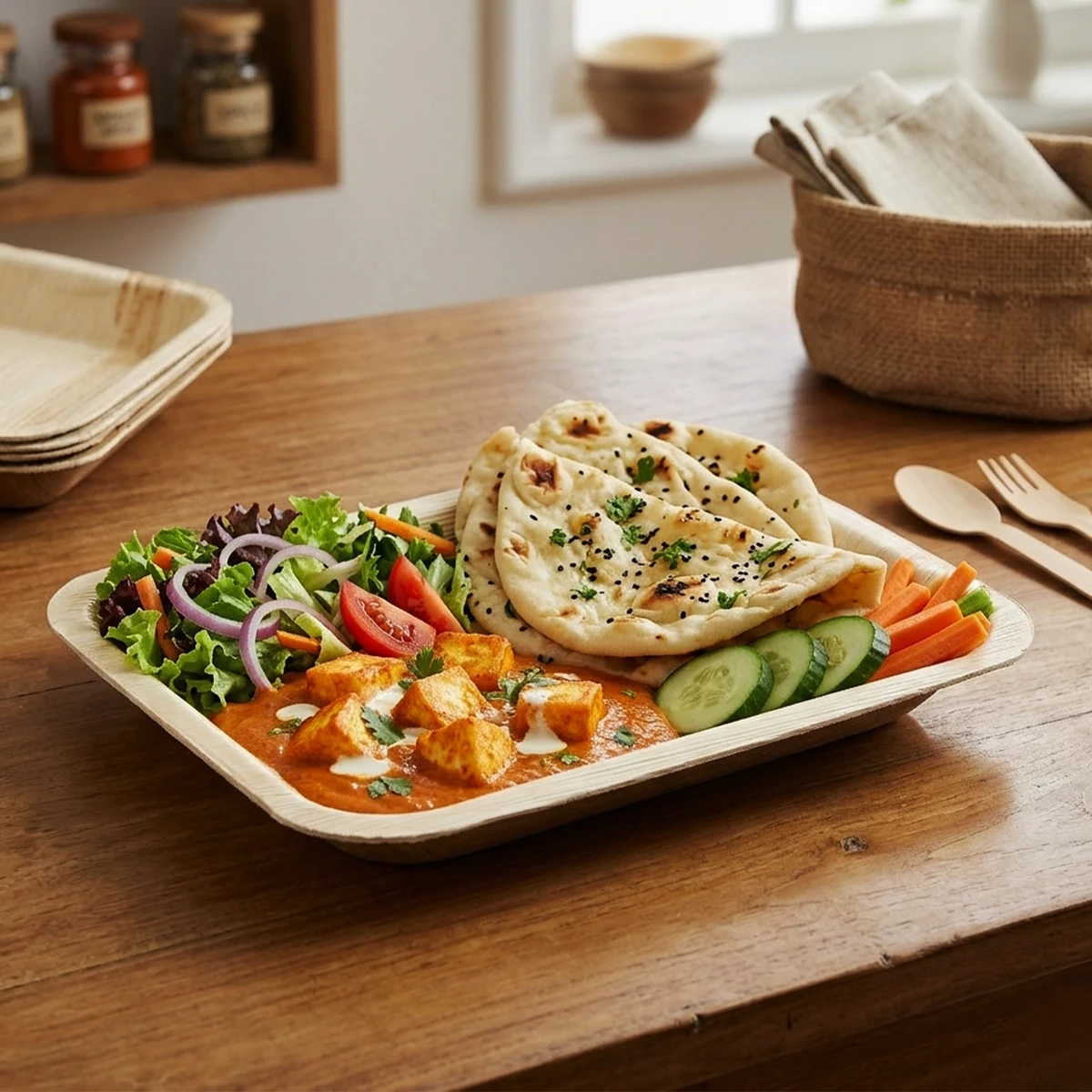
Experience Foliware's premium areca palm leaf tableware with a minimum order of just 1 carton. Ideal for first-time buyers, distributors, HoReCa businesses, and institutional procurement.
Experience Foliware's premium areca palm leaf tableware with a minimum order of just 1 carton. Ideal for first-time buyers, distributors, HoReCa businesses, and institutional procurement.
EU import duty on Indian-made tableware is set by two inputs together: the Combined Nomenclature code you declare and the origin you can prove. Look the rate up in TARIC, the EU’s integrated tariff database, for your code and India on the day you clear. Any rate printed in an article will date, because preferences, quotas and nomenclature all change.
You can find a duty percentage for leaf tableware in a dozen places online. Almost all of them are wrong for at least one of four reasons.
They are attached to a heading that may not be your heading, and the candidate codes for leaf tableware are genuinely contested, as set out in HS classification for leaf tableware. They ignore origin, so they quote one rate where two exist. They were correct on the date they were written, and the Generalised Scheme of Preferences regime applying to India changes on 1 January 2027. And they are not the legal source: only TARIC is, and TARIC data is transmitted daily to national administrations precisely because it moves.
So the useful thing an article can give you is the method, not the number.
| Input | What it determines | Who settles it | Evidence it rests on |
|---|---|---|---|
| Combined Nomenclature code | Which duty line, quota, prohibition or trade defence measure applies at all | The customs authority in the member state of import | Product facts, and a Binding Tariff Information ruling if you want it fixed |
| Origin | Which of the rates on that duty line you get: the erga omnes third country rate, or a preferential rate | The importer’s declaration, supported by proof of origin | A statement on origin from a registered exporter, or a certificate of origin |
| Customs value | The amount the rate is applied to | The declarant, under Articles 70 and 71 of the Union Customs Code | The commercial invoice plus the additions the code requires |
Change any one of the three and the duty changes. Buyers routinely negotiate hard on the third row and never check the first two.
Do this before you accept a duty figure from anyone, including a supplier.
https://ec.europa.eu/taxation_customs/dds2/taric/taric_consultation.jsp.The same information in a more guided form sits in Access2Markets, the European Commission’s portal for importers and exporters, under My Trade Assistant. Access2Markets also returns the rules of origin and the documentary requirements for the same product and country pair, which TARIC does not.
If the third country duty for your code is already zero, stop. Preference adds nothing, and the origin paperwork below becomes a compliance formality rather than a saving.
Non-preferential origin is the origin a product has for every purpose other than claiming a reduced duty rate. It is governed by Articles 59 to 63 of Regulation (EU) No 952/2013, the Union Customs Code. Goods wholly obtained in a single country originate there. Goods whose production involves more than one country originate where they underwent their last substantial, economically justified processing resulting in a new product or an important stage of manufacture. It drives trade defence measures, quotas, statistics and origin marking, and it does not by itself reduce duty.
A point European buyers get wrong: the EU does not routinely demand a certificate of origin on an ordinary import. It demands one where a specific measure requires it. If your heading carries no anti-dumping duty, no quota and no surveillance measure, your broker may never be asked for a non-preferential certificate at all. That does not make the document useless, because banks and documentary credits frequently call for it, but it is a commercial requirement rather than a customs one. The distinction is unpacked in what a certificate of origin proves and who issues it.
This is the part that has moved, and the part most published guidance has not caught up with. Three things are true at once.
India is a beneficiary of the EU’s standard Generalised Scheme of Preferences arrangement. The scheme runs under Regulation (EU) No 978/2012, which remains in force until 31 December 2026. India sits in the Group III regional cumulation group alongside Bangladesh, Bhutan, Nepal, Pakistan and Sri Lanka.
A new GSP regulation takes over on 1 January 2027. Regulation (EU) 2026/1395 was published in the Official Journal on 22 June 2026 and applies from 1 January 2027 for ten years. If your programme runs across that date, check the treatment of your heading under both regimes rather than assuming continuity.
Graduation removes preference for some sections and not others. Under Commission Implementing Regulation (EU) 2025/1909, India is graduated out of GSP preference for twelve product sections for the period 2026 to 2028, including mineral products, chemicals, plastics, rubber, textiles, ceramics and glass, base metals, machinery and vehicles. Section S-2, vegetable products, and section S-9a, covering wood and articles of wood together with manufactures of plaiting materials, are not on India’s graduation list. The leaf tableware headings are therefore not excluded from GSP by graduation. That does not mean a preference exists for your specific code, because preference also depends on whether the heading carries a positive third country duty and how it is treated in the scheme. TARIC is where you confirm it.
The EU and India concluded trade agreement negotiations in January 2026, and the agreement is not in force. The European Commission put its proposals to the Council for signature in September 2026. Council adoption, signature, European Parliament consent, the Council’s decision to conclude, and Indian ratification all remain outstanding. Nothing in that agreement can be claimed on a customs entry today. Plan on the GSP position and treat any future preference as upside to re-baseline when it applies.
Under the GSP, preference is claimed on a statement on origin made out by an exporter registered in the REX system, the EU’s Registered Exporter system for self-certification of origin. It is not a chamber of commerce certificate, and it is not the old Form A for exporters who have moved to REX. The mechanics matter on a first shipment.
A first full container will be well above EUR 6,000, so the question to ask a supplier is short: are you REX registered, and what is the number. Ask it at quotation stage, not at shipment, because registration is not instant. This belongs alongside the other checks in how to verify an Indian exporter before you send money.
Being shipped from India is not origin. The GSP origin rules require the product to be wholly obtained in the beneficiary country, or to satisfy the working or processing rule for its heading in Annex 22-03 to Commission Implementing Regulation (EU) 2015/2447.
For the three candidate chapters those rules are not demanding. Chapter 14 requires manufacture from materials of any heading. Chapters 44 and 46 require manufacture from materials of any heading except that of the product, or manufacture in which the value of all materials used does not exceed 70 percent of the ex-works price.
Leaf tableware made in India from leaf harvested in India, with no imported input beyond consumables and packaging, meets these comfortably. The honest caveat is that the rule which applies is the rule for the heading you declare, so the origin analysis cannot be finalised until classification is settled.
Duty is charged on the customs value, not on the invoice total and not on the landed cost.
Under Article 70 of the Union Customs Code the primary basis is the transaction value, the price actually paid or payable for the goods when sold for export to the customs territory of the Union. Article 71 then requires additions where the buyer bears them and they are not already in the price, including commissions and brokerage other than buying commissions, the cost of containers and packing, and the cost of transport, insurance, loading and handling up to the place where the goods are brought into the customs territory of the Union.
Your Incoterm therefore changes the arithmetic but not the answer. On an FOB Indian port purchase the invoice excludes ocean freight, so freight and insurance to the EU frontier must be added to reach customs value. On a CIF European port purchase they are already inside the invoice. Buyers comparing an FOB quotation against a CIF quotation on invoice value alone are comparing two different duty bases. The full stack is in building a landed cost model for a first container.
Costs arising after the goods enter the EU customs territory, such as inland haulage from Rotterdam to a warehouse in Germany, stay outside the customs value for duty. The import VAT base is calculated differently and is dealt with in import VAT and reverse charge on a first EU import.
Run this with your own quotation in front of you. Every input is something you hold or can obtain.
Line 7 is the number to carry into the supplier conversation. It converts an abstract compliance requirement into a figure, and tells you whether the paperwork is worth chasing on a trial order or only from the first full container.
What duty will I pay on palm leaf plates from India? That depends on the Combined Nomenclature code declared, the origin you can prove and the customs value, so no single figure is correct for every buyer. Look the rate up in TARIC for your code with India as the country of origin and your expected clearance date, and confirm it with your customs broker before you commit.
Does India still get EU tariff preference? India is a beneficiary of the standard GSP arrangement under Regulation (EU) No 978/2012, which runs until 31 December 2026, with Regulation (EU) 2026/1395 applying from 1 January 2027. India is graduated out of preference for twelve product sections under Implementing Regulation (EU) 2025/1909, and the sections covering vegetable products and articles of wood and plaiting materials are not among them.
Does the EU-India trade agreement reduce my duty now? No. Negotiations concluded in January 2026 and the Commission put the agreement to the Council for signature in September 2026. Council adoption, signature, European Parliament consent and Indian ratification are still outstanding, so nothing in it can be claimed on a customs entry today.
Is duty calculated on the invoice value or on the landed cost? On the customs value, which under Articles 70 and 71 of the Union Customs Code is the transaction value plus specified additions including transport and insurance to the point the goods enter the EU customs territory. Costs arising after that point, such as inland haulage within the EU, are outside the duty base.
Who is liable if the duty turns out to be wrong? The declarant, which is normally you as importer of record, not the Indian supplier. A retrospective assessment can reach back three years. Confirm duty exposure with your own customs broker rather than taking it from a supplier’s email.
Lane, documentation and destination rules for the markets this article applies to. Each page carries the route, the paperwork set and the quotation route for that destination.
Each link below answers the question this article raises next, whether that is the rule behind a decision, the same question in another destination, or the commercial step that follows.
Send us the product, the volume per shipment or per year, and the destination country and port of entry, together with the tariff heading your broker intends to declare. The heading tells us which origin rule applies and what documentation to prepare, and the destination tells us the entry point to quote against. All four go on the enquiry form .