
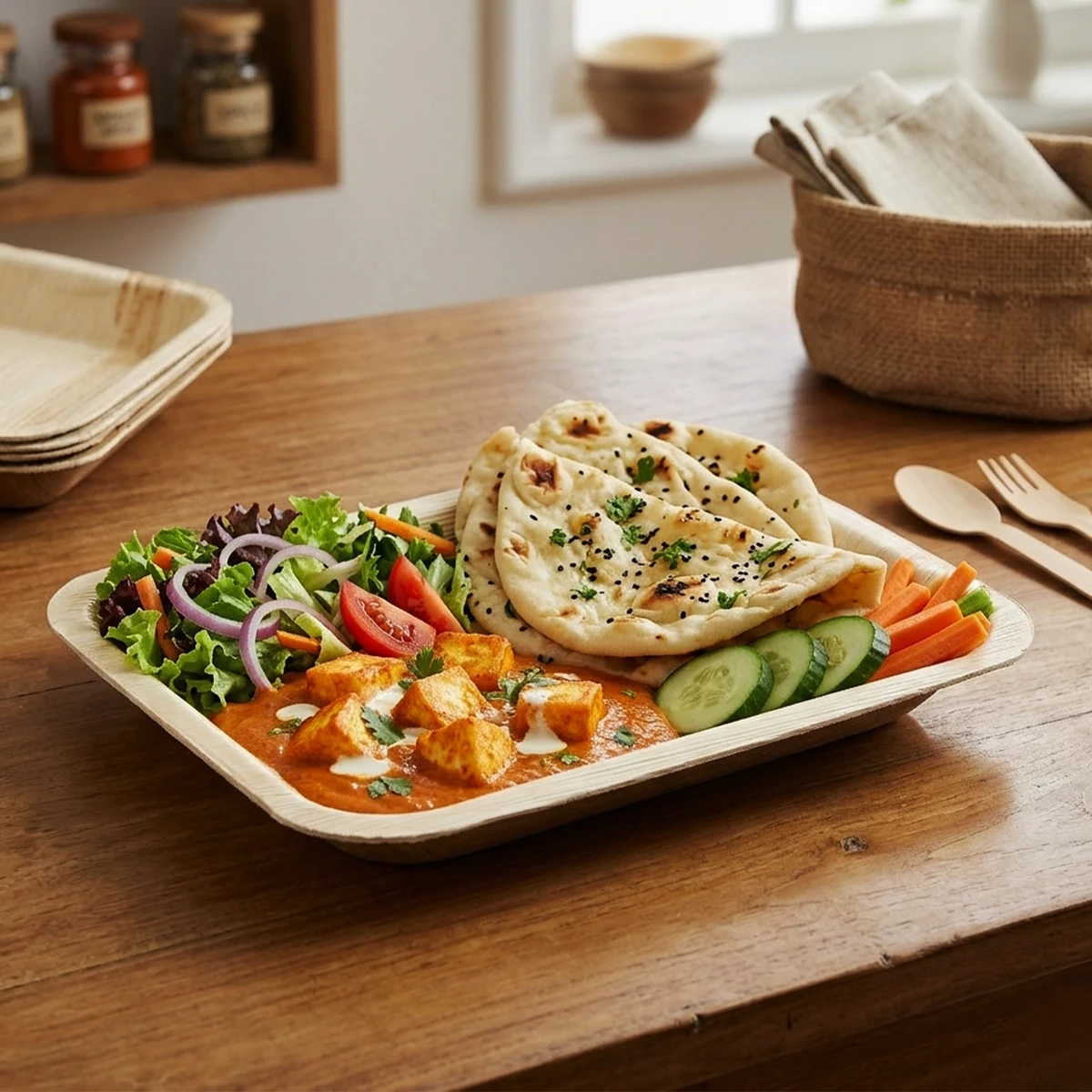
Start with a Trial Order 📦
Experience Foliware's premium areca palm leaf tableware with a minimum order of just 1 carton. Ideal for first-time buyers, distributors, HoReCa businesses, and institutional procurement.
Experience Foliware's premium areca palm leaf tableware with a minimum order of just 1 carton. Ideal for first-time buyers, distributors, HoReCa businesses, and institutional procurement.
Note. AGEC provisions and EU food
contact rules can change. Confirm current requirements with the
Ministere de la Transition ecologique and the European Commission’s food
contact materials guidance before you ship.
France’s loi anti-gaspillage pour une economie circulaire, known as
AGEC, has banned single use plastic tableware in food service settings
since 1 January 2023. Whether a specific plant fibre product falls
inside that ban depends on how its material is classified under the
law’s definitions, which is the buyer’s own classification question.
Separately, any tableware touching food is assessed under the EU’s food
contact materials framework, supported by a declaration of compliance.
AGEC’s wider circular economy goals continue to develop beyond this
confirmed rule.
France’s anti-waste and circular economy law, AGEC, includes a ban on
single use plastic tableware in food service settings, in force since 1
January 2023. This is not a forward-looking target. It has applied for
over three years and is the specific, dated provision within AGEC that a
tableware buyer needs to account for now, as distinct from the law’s
broader and still developing circular economy agenda.
AGEC’s food service ban targets tableware defined as single use
plastic under the law. That definition turns on material composition and
the specific criteria the law and its implementing texts set out for
what counts as plastic, not on a product category label. A pressed plant
fibre item without a plastic coating or lining is assessed against that
same material definition, and settling whether a specific product falls
inside or outside the ban is a classification exercise the buyer carries
out against the product’s actual composition, not a status this article
can assign to a category of product in general.
This is worth being precise about, because it is the point where
suppliers most often overreach. A material being plant derived does not
by itself answer a legal classification question under French law. The
honest position is that classification depends on the product’s material
specification, and that specification is what a French buyer should be
requesting and checking, rather than accepting a general claim about the
material family.
The 2023 food service ban is one dated, confirmed provision inside a
law with a considerably wider circular economy agenda, covering areas
well beyond tableware. That broader agenda continues to develop over
time. This article does not attempt to itemise future measures or dates
beyond what is confirmed and already in force, because doing so would
mean stating requirements as current when they are direction of travel
rather than settled rule. Buyers evaluating a multi-year supply
relationship into France should treat the 2023 ban as the current,
binding requirement, and treat AGEC’s wider circular economy direction
as context for where French policy is heading, not as an additional
checklist item to satisfy today.
Separately from AGEC, any tableware intended to touch food sold in
France is assessed under the EU’s food contact materials framework,
anchored in Regulation (EC) No 1935/2004, which sets general safety
requirements for food contact materials across EU member states
including France. A manufacturer supports this with a declaration of
compliance, backed by testing, confirming the material meets those
requirements for its intended use. This is a food safety question,
entirely separate from AGEC’s single use plastic classification question
above, and a product can need to satisfy both independently.
A French buyer sourcing tableware from outside the EU is typically
working through three separate questions at once, and it helps to keep
them distinct rather than folding them into one compliance request.
| Question | What it is | What to ask the supplier for |
|---|---|---|
| Is this product single use plastic under AGEC | A material classification question tied to the law’s definitions |
The product’s material specification, so the buyer’s own classification can be made accurately |
| Is this product fit for food contact | An EU wide food safety question | A declaration of compliance backed by test data |
| What paperwork travels with the shipment itself | Universal export documentation | A commercial invoice and packing list at dispatch, and a certificate of origin where the shipment requires one |
A fourth question, packaging producer responsibility obligations
within France, follows a similar principle to other EU member states,
where the obligation typically attaches to whoever places filled
packaging on the national market rather than to the overseas
manufacturer. No confirmed French specific source is available to state
the mechanics of that obligation precisely, so this article does not
attempt to. A buyer should raise it with their own compliance advisor
rather than assume either that it applies in the same form as another
country’s scheme or that it does not apply at all.
Send the product’s material specification alongside your enquiry so
classification against AGEC’s definitions can be worked through on your
side with accurate information, and expect the food contact declaration
of compliance as standard supporting documentation, entirely separate
from that classification question.
Is the France single use plastic tableware ban still coming
into force, or is it already law? It has been in force since 1
January 2023. It is a current, binding requirement in French food
service settings, not a future target.
Does the ban apply to plant fibre tableware? It
applies to products defined as single use plastic under AGEC’s criteria,
which turn on material composition. Whether a specific plant fibre
product falls inside or outside that definition is a classification
question against the product’s actual material specification, not a
status assumed from the material family.
What is required for food contact suitability in
France? The EU’s food contact materials framework, anchored in
Regulation (EC) 1935/2004, sets the general safety requirements, and a
declaration of compliance backed by testing is the standard way a
manufacturer supports it.
Does AGEC have further requirements coming for tableware
beyond the 2023 ban? AGEC’s circular economy agenda is broader
than the confirmed 2023 ban and continues to develop. This article does
not state specific future dates or measures beyond what is currently
confirmed and in force.
Who handles French packaging producer responsibility
obligations for an imported product? That typically follows the
same principle as other EU member states, where the obligation attaches
to whoever places filled packaging on the national market. No confirmed
French specific source is available here to state the mechanics
precisely, so raise it with your own compliance advisor.
Ministere de la Transition ecologique, France Loi anti-gaspillage
economie circulaire
https://www.ecologie.gouv.fr/loi-anti-gaspillage-economie-circulaire
Supports: AGEC provisions including the single use plastic tableware ban
in food service, in force since 1 January 2023
European Commission Legislation, Food contact materials
https://food.ec.europa.eu/food-safety/chemical-safety/food-contact-materials/legislation_en
Supports: the structure of the EU food contact materials framework
applicable to tableware sold in France
EUR-Lex Regulation (EC) No 1935/2004 on materials and articles
intended to come into contact with food
https://eur-lex.europa.eu/eli/reg/2004/1935/2021-03-27 Supports: that
Regulation (EC) 1935/2004 is the primary legal text setting general food
contact material safety requirements across the EU
Lane, documentation and destination rules for the markets this article applies to. Each page carries the route, the paperwork set and the quotation route for that destination.
Each link below answers the question this article raises next, whether that is the rule behind a decision, the same question in another destination, or the commercial step that follows.
Send the product, the volume and the destination. A quotation follows within one business day.