
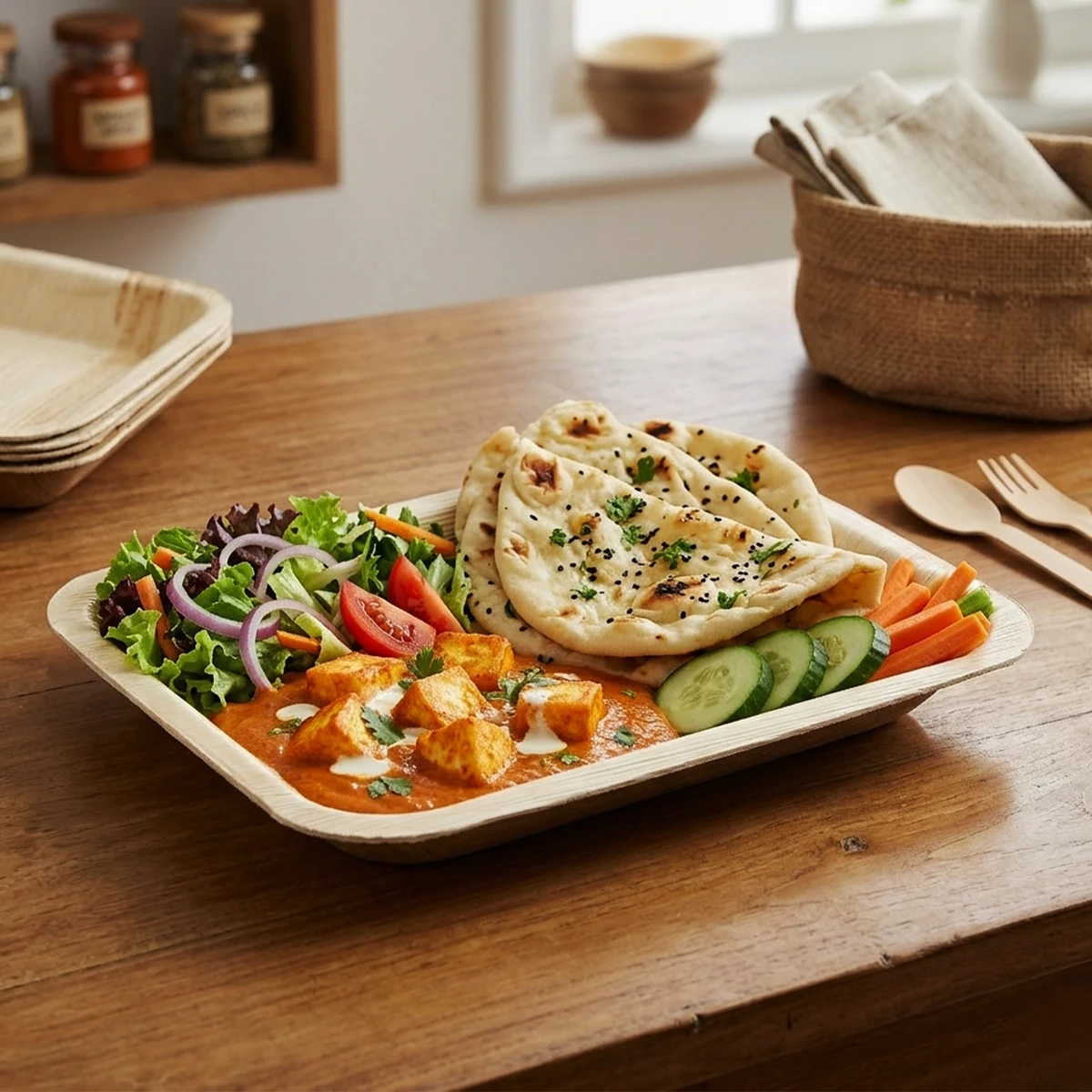
Start with a Trial Order 📦
Experience Foliware's premium areca palm leaf tableware with a minimum order of just 1 carton. Ideal for first-time buyers, distributors, HoReCa businesses, and institutional procurement.
Experience Foliware's premium areca palm leaf tableware with a minimum order of just 1 carton. Ideal for first-time buyers, distributors, HoReCa businesses, and institutional procurement.
A supplier compliance file for food contact tableware needs five
categories of document: legal registration, management system
certification, laboratory test reports, product specification, and
export or import documentation where the shipment crosses a border. Each
proves a different thing, and each is refreshed on a different cycle,
from once at registration to every single batch. Treating all five as
equally current because one certificate is recent is the most common gap
in an onboarding file.
A compliance file exists to answer several distinct questions: is
this a real, legally registered business, does it run a controlled
system, has its output actually been tested, what exactly is being
supplied, and is the paperwork in order for the goods to move. A single
certificate, however current, only answers one of those questions. A
file that stops at “the supplier sent us an ISO certificate” has
confirmed a management system exists and has confirmed nothing about a
specific batch, a specific specification, or the legal entity issuing
the invoice.
This checklist applies to any tableware or food packaging supplier,
not only Foliware. Use it to check a new supplier’s file, and use it to
check that your existing file has not gone stale.
| Document | What it proves | Refresh cycle |
|---|---|---|
| Legal entity registration and tax identification | That the business is a real, registered legal entity you can contract with and hold accountable |
One-off, re-verify if the entity name or structure changes |
| Importer Exporter Code, where the supplier exports | That the supplier is registered with the relevant trade authority to legally export |
One-off, re-verify if the code lapses or the entity changes |
| MSME or equivalent business registration | The registered size classification of the business, relevant to some procurement policies |
One-off, re-verify periodically as classification thresholds and business scale change |
| ISO 9001:2015 certificate | That an audited quality management system is in place, covering process control, inspection and corrective action |
Per certification cycle, management system certificates are issued and re-audited on a recurring basis set by the certification body |
| ISO 22000:2018 certificate | That an audited food safety management system is in place, covering hazard analysis and control points |
Per certification cycle, on the same recurring basis as the quality certificate |
| Microbiological and heavy metals laboratory test report | That a specific batch was tested against defined parameters, by an accredited laboratory |
Per batch, request the report tied to the batch you are actually purchasing, not a historic one-off report |
| Product specification sheet | The exact dimensions, pack structure and carton count for the format you are ordering |
Per product line, re-verify if the supplier revises a specification |
| Certificate of origin, where required by destination | The country of manufacture, for customs and trade agreement purposes |
Per shipment, issued against the specific consignment being exported |
| Packing list and commercial invoice | What is actually in a specific shipment and its declared value for customs purposes |
Per shipment |
| Bill of lading or airway bill | Proof the goods were handed to the carrier and the terms of that carriage |
Per shipment |
The refresh cycle is the part of this checklist that gets ignored
most often, and it is also the part that determines whether a document
is still useful. A certification document, whether quality or food
safety, is checked and re-issued on a fixed cycle by an accredited
certification body, with periodic surveillance in between. That means a
certificate is current evidence of a system, not evidence of a single
day’s output. A laboratory report is the opposite: it is only
representative of the specific batch named on it, which is why it needs
to be refreshed with every batch a buyer is actually purchasing, not
treated as a one-time file item like the certification documents above
it.
Shipment level documents, certificate of origin, packing list, bill
of lading, are the most disposable in file terms and the least reusable.
Each is specific to one consignment and tells you nothing about the next
one.
A missing legal registration or export code document is a stop
condition. Do not proceed with onboarding until it is resolved, because
it means you cannot confirm who you are actually contracting with.
A missing or outdated certification is a flag to raise directly with
the supplier, and a reasonable request is the certificate’s current
status and its next scheduled audit date, not a guess about whether it
remains valid.
A missing batch specific laboratory report for goods you are about to
receive is worth pausing an order over, because a historic one-off
report or a report tied to a different batch does not answer the
question of whether the goods in your specific shipment were tested.
This page is the document inventory: what belongs in the file and how
current each item has to be. Two related questions are answered
elsewhere. If you are submitting into a contract caterer’s internal
approval process and need to know the order to send documents in, see the documents that stall
vendor approvals. If the file is going to a purchase or tender
committee that meets on a cycle, see building an audit ready
supplier file, which deals with the timing problem rather than the
contents.
Ask any supplier, Foliware included, to map their current
documentation against these five categories before your first order, and
to state plainly which items are one-off, which are per certification
cycle, and which are per batch or per shipment. A supplier that can
answer that question directly, without treating it as an unusual
request, is easier to build a durable compliance file with than one that
sends whatever documents happen to be on hand.
What is the minimum file needed before placing a first
order? Legal registration, current management system
certifications, and a specification sheet for the format you are
ordering. A batch specific laboratory report becomes relevant once you
have a confirmed batch to receive against.
How often should I request a new laboratory report?
Per batch. A laboratory report from an earlier shipment or from initial
product development does not confirm anything about a batch you are
purchasing now.
Do I need to re-request the ISO certificates for every
order? No. Certification documents are checked and re-audited
on a recurring cycle by the certification body. Confirm the certificate
is current and re-request it if it has lapsed or if a new cycle has
completed since your last check.
Is this checklist specific to Foliware? No. It
applies to any supplier of food contact tableware or similar packaging.
Use it to evaluate any vendor your organisation is considering, and to
audit whether your existing supplier files have gone stale.
What is the single most common gap in a supplier compliance
file? Treating a current certification as evidence that a
specific batch has been tested. The two documents answer different
questions, and a file needs both.
International Organization for Standardization ISO 9001:2015
Quality management systems, requirements
https://www.iso.org/standard/62085.html Supports: what an ISO 9001
certificate confirms about a supplier’s quality management
system
International Organization for Standardization ISO 22000:2018
Food safety management systems, requirements for any organization in the
food chain https://www.iso.org/standard/65464.html Supports: what an ISO
22000 certificate confirms about a supplier’s food safety management
system
NABL India About NABL https://nabl-india.org/about-nabl/
Supports: what laboratory accreditation confirms about a laboratory
issuing a batch test report
DGFT, Government of India DGFT trade services portal
https://www.dgft.gov.in/CP/ Supports: that the Importer Exporter Code is
issued by DGFT and is mandatory for Indian export
Foliware operational data Certifications, registrations and
testing scope: ISO 22000:2018, ISO 9001:2015, Importer Exporter Code,
Udyam MSME, microbiological and heavy metals testing at a NABL
accredited laboratory Internal operational record, confirmed 4 September
2026 Supports: that Foliware holds these as claimed on site
Lane, documentation and destination rules for the markets this article applies to. Each page carries the route, the paperwork set and the quotation route for that destination.
Each link below answers the question this article raises next, whether that is the rule behind a decision, the same question in another destination, or the commercial step that follows.
Send the product, the volume and the destination. A quotation follows within one business day.