
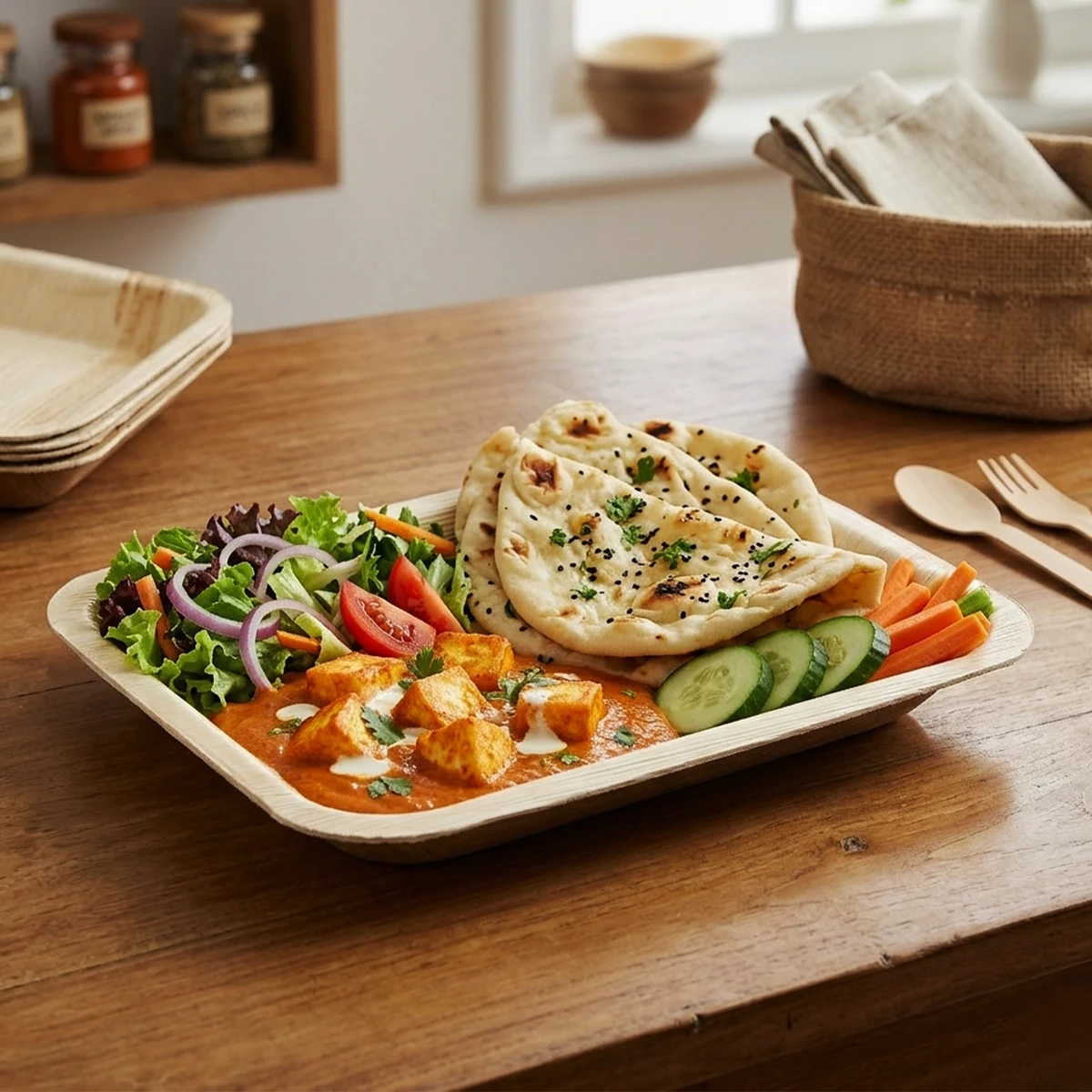
Start with a Trial Order 📦
Experience Foliware's premium areca palm leaf tableware with a minimum order of just 1 carton. Ideal for first-time buyers, distributors, HoReCa businesses, and institutional procurement.
Experience Foliware's premium areca palm leaf tableware with a minimum order of just 1 carton. Ideal for first-time buyers, distributors, HoReCa businesses, and institutional procurement.

EU Green Public Procurement criteria for catering are voluntary and contain one general provision on disposables, that they are for takeaway as a rule with certain exceptions. The scoring that decides a Nordic tender comes from national instruments instead: in Norway, a statutory minimum weighting of 30 percent for climate and environment; in Sweden, the criteria library published by Upphandlingsmyndigheten; in Denmark, ecolabel references and framework agreement terms. Read the tender for which of those it uses before you price it.
Suppliers preparing for a Nordic tender usually start with the EU Green Public Procurement criteria and find almost nothing about disposables. That is correct rather than an oversight.
The EU GPP criteria for food procurement, catering services and vending machines, published by the Joint Research Centre in 2019, treat disposables inside a broader criterion on chemical products and consumable goods. The substantive provision for catering services is that disposable items such as cutlery are for takeaway only as a general rule, allowing for certain exceptions. A 2025 Joint Research Centre report proposing criteria for sustainable public procurement for food, food services and vending machines does not add a standalone scored criterion for single-use serviceware either, and it is explicit that the criteria are for voluntary adoption.
Two conclusions follow. First, at EU level the policy direction is to reduce disposables rather than to specify better ones, which is worth understanding before you build a bid strategy on the opposite assumption. Second, the actual scoring is national. That is where the rest of this article goes.
Norway is the clearest case in Europe, because the weighting is set by regulation rather than by each contracting authority.
Norwegian procurement rules require climate and environmental considerations to be weighted at a minimum of 30 percent in public procurement, a change that took effect on 1 January 2024. It operates on a comply or explain basis. A contracting authority may instead set climate and environmental requirements in the technical specification where that demonstrably delivers a better environmental outcome, but it has to justify that choice in writing in the procurement documents. Procurements with negligible climate or environmental impact can be exempted, again with a documented reason.
For a disposables line inside a catering or consumables tender, this has three practical consequences.
The environmental section is not a tie-breaker. Where the 30 percent is applied as award criteria, environmental score is a third of the decision. A bid that is strong on price and thin on evidence loses to a bid that is average on price and fully evidenced.
Read whether the authority used the exception. If the climate and environment requirement has been pushed into the technical specification instead, it is now a pass or fail gate rather than a scored criterion, and an unevidenced claim disqualifies rather than scoring zero. Which route the authority took is stated in the tender documents. Find it before you write a word.
Documentation beats adjectives. Guidance from the Norwegian procurement authority on food and meal services points contracting authorities towards concrete requirements, including contract terms on packaging. Concrete requirements are answered with documents.
Norwegian producer responsibility also has no tonnage threshold, so a supplier delivering even small volumes needs the position set out in packaging EPR across Sweden, Denmark and Norway settled before award, not after.
Sweden works differently. Upphandlingsmyndigheten, the Swedish National Agency for Public Procurement, publishes a criteria library that contracting authorities copy into tenders, which means a Swedish tender is often assembled from published criteria you can read in advance.
The structure matters as much as the content. Swedish criteria are published at three ambition levels, bas, avancerad and spjutspets, and each criterion is flagged as a technical specification, an award criterion or a special contract condition. Reading which level and which type a tender has copied tells you immediately whether your answer is a gate, a score or a promise for the contract period.
For this category the relevant group is packaging and return crates for food, which at the time of writing contains seven criteria. Return crates appear as technical specifications. Circular packaging solutions, design for recycling for recyclable plastic packaging and recycled PET for beverage packaging and meat trays appear as special contract conditions. Plastic packaging from renewable raw material appears as an award criterion.
Note what is absent. There is no Swedish criterion for single-use serviceware in that group, and the criteria that exist are aimed at plastic packaging and reusable crates rather than at disposable plates. A bid into a Swedish food or meal services tender therefore answers packaging criteria on the transport and secondary packaging, plus whatever the authority has written itself for the disposables line.
The practical effect is that a Swedish tender often asks for a commitment plus verification during the contract, not a certificate at tender. Budget for the contract management effort, not only the bid.
Denmark has no purchasing goal for disposable tableware within the Partnerskab for Offentlige Grønne Indkøb, the Danish partnership for green public procurement, whose goals cover areas such as food, transport, cleaning, textiles and commercial kitchen equipment. A supplier looking for a Danish national criteria document for disposables will not find one.
What Danish contracting authorities use instead is a mixture: ecolabel references, their own environmental requirements, the EU criteria where they choose to apply them, and framework agreements procured centrally on behalf of many public buyers. If you are bidding in Denmark, the two questions to answer first are whether the requirement is inside an existing framework agreement you would need to be a party to, and which ecolabel the authority has named.
Danish producer responsibility has a commercial edge worth remembering here. Registration with Dansk Producentansvar is a statutory requirement, and Danish distributors check the register before opening an account, so an unregistered supplier can fail commercially before any environmental criterion is scored.
Across all three markets, the named instrument is frequently the Nordic Swan Ecolabel. Criteria document 047, Disposables for food, covers takeaway packaging, disposable mugs, glasses, plates, cutlery and straws, bags and films, filters and sticks. Version 4.10 is valid until 30 September 2027.
Its requirement areas tell you what an evaluator will ask about even when the tender does not require the licence itself: a high proportion of renewable material or recycled plastic, forestry certification for wood based raw material, a prohibition on recycled paper, paperboard and cardboard, restrictions on fluorine compounds, phthalates, bisphenol A, flavourings, perfumes and PVC, requirements on adhesives and dyes, and marking with sorting symbols or text.
Read that list against an untreated pressed leaf article and most of it is answerable. The fluorine restriction lines up with the PFAS position set out in substances of concern and PFAS limits under PPWR. The sorting mark requirement is an artwork question rather than a product question. What is not automatic is the licence itself, which is a separate application, a cost and a lead time.
This is the table to work through before deciding whether to bid. The middle column is what the criterion actually asks for. The right column is honest about where evidence has to be created rather than retrieved.
| Criteria family | What the tender asks for | Position for an untreated pressed leaf article |
|---|---|---|
| Material origin and renewability | Share of renewable raw material, and its origin | Evidenced from the product description and the supply chain, since the article is a naturally shed leaf sheath with no added material |
| Chemical restrictions | Absence of named substance groups, often including fluorine compounds, phthalates, BPA, perfumes and PVC | Evidenced by declaration plus test data. Testing is required, and the parameters should match the tender list rather than a generic panel |
| Food contact safety | Declaration of Compliance and migration testing | Evidenced, provided the declaration names the article and the test conditions match the service conditions. See migration testing for plant fibre tableware |
| Compostability or recyclability | A certificate to a named standard, with products in scope | Not automatic. A certificate is a separate project with a cost and a lead time. See what a compostability certificate proves |
| Ecolabel licence | A Nordic Swan or EU Ecolabel licence for the specific product | Not automatic. Requires application to the licensing body |
| Packaging and sorting information | Sorting marks, material identification, EPR registration in the market | Artwork plus registration. Both have lead times measured in weeks |
| Social and labour conditions | Supplier code of conduct compliance, sometimes an audit report | Evidenced where a current SMETA or amfori BSCI report exists. See social compliance audits |
| Transport and logistics | Packaging efficiency, delivery consolidation, sometimes transport emissions | Evidenced through pallet and volume data. See asking a supplier for container loading data |
| Contract period performance | Evidence during the contract, not only at bid | An internal process commitment, and the item most often underestimated |
Do not send test results for parameters the tender did not ask about and do not claim a licence you have applied for but not received. Both are read as noise.
Where the tender is scored on a reusable solution and asks about disposables only as an exception. Both the EU criteria and Nordic ecolabel conditions push catering towards reuse for on-site dining. If the authority has a plate room and is asking the market to help it stop buying disposables, a disposables bid is answering a question they have already closed.
Where a certificate is a pass and fail gate and you do not hold it. Applying for an ecolabel or a compostability certificate to meet a closing date that is weeks away does not work. Note it, start the certificate for the next cycle, and do not submit a bid that fails at the first gate.
Where the volume does not justify the compliance build. A tender for a small annual quantity that requires a licence, a test panel and a registration is a loss leader. It can still be right as a market entry decision, but decide that deliberately rather than by accident.
Bid where disposables are genuinely required: outdoor and event catering, satellite sites with no wash-up, mobile catering, emergency and field feeding, and peaks beyond dishwashing capacity. Those are the parts of Nordic public catering where this category has a legitimate future, and the evidence file above is what wins them.
Are EU Green Public Procurement criteria mandatory? No. They are voluntary criteria that contracting authorities may adopt and adapt. What can be mandatory is national law, for example the Norwegian minimum weighting for climate and environment, and whatever the individual tender document makes a requirement.
Does the Norwegian 30 percent rule mean environment is always worth 30 points? Not always. It is a minimum weighting where climate and environment are used as award criteria, with a comply or explain alternative allowing requirements to be set in the technical specification where that gives a demonstrably better environmental result, and an exemption for procurements with negligible impact. The tender documents state which route the authority took.
Do we need a Nordic Swan licence to win Nordic public work? Not always, but the criteria in Nordic Swan document 047 for disposables for food shape what evaluators ask about even when the licence is not required. Where a licence is a pass and fail requirement, there is no substitute for holding it.
What evidence should we prepare before any tender appears? A Declaration of Compliance naming the article, a migration test report matching realistic service conditions, a chemical test file covering the substance groups these criteria name, packaging data by material and weight, producer registration in the market, and a current social audit report. That file answers most of what recurs.
Who pays for the testing? The supplier, normally, and it should be treated as a category entry cost rather than a bid cost, because the same file serves every subsequent tender in that market until it expires.
Can our Indian manufacturer hold the registration for us? For packaging producer responsibility, usually not, because the obligation attaches to the entity placing the packaging on the national market. You or your supplier: who registers for EPR when you import from India works through the structures where the answer differs, including authorised representative arrangements.
Lane, documentation and destination rules for the markets this article applies to. Each page carries the route, the paperwork set and the quotation route for that destination.
Each link below answers the question this article raises next, whether that is the rule behind a decision, the same question in another destination, or the commercial step that follows.
Send your enquiry with the product, the volume, the destination, the tender reference and the closing date. For example: Reinforced Round Traditional Patravali Meal Plate and 7 inch bowls, estimated 20 pallets a year, delivered Oslo, tender reference and closing date attached. The closing date decides what is achievable: a declaration and test file can be assembled quickly, a certificate or an ecolabel licence cannot. Naming the tender means the answer tells you which criteria you can evidence now and which need a longer run-up. Foliware ships to buyers in Sweden , Denmark and Norway .
Request a quotation