
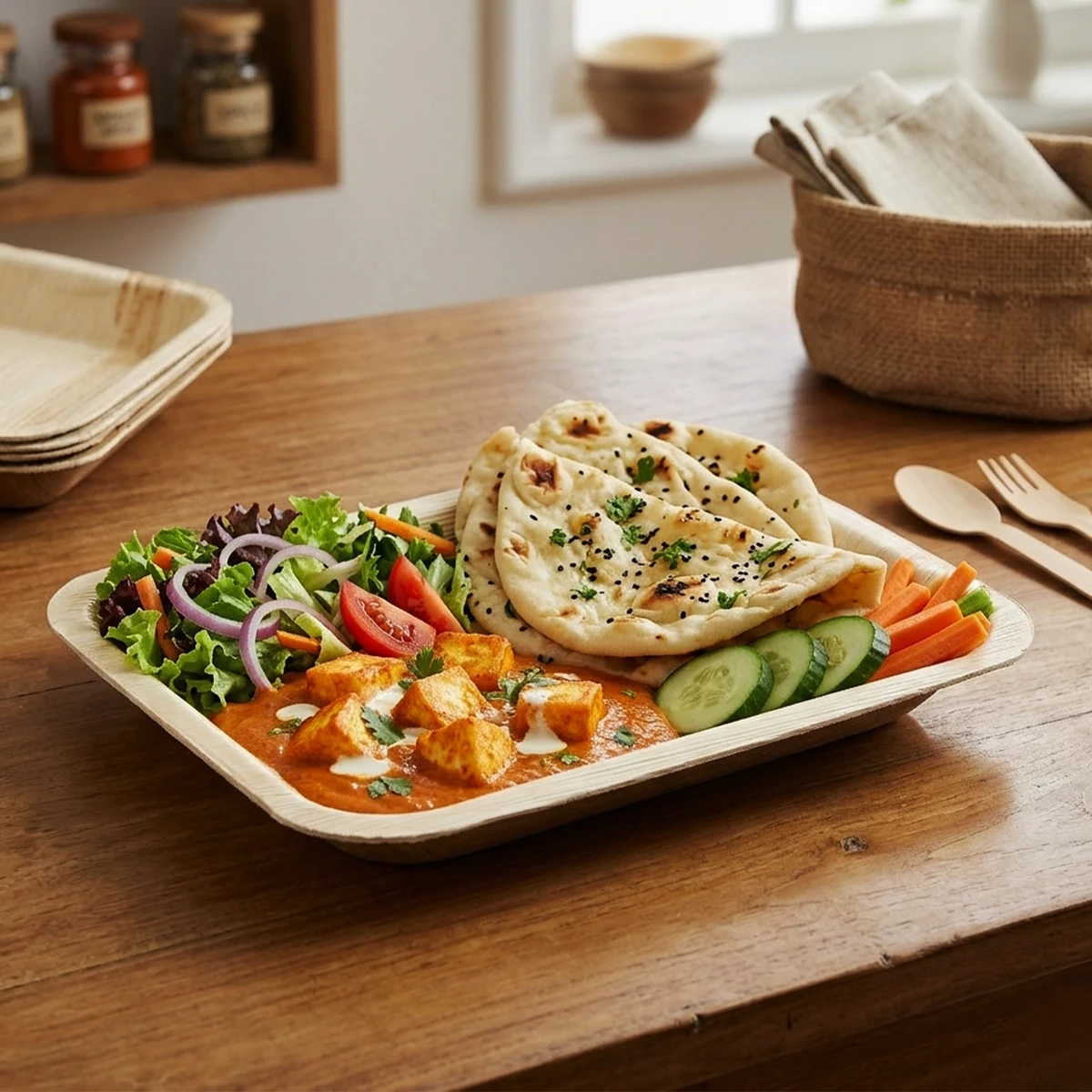
Start with a Trial Order 📦
Experience Foliware's premium areca palm leaf tableware with a minimum order of just 1 carton. Ideal for first-time buyers, distributors, HoReCa businesses, and institutional procurement.
Experience Foliware's premium areca palm leaf tableware with a minimum order of just 1 carton. Ideal for first-time buyers, distributors, HoReCa businesses, and institutional procurement.

India has a deep, established supply base for pressed areca leaf tableware and a real one for sugarcane bagasse moulded items and solid bamboo articles. It is not the right origin for birchwood cutlery, wheat bran pressed tableware or polylactic acid resin, because India converts imported PLA rather than making it. Bamboo fibre composite tableware cannot lawfully be placed on the EU market from any origin.
Material comparisons answer “which is better”. A sourcing manager asks something narrower and more urgent: can I get this material, at my volume, from this country, with a compliance file I can defend, repeatably.
Three things decide that, and price is not one of them.
Depth of supply base. How many independent producers exist, and whether you can move between them if one fails. A category served by two units in one district is a single point of failure wearing a country’s name.
Where the constraint sits. Every material has one binding constraint and it is rarely machinery. In this region it is usually raw material seasonality, trained grading labour, or an input that has to be imported.
Whether the compliance file exists. A unit that can make the goods is not necessarily one that can produce a Declaration of Compliance with a test report behind it, PFAS data for a barrier coating, or packaging weights by material for your extended producer responsibility return. This is the most common gap between “can make” and “can supply Europe”.
This is the map, not a product comparison. For product properties, compare the materials on their merits separately.
| Material | Indian supply base | Where the constraint sits | Origin verdict for a European buyer |
|---|---|---|---|
| Pressed areca leaf tableware | Deep and established, concentrated in the areca growing districts of Karnataka, Kerala, Tamil Nadu and the north east | Leaf sheath seasonality and trained grading labour, not presses | India is the principal origin. Source here |
| Sugarcane bagasse moulded tableware | Real, alongside a large domestic sugar industry that supplies the fibre | The barrier chemistry used for grease and water resistance, and whether the producer can evidence it against EU limits | Viable from India. Verify the coating and its test data before anything else |
| Solid bamboo articles, boards and utensils | Large growing base. India’s bamboo resource covers 13.96 million hectares across 136 species, supported by the National Bamboo Mission | Processing capacity for food contact articles rather than raw material | Viable from India, with the EUDR position checked against your classification |
| Bamboo fibre composite tableware | Exists, and is not the point | Not a supply question. Ground bamboo is not an authorised additive in plastic food contact materials in the EU | Do not source this category from anywhere for the EU market |
| Paper and board plates, cups and containers | Substantial paper industry, with a converting base | Food grade barrier coated base board, which is frequently imported, and the coating chemistry | Possible, but check where the base board comes from and what the coating is |
| Birchwood or poplar cutlery and stirrers | Thin. India is not a birch growing country | Raw material, which does not grow here at scale | India is usually not the right origin |
| PLA and CPLA cutlery, lids and cups | Converters exist. Polymer production does not, yet | The resin, which is imported. India’s first industrial scale PLA plant is under construction and not producing | India is a converter, not a resin origin, today |
| Wheat straw and bran pressed tableware | Marginal as an export category | Neither the raw material stream nor the equipment base is established here for export volume | Not India |
| Coir and jute | World scale raw material base | These are fibre and packaging materials, not food contact tableware materials at volume | Not a tableware answer |
Areca leaf tableware is pressed from the fallen leaf sheath of the areca palm. The sheath falls on its own, is collected, cleaned and pressed under heat, and nothing is added to bind it. India is where the trees are and where the pressing industry grew up around them, which is why almost every European enquiry for this product routes here. Where areca leaf tableware is actually made sets out what the supply base looks like on the ground.
The constraint is worth understanding because it is not the one buyers expect. Presses are not the bottleneck. Collection, cleaning, sorting, grading and packing are people, and the grading step in particular is a trained judgement made piece by piece against a defect standard. That is why a unit cannot double output in a month by buying machinery, and why capacity planning in this category is a labour and season conversation rather than an equipment one. Areca leaf seasonality is the calendar behind most lead time answers you will get.
The second constraint is the compliance file, and it separates units sharply. A pressing unit that has never exported to the European Union will not have a Declaration of Compliance with supporting migration test data, packaging weights by material, or an accredited management system certificate. That is not a quality judgement about the plates. It is a statement about whether the unit can support a European importer’s obligations. The EU specific documents a European buyer adds to a standard vendor pack is the list to send.
India has a very large sugar industry, so the fibre stream exists and moulded fibre tableware is produced here. Two honest qualifications.
China has the deeper supply base for moulded bagasse. More producers, more equipment makers and longer experience in the category. If breadth of supply and the ability to move between producers matters more to you than origin diversification, that is a real point in China’s favour, and comparing eco tableware supply by country of origin works through the trade.
The barrier chemistry is the thing to verify, not the fibre. Moulded fibre alone is not grease or water resistant enough for many foodservice uses, so producers apply a barrier. Under Regulation (EU) 2025/40, the Packaging and Packaging Waste Regulation, food contact packaging is subject to limits on per and polyfluoroalkyl substances of 25 parts per billion for an individual PFAS, 250 parts per billion for the sum of targeted PFAS and 50 parts per million for all PFAS combined. Ask what the barrier is, ask for the test report against those limits, and read the report before you read the price. PFAS limits under PPWR and what an untreated leaf product has to show sets out the position, and it is one of the few places where an untreated pressed leaf product has a genuine structural advantage: there is no coating to test.
This is where sourcing shortlists most often go wrong, so it is worth separating properly.
Solid bamboo articles are made from the culm: boards, skewers, utensils, some plates. India’s bamboo resource is large, covering 13.96 million hectares across 136 species according to the National Bamboo Mission, with development concentrated in the north eastern states and in Madhya Pradesh, Maharashtra, Chhattisgarh, Odisha, Karnataka and others. The constraint here is processing and food contact manufacturing capacity rather than raw material. This category is sourceable from India.
One classification point to settle early. Heading 4419, tableware and kitchenware of wood, is listed in Annex I to Regulation (EU) 2023/1115, the EU Deforestation Regulation, which applies from 30 December 2026 for large and medium operators and from 30 June 2027 for micro and small operators. The Commission’s delegated regulation of 13 July 2026 states at recital 7 that in the case of wood, products listed in Annex I do not fall within the scope of the Regulation if they are made of bamboo, rattan and other materials of woody nature. Confirm your own position with your customs authority rather than relying on a summary, but the bamboo exclusion is the reason solid bamboo articles and wooden ones are not in the same place on this question. Does EUDR apply to areca leaf tableware works through the same analysis for pressed leaf.
Bamboo fibre composite tableware is a different product entirely: ground bamboo used as a filler in a plastic, usually melamine formaldehyde. The European Commission’s position on it is unambiguous. Under Commission Regulation (EU) No 10/2011 on plastic materials and articles intended to come into contact with food, Article 5 permits only substances on the Union list in Annex I to be intentionally used in the manufacture of plastic layers. Ground bamboo is not on that list. The Commission ran a coordinated enforcement action called Bamboo-zling across 21 Member States in 2021 and 2022, which identified 748 cases, 644 of them products on the market and 104 border rejections, and required withdrawal.
For a European buyer the practical conclusion is simple and it has nothing to do with India. Bamboo melamine tableware cannot lawfully be placed on the EU market, whatever origin it is offered from. If a supplier anywhere offers you “bamboo fibre” plates or cups for Europe, the question to ask is whether the article is a plastic with a plant filler, and if it is, the conversation ends there.
Four cases, stated plainly.
Birchwood and poplar cutlery and stirrers. The raw material does not grow here at volume. The established supply bases for wooden cutlery are elsewhere, and buying it from an Indian intermediary usually means buying imported product with an extra margin on it. If wooden cutlery is a core line, source it where the wood is, and note that if your goods are classified in heading 4419 the EU Deforestation Regulation due diligence obligation applies on the dates above.
PLA and CPLA articles, if origin of the polymer matters to you. India has converters but no industrial scale polylactic acid plant in production. Balrampur Chini Mills is building what is described as India’s first, at 75,000 tonnes a year on a greenfield site beside an existing sugar plant, using sugarcane feedstock and Sulzer technology. Until it runs, an Indian PLA converter is working with imported resin. That matters in two ways: the non preferential origin of the finished article depends on where substantial transformation occurred and is a question for your customs authority, and the sustainability story you tell about the product belongs partly to a country that is not India. Duty and origin on Indian made tableware entering the EU covers the origin determination.
There is a second point on PLA that has nothing to do with origin and catches buyers regularly. Directive (EU) 2019/904 on the reduction of the impact of certain plastic products on the environment defines plastic by reference to polymers, and its recitals are explicit that plastics manufactured from bio based starting substances, including bio based and biodegradable plastics, are covered. PLA is a plastic for the purposes of that Directive. A PLA cup is a single use plastic product, and Article 7 marking obligations apply to beverage cups. Buying PLA does not exit the single use plastics regime. Where the EU single use plastics rules actually bite on leaf tableware sets out the boundary.
Wheat straw and bran pressed tableware. Neither the raw material stream nor the equipment base is established here for export volume. Central and Eastern Europe and China are where this category sits.
Coir and jute. India’s coir and jute base is world scale and it is not a food contact tableware base. If someone offers you coir tableware at volume, ask what the article actually is and what binds it.
India has a substantial paper industry and a converting base for plates, cups and containers. The constraint is the coated base board, which is frequently imported, and the coating itself. Two checks before you shortlist an Indian producer of paper foodservice items. Ask where the base board originates and who made it, because that is the party holding the food contact conformity data. And ask what the coating is: a polyethylene coated paper cup is a plastic containing product under Directive (EU) 2019/904 and carries the marking obligation for beverage cups, whereas an aqueous dispersion coating is a different conversation with different evidence behind it. Neither answer is disqualifying, and both change what you have to hold in your file.
You do not have to take any of this on trust, including from this article. India publishes its own export statistics.
The Department of Commerce, Ministry of Commerce and Industry, runs Tradestat, the export and import data bank, which covers 2017 to 2018 onwards and lets you query exports by commodity at two, four, six and eight digit Harmonised System code and by destination country, with commodity by country reports available. The method is this: take the HS code your product would fall under, query exports to your own destination country, and see whether India actually ships the category there in meaningful quantity.
Two caveats that make this a method rather than an oracle. HS codes are broad, and a niche product often hides inside a residual heading alongside unrelated goods, so read the heading text before you read the number. And leaf tableware in particular sits across more than one candidate heading, which is exactly why HS classification for leaf tableware across 1404, 4419 and 4602 exists. Use the query to test whether a supply base claim is plausible, not to size a market.
Which eco tableware material should I choose? That depends on your service conditions, your disposal route and your price position, and it is a product question rather than a sourcing one. This article answers whether you can get a material at volume from India. Run any shortlist through a like for like tender so the quotations come back comparable.
Is bamboo tableware banned in the EU? Bamboo melamine and similar plastic articles containing ground bamboo as a filler cannot lawfully be placed on the EU market, because ground bamboo is not an authorised substance for plastic food contact materials. Solid bamboo articles are a different product and are not covered by that position. Ask any supplier which of the two they are selling, in writing.
Does buying PLA avoid the single use plastics rules? No. Directive (EU) 2019/904 covers plastics made from bio based starting substances, including bio based and biodegradable plastics. Compostability and plastic status are separate questions and a product can be both.
Can one Indian supplier give me a full eco range in one container? A single pressing unit makes one material. A trading house can consolidate several, which is a genuine service, and what you give up is specification control per line and a single point of escalation. How to read a B2B directory listing explains how to tell which you are talking to.
Is India cheaper than China for eco tableware? Not reliably, and the comparison is landed cost rather than unit price. What India offers on the leaf category is that it is the origin of the raw material rather than a converter of it. On moulded bagasse the Chinese supply base is deeper.
What should I ask a supplier of a material you do not make? The same three things: where the raw material comes from, what constrains their capacity, and who holds the food contact conformity data for the finished article. Those work across every material on the map above.
Lane, documentation and destination rules for the markets this article applies to. Each page carries the route, the paperwork set and the quotation route for that destination.
Each link below answers the question this article raises next, whether that is the rule behind a decision, the same question in another destination, or the commercial step that follows.
Send your enquiry with the product, the volume and the destination, and list every material on your shortlist, including the ones Foliware does not make. For example: pressed areca leaf plates and bowls plus bagasse clamshells and wooden cutlery, around one 40 foot container a quarter, delivered Copenhagen , shortlisting India against China. Listing the full shortlist means the reply tells you where leaf is the right answer and where it is not, rather than quoting only the part that suits the supplier.
Request a quotation