
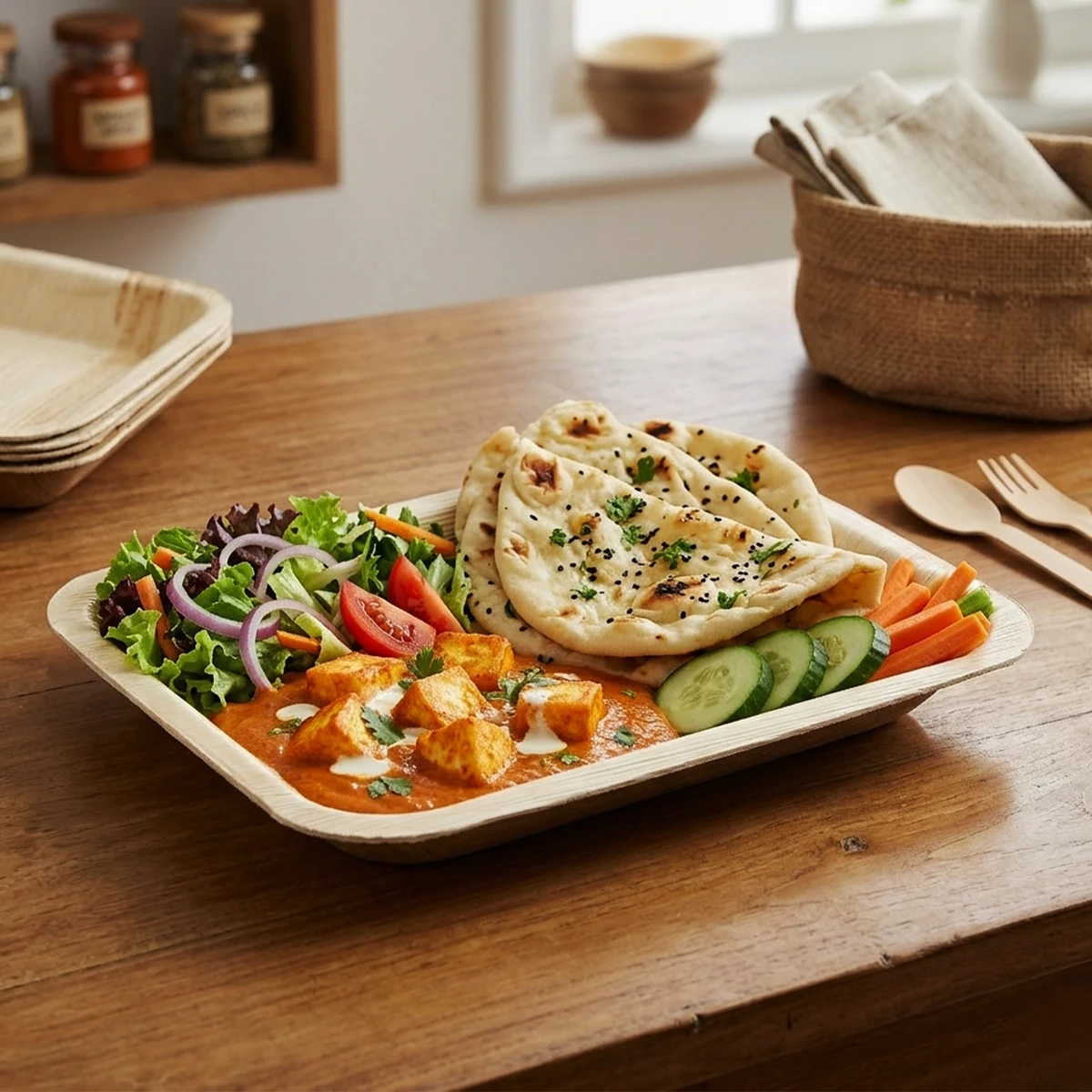
Start with a Trial Order 📦
Experience Foliware's premium areca palm leaf tableware with a minimum order of just 1 carton. Ideal for first-time buyers, distributors, HoReCa businesses, and institutional procurement.
Experience Foliware's premium areca palm leaf tableware with a minimum order of just 1 carton. Ideal for first-time buyers, distributors, HoReCa businesses, and institutional procurement.
EN 13432:2000 is a packaging standard for industrial composting, and a certificate issued against it attaches to a specific tested product, not to a material in general. EN 17427:2022 is a home composting standard written for carrier bags, not tableware. Neither certificate proves that a local waste system will accept the item, and under Regulation (EU) 2025/40 an existing certificate does not create a presumption of conformity.
Buyers routinely ask for “EN 13432 or EN 17427, whichever you have”, as though they were an industrial tier and a home tier of one scheme. They are different standards with different subjects.
EN 13432:2000 is titled “Packaging. Requirements for packaging recoverable through composting and biodegradation. Test scheme and evaluation criteria for the final acceptance of packaging”. Its subject is packaging, and its composting conditions are industrial. TÜV Austria’s OK compost INDUSTRIAL scheme certifies against it.
EN 17427:2022 is titled “Packaging. Requirements and test scheme for carrier bags suitable for treatment in well-managed home composting installations”. Its subject is carrier bags. Not tableware, not packaging generally, carrier bags.
That matters for anyone specifying leaf, pulp or board tableware. There is no European standard written for home compostability of a plate. Home compostability claims on tableware rest on certification scheme requirements rather than on a European standard covering the product type. TÜV Austria states that its OK compost HOME programme is not based on a specific standard, and that the programme requirements defined in 2003 have since served as the basis for drafting several standards.
| EN 13432:2000 | EN 17427:2022 | |
|---|---|---|
| Subject | Packaging | Carrier bags |
| Composting route | Industrial | Well-managed home composting installations |
| Conditions | Elevated and controlled. TÜV Austria cites industrial composting temperatures of 55 to 60 degrees Celsius | Lower and less constant than industrial, and therefore slower |
| Scheme mark commonly seen | OK compost INDUSTRIAL, Seedling | OK compost HOME |
| Written for tableware? | No, for packaging | No, for carrier bags |
The honest reading for a tableware buyer is that an industrial compostability certificate against EN 13432 is a real and meaningful document, and a home compostability mark on tableware is a scheme certificate rather than conformity with a product-specific European standard. Both can be genuine. They prove different things and you should ask for them in different words.
This is where most supplier claims fall apart under inspection.
TÜV Austria’s OK compost INDUSTRIAL scheme certifies products and materials, not companies, and requires that all components, inks and additives meet the biodegradability requirements for the final product to be certified. The Seedling label is certified against EN 13432 and EN 14995 and is issued by TÜV Austria Belgium and DIN CERTCO, with the logo and certificate number printed on the pack.
Follow the logic through and three common claims stop working.
“Areca leaf is compostable, so our plates are certified.” A material property is not a certificate. The certificate covers a tested article.
“We have a certificate for our 10 inch plate, so the 12 inch is covered.” Not unless the certificate says so. Ask for the product reference on the certificate and compare it to the SKU you are buying.
“Our factory is certified.” Factories are not certified under these schemes. An ISO 22000:2018 or ISO 9001:2015 certificate covers a management system and is a different document with a different purpose. Foliware India LLP holds both, and neither is a compostability certificate.
If the printed pack will carry a mark, the licence and the certificate have to cover the exact article in the pack. A sustainability label displayed without a certification scheme behind it is a blacklisted practice under the consumer protection rules that apply from 27 September 2026, set out in the guide to what you may and may not say about green claims in the EU.
Ask for the certificate as a PDF, not a logo in a brochure. Then check five things in this order, because each one fails more often than the one after it.
| Field | What good looks like | Failure mode you are looking for |
|---|---|---|
| Scope | Names the article type and the material | Scope written as a material family only, with no article |
| Holder | The legal entity you are buying from, or a named licensee relationship you can trace | Certificate held by a raw material supplier or a trading company with no stated link to your seller |
| Product reference | Model or SKU identifiers you can match to your purchase order | A product name that does not appear on any quotation you hold |
| Standard and route | EN 13432 with industrial composting stated, or the home scheme named explicitly | “Compostable” with no standard and no route |
| Validity | Issue date and expiry, with a current date | Expired certificate, or no expiry printed at all |
A sixth check is worth the five minutes it takes: verify the certificate number against the issuing body’s own register rather than trusting the PDF. Certificates are among the easiest documents to alter, and the register is the control. The wider question of verifying what an Indian supplier tells you is covered in the guide to how to verify an areca leaf plate exporter before you send money.
This is new and most buyers have not caught up with it.
Regulation (EU) 2025/40, the Packaging and Packaging Waste Regulation, sets compostability requirements in Article 9. Article 9(1) requires certain named formats to be industrially compostable by 12 February 2028: permeable tea, coffee and other beverage bags, soft after-use system single-serve units, and very lightweight and lightweight plastic carrier bags. Plates are not on that list. Article 9(2) lets a Member State require additional packaging formats to be compostable where it has appropriate collection infrastructure.
The important part for certificate holders is what the Commission guidance says about standards. It states that the existing standard EN 13432 on industrial composting can be used as guidance until the new standard is adopted, and that existing certifications do not create a presumption of conformity with the compostability requirement. The Commission requested harmonised standards, and presumption of conformity will follow only once new standards are officially listed.
So an EN 13432 certificate in September 2026 is evidence, and useful evidence. It is not a legal presumption of conformity under the Packaging and Packaging Waste Regulation. Anyone selling you a certificate as though it closes a PPWR question is overselling it. The wider picture of which PPWR duties bite now and which are dated later is in the analysis of what changed for imported foodservice packaging on 12 August 2026.
A compostability certificate is a laboratory and scheme conclusion about how an article behaves under defined conditions. It says nothing about whether the waste system at your customer’s site will accept the article.
That gap is visible in the Regulation itself. Article 9(2) conditions a Member State’s power to mandate compostability on having appropriate collection infrastructure, and the Commission guidance says home composting should only be considered in the context of specific local conditions and under the supervision of the relevant authorities. Composting infrastructure and acceptance rules are local, and many organic waste streams are specified for food waste rather than for serviceware.
The practical consequence for a buyer in Germany, France, the Netherlands, Sweden or Ireland is that the end-of-life story you print should match what the operator’s waste contractor will actually do, and only the waste contractor can tell you that. Ask the site’s contractor before you print a disposal instruction, and confirm the position with the local competent authority where the answer has legal consequences.
Here is the unhelpful version, stated plainly. If your customer’s site sends everything to energy recovery, a compostability certificate buys them nothing operationally, and a cheaper uncertified product with the same material story may serve them better. If your customer runs a closed-loop event with a dedicated organic stream, certification is worth paying for and worth specifying tightly. Sell the certificate to the second buyer and be honest with the first. Nordic public buyers tend to ask exactly this question in tender, which is why their criteria are a good template even outside public procurement, as set out in the guide to green public procurement criteria for catering disposables in the Nordics.
Do I need industrial or home compostability certification? It depends on where the item goes after use. Industrial compostability, evidenced against EN 13432, suits a site with a commercial organic waste contract. Home compostability matters where the end user composts at home. Ask the waste contractor first, then specify, because paying for the harder certification you do not need is common.
Is there a European standard for home compostable plates? Not for plates. EN 17427:2022 is written for carrier bags. Home compostability claims on tableware rest on certification scheme requirements such as TÜV Austria’s OK compost HOME programme rather than on a European standard covering the product type.
Does a compostability certificate satisfy PPWR? No. The Commission guidance for Regulation (EU) 2025/40 states that existing certifications do not create a presumption of conformity with the compostability requirement, and that EN 13432 can be used as guidance until the new standard is adopted.
Who issues the Seedling label? European Bioplastics states that the Seedling is issued by TÜV Austria Belgium and DIN CERTCO, against EN 13432 and EN 14995, with the certification process governed by agreements between the certifier and the trademark owner. The certificate number is printed alongside the logo.
Can a certificate cover a whole product range? Only if its scope and product references say so. Check the product reference field against your SKU list. A certificate for one article does not extend to a different size or a different article by implication.
What if my supplier has no compostability certificate? That is not automatically a problem. It becomes a problem if you intend to print a compostability claim, because from 27 September 2026 a sustainability label must be based on a certification scheme. Without a certificate, sell the product on its material and origin facts rather than on an end-of-life claim.
How long is a compostability certificate valid? Validity is set by the scheme and printed on the certificate. Check the expiry date and verify the number against the issuing body’s register rather than relying on the PDF you were sent.
Lane, documentation and destination rules for the markets this article applies to. Each page carries the route, the paperwork set and the quotation route for that destination.
Each link below answers the question this article raises next, whether that is the rule behind a decision, the same question in another destination, or the commercial step that follows.
Send an enquiry naming the product, the volume and the destination, for example 50,000 units of the Reinforced Round Traditional Patravali Meal Plate, 12 inch round, delivered Amsterdam, and state whether industrial or home compostability is required and which waste stream the end user runs. Foliware India LLP will tell you what certification exists for that article, what does not, and what the material and process evidence supports instead.