
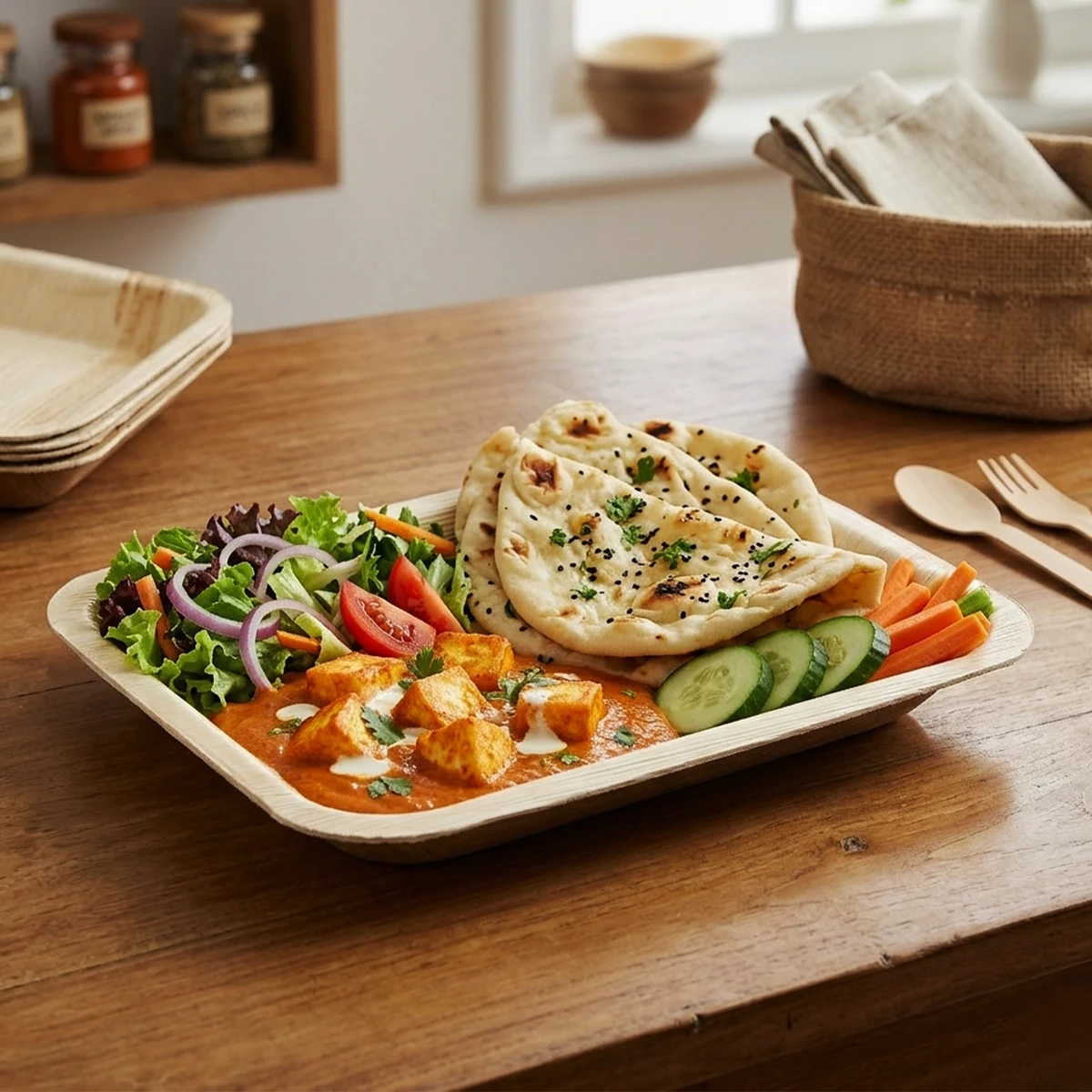
Start with a Trial Order 📦
Experience Foliware's premium areca palm leaf tableware with a minimum order of just 1 carton. Ideal for first-time buyers, distributors, HoReCa businesses, and institutional procurement.
Experience Foliware's premium areca palm leaf tableware with a minimum order of just 1 carton. Ideal for first-time buyers, distributors, HoReCa businesses, and institutional procurement.
Note. Packaging registration and food
contact rules can change. Confirm current requirements with Zentrale
Stelle Verpackungsregister and the European Commission’s food contact
materials guidance before you ship.
Two separate obligations apply to tableware sold into Germany. Food
contact suitability is assessed under the EU’s food contact materials
framework, and a manufacturer supports it with a declaration of
compliance backed by testing. Registering packaging in Germany’s LUCID
register is a different obligation, and it attaches to whichever party
first places filled packaging on the German market. In a normal import
arrangement, that party is the German importer, not the overseas
manufacturer.
It is easy to fold food contact compliance and packaging compliance
into one mental checklist because both show up during the same supplier
evaluation. They are not the same obligation, they are not decided by
the same rule, and critically, they do not sit with the same party.
Food contact suitability is a question about the material itself: is
it safe for the food it will touch. That question is answered by testing
and documented in a declaration of compliance, and the manufacturer is
the natural party to produce it.
Packaging registration is a question about who is responsible, under
German law, for the environmental footprint of packaging once it is
placed on the German market. That question is not answered by testing.
It is answered by identifying which party in the commercial chain first
placed the filled packaging into German commerce, and it is a legal
registration obligation on that party, not a document a supplier hands
over.
Materials and articles intended to come into contact with food are
governed at EU level by Regulation (EC) No 1935/2004, the framework
regulation setting general safety requirements for food contact
materials across member states, including Germany. The European
Commission maintains the current structure of this framework, including
where specific EU measures exist for particular material categories and
where general requirements apply in the absence of one.
For a material category without its own dedicated EU measure,
compliance is demonstrated against the general safety requirements the
framework sets, supported by the manufacturer’s own testing. That is
what a declaration of compliance does: it states, on the basis of
testing, that the material meets those requirements for its intended
food contact use. A German importer bringing in tableware from an
overseas manufacturer should expect this declaration as standard
supporting documentation, alongside the underlying test evidence it
draws on.
Germany’s packaging law requires the party that first places
packaging filled with goods on the German market to register as a
producer with the central packaging register, known as LUCID,
administered by Zentrale Stelle Verpackungsregister. Registration is
what allows the packaging volumes involved to be tracked and the
associated licensing obligations to be met.
The phrase that matters is “first places on the German market.” In a
standard import arrangement, goods are manufactured overseas, shipped,
and then brought into German commerce by an importer or distributor
based in Germany. The overseas manufacturer does not place the filled
packaging on the German market. The German importer does. That makes the
German importer, not the Indian manufacturer, the party the LUCID
obligation attaches to in the ordinary course of an import
transaction.
This is worth stating plainly because it runs against how the
obligation sometimes gets discussed in supplier evaluation
conversations, as if a certificate or registration from the
manufacturer’s side would satisfy it. It would not, because the
obligation was never assigned to the manufacturer’s side of the
transaction in the first place.
A German distributor is not looking for proof that an Indian
manufacturer holds a LUCID registration. An Indian manufacturer
registering in LUCID would not be meeting an obligation that belongs to
it under German law, because the obligation only attaches once packaging
is placed on the German market, and the manufacturer is not the party
doing that.
What a distributor should be looking for from the supplier is the
information needed to complete its own registration accurately: the
packaging materials used, their weights, and their composition, since
German licensing fees are calculated against packaging material and
weight. A supplier that can provide clear packaging specification data
makes the distributor’s own LUCID registration faster and more accurate.
It does not transfer the registration obligation, and no document a
supplier provides substitutes for the distributor’s own
registration.
The table below sets out where the line sits.
| Question | Legal basis | Who the obligation sits with | What an overseas supplier can provide |
|---|---|---|---|
| Is the material fit for food contact | EU food contact materials framework, Regulation (EC) 1935/2004 | Demonstrated by the manufacturer through testing | A declaration of compliance backed by test data |
| Who registers packaging in LUCID | German packaging law, administered through ZSVR | The party that first places filled packaging on the German market, ordinarily the German importer |
Packaging material, weight and composition data to support the importer’s own registration |
State that Germany is your destination when you enquire, and ask for
the declaration of compliance alongside the packaging specification data
your own LUCID registration will need. Neither document substitutes for
the other, and neither is optional once your shipment is destined for
the German market.
Does an overseas manufacturer need to register in
LUCID? Not in a standard import arrangement. The obligation
attaches to whichever party first places filled packaging on the German
market, which is ordinarily the German importer, not the
manufacturer.
What is a declaration of compliance? A supplier
statement, backed by testing, that a material meets the general safety
requirements the EU’s food contact materials framework sets for its
intended use. It addresses food contact suitability, not packaging
registration.
What should I ask an overseas supplier for if I am the German
importer? A declaration of compliance for food contact
suitability, and clear data on the packaging materials and weights used,
which your own LUCID registration and fee calculation will need.
Are food contact compliance and packaging registration the
same requirement? No. They are governed by different rules and
sit with different parties. Food contact suitability is a material
question answered by the manufacturer’s testing. Packaging registration
is a market access question that follows whoever places the goods on the
German market.
Does Foliware register in LUCID on behalf of a German
customer? No. That registration is the German importer’s own
legal obligation. Foliware’s role is to supply the food contact
declaration and the packaging specification data the importer needs to
complete it accurately.
European Commission Legislation, Food contact materials
https://food.ec.europa.eu/food-safety/chemical-safety/food-contact-materials/legislation_en
Supports: the structure of the EU food contact materials framework,
including where general requirements apply in the absence of a material
specific EU measure
EUR-Lex Regulation (EC) No 1935/2004 on materials and articles
intended to come into contact with food
https://eur-lex.europa.eu/eli/reg/2004/1935/2021-03-27 Supports: that
Regulation (EC) 1935/2004 is the primary legal text setting general
safety requirements for food contact materials across the EU, including
Germany
Zentrale Stelle Verpackungsregister Registering with the LUCID
Packaging Register
https://www.verpackungsregister.org/en/registration/find-out-about-registrations
Supports: who must register as a producer under German packaging law,
specifically that the obligation attaches to the party first placing
packaging on the German market
Lane, documentation and destination rules for the markets this article applies to. Each page carries the route, the paperwork set and the quotation route for that destination.
Each link below answers the question this article raises next, whether that is the rule behind a decision, the same question in another destination, or the commercial step that follows.
Send the product, the volume and the destination. A quotation follows within one business day.