
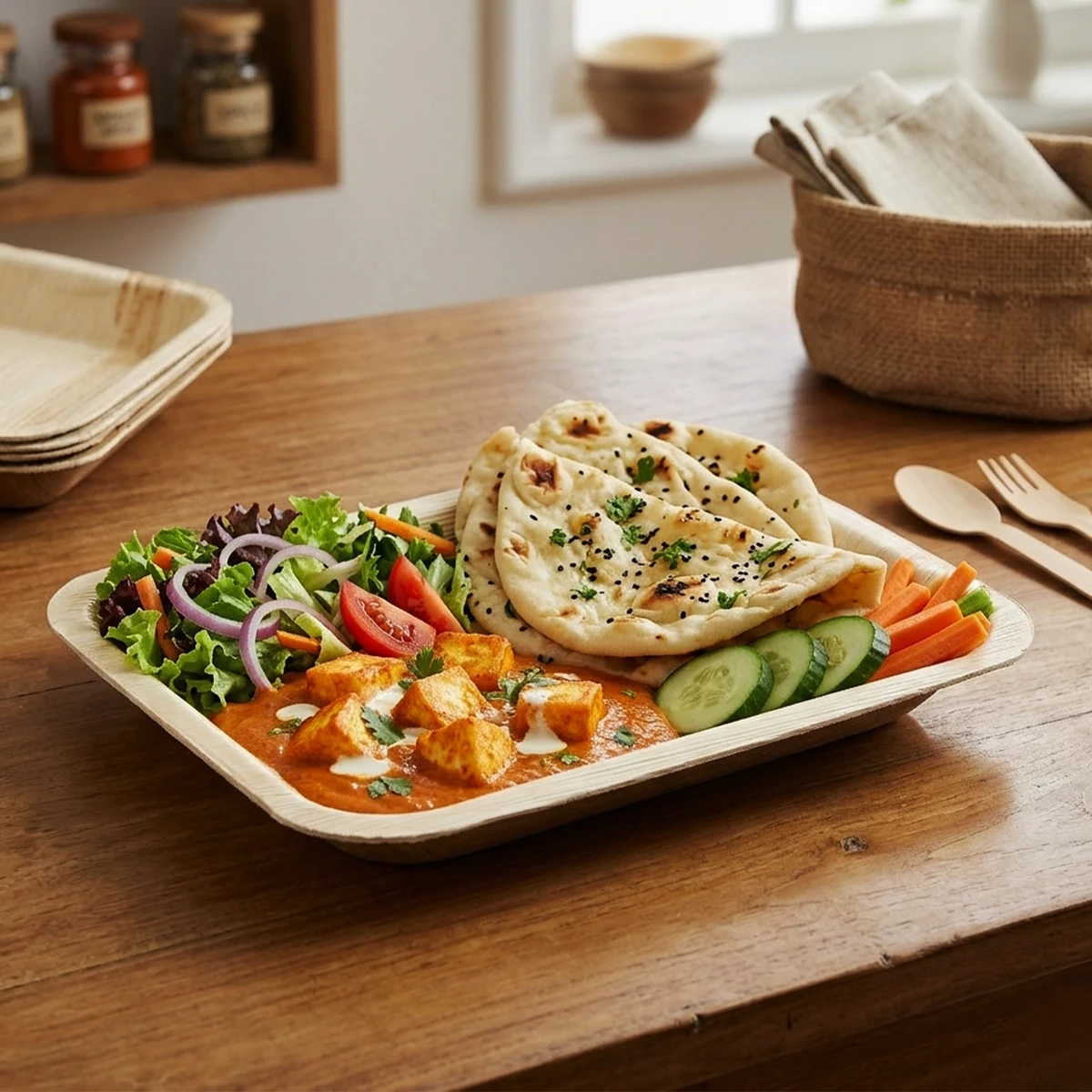
Start with a Trial Order 📦
Experience Foliware's premium areca palm leaf tableware with a minimum order of just 1 carton. Ideal for first-time buyers, distributors, HoReCa businesses, and institutional procurement.
Experience Foliware's premium areca palm leaf tableware with a minimum order of just 1 carton. Ideal for first-time buyers, distributors, HoReCa businesses, and institutional procurement.
Buying direct from an Indian manufacturer removes an intermediary margin and gives you specification control, in exchange for a lead time measured in weeks, a container sized minimum, working capital tied up in transit, and full ownership of EU compliance. Buyers below roughly one container a year for the SKU family, or who replenish in days, are usually better off with a European importer.
Direct from the manufacturer means you contract with the Indian factory, you are the importer of record in your Member State, you make the customs declaration, you register and report for packaging extended producer responsibility, and you hold the compliance file. You buy on an Incoterms 2020 rule, most often FOB Chennai or CIF at your destination port, and everything after that point is yours.
Through a European importer or distributor means you buy goods already inside the European Union from a company established in your market. It has already cleared customs, already registered for EPR, already holds the compliance documents, and invoices you in euro or sterling on its own trading terms. You buy cases or pallets rather than containers.
A third arrangement is worth naming because suppliers sometimes propose it. A non EU seller can sell on delivered terms using a customs representative established in the Union acting under indirect representation, which Article 18 of Regulation (EU) No 952/2013, the Union Customs Code, provides for. That gets the goods cleared. It does not automatically move every downstream EU obligation away from you. Ask your customs broker who is named as declarant and who is registered as producer for packaging in your market before assuming DDP has solved anything.
The table compares the two routes on the things that change a procurement decision.
| Direct from Indian manufacturer | Through a European importer | |
|---|---|---|
| Lead time | Production plus sea transit plus clearance, measured in weeks from order | Days from stock, subject to their stock cover |
| Minimum order | Commercially a full container for a viable landed cost, though smaller LCL shipments are possible | Cases or pallets |
| Working capital | Deposit, then goods funded through production, transit and clearance before a single unit sells | Funded on the importer’s payment terms, often after delivery |
| Compliance ownership | Yours: customs declaration, EPR registration and reporting, Declaration of Compliance, product claims | The importer’s for the import step, though claims you make yourself remain yours |
| Specification control | Direct: size, wall thickness, pack count, carton, private label, artwork | Whatever the importer already lists, or a special order at their MOQ |
| Risk when a batch is wrong | Yours to resolve with a supplier in another jurisdiction, usually after the goods have arrived | The importer’s to resolve, and you have a counterparty in your own legal system |
| Unit price | Lower ex works, before you add freight, duty, clearance, EPR fees, storage and your own handling | Higher per unit, with those costs already inside it |
The last row is the one buyers misread. The comparison is not the Indian factory price against the importer’s price. It is the landed cost per unit in your own warehouse against the importer’s invoice price, and the gap is smaller than the factory quotation makes it look.
On a direct purchase you are the operator placing both the goods and their packaging on the EU market. Regulation (EU) 2025/40, the Packaging and Packaging Waste Regulation, which has applied since 12 August 2026, puts manufacturer obligations onto the importer that places packaging on the Union market. That means registration and reporting with the national scheme, packaging data you must obtain from your supplier, and the compliance file behind any claim on the pack. Who registers for EPR when you import from India is settled in most cases and the answer is the importing buyer.
On a purchase from a European importer, the importer has already done that step for the goods it placed on the market. What does not transfer is anything you say yourself. If you relabel, repack, brand it or make a compostability claim in your own catalogue, those claims are yours to substantiate regardless of who imported the goods.
This is the most underestimated cost of going direct. It is not a fee, it is a role. Someone in your business has to own customs classification, EPR registration and the annual return, the compliance file and the document chain. If you cannot name that person today, you are not ready to buy direct, and no supplier gains from pretending otherwise.
Do not take this on feel. The calculation is short and runs on your own inputs.
Direct route cash cycle, in days equals deposit paid before production, plus production days, plus port to port transit days, plus clearance and inland days, plus your own stock cover days, plus your customer’s payment days, less any credit the supplier extends after shipment.
Importer route cash cycle, in days equals your stock cover days, plus your customer’s payment days, less the payment terms the importer gives you.
Subtract the second from the first, then multiply the difference by your average daily cost of goods sold for that range. That figure is the extra cash the direct route ties up at any moment, and it is the number your finance director will ask for.
Two inputs get understated. Clearance and inland days depend on your broker and on whether documents arrive before the vessel. Stock cover rises on the direct route, because replenishment lead time went from days to weeks. Holding stock in Europe or shipping to order is the same decision seen from the other side. Against that, count what the direct route returns: the intermediary margin, and on a repeat programme a fixed specification rather than whatever the importer’s supplier changed.
This list is deliberately specific, and some of it costs a direct exporter business. It is still right.
You buy less than about one full container a year across the SKU family. The fixed costs of the direct route do not scale down. Customs entry, EPR registration and annual reporting, a compliance file, a laboratory report, an inspection and the internal time to run all of it are broadly the same whether you import one container or six. Spread over a small volume they will exceed the margin you saved.
Your replenishment cycle is measured in days. A festival caterer who reorders on Tuesday for a Saturday event, a hotel group covering an unexpected banquet, a wholesaler refilling a branch overnight: none of these can be served from a factory that is weeks away by sea. Buy from stock in Europe, or hold your own stock, which is the same commitment in a different place.
Nobody in your business can own customs and EPR. If the answer to “who files the packaging return” is silence, the answer to “should we import directly” is no, for now.
Your demand is spiky and you cannot forecast it. Container buying rewards forecasting. If your volume swings unpredictably, an importer is absorbing that volatility for you and charging you for it, which is a reasonable trade.
You need one invoice across many categories. An areca leaf plate factory in Karnataka supplies leaf tableware. A European foodservice distributor supplies it alongside cutlery, napkins, cups, films and cleaning chemicals, on one delivery and one invoice. If consolidation is what your operation needs, that is a real service and going direct removes it.
You need a counterparty inside your own legal system. Enforcement against a supplier in another jurisdiction is slow, expensive and uncertain. India, Ireland and the United Kingdom are not contracting states to the United Nations Convention on Contracts for the International Sale of Goods, so the default legal backdrop many buyers assume is not there and has to be built into the contract. If a batch failure would be commercially serious and you want a supplier you can pursue locally, buy locally and accept the margin. Take your own legal advice rather than relying on a summary.
You are testing a listing. If the range might not survive its first season, the direct route front loads cost and commitment into exactly the scenario where you want neither.
The mirror image, and a narrower group than most factory websites suggest. You have predictable annual volume of at least a container for the SKU family. You have a named owner for customs and EPR, or a broker and compliance adviser already engaged. You need specification control: a particular diameter, pack count, carton format, private label or artwork an importer’s standard range does not carry. You can fund goods in transit without straining the business. And you can hold enough safety stock in Europe to cover a lead time measured in weeks.
Meeting four of those five is usually enough. Meeting two is not.
The common landing point is neither route in full. It is direct supply for the two or three SKUs that carry the volume, and a European importer retained for the long tail and emergency cover. The direct programme carries the margin and the specification. The importer absorbs the variability.
If that is where you expect to end up, structure it from the start. Keep the importer relationship warm rather than letting it lapse, because the first time a vessel is late you will want it, and plan the crossover so both do not arrive at once. Switching suppliers without a supply gap applies to switching routes too.
How much cheaper is buying direct? The honest answer is that nobody can tell you without your numbers. The factory price is only one input; freight, duty, clearance, EPR fees, storage, handling, finance cost on goods in transit and your own compliance time all sit between it and the shelf. Build the landed cost model first and compare that total against the importer’s invoice price.
Can the Indian supplier be the importer of record so I do not have to be? Sometimes, through a customs representative established in the Union acting under indirect representation as provided for in the Union Customs Code. That covers the customs step. It does not automatically make the supplier the registered producer for packaging in your market or transfer every product obligation. Confirm with your own customs broker and the national packaging register before relying on it.
What is the smallest sensible first direct order? Commercially, enough volume that fixed costs per unit are not absurd, which for most buyers means a full container or a substantial part load. Many buyers deliberately start smaller, accepting poor unit economics on the first shipment to test the supplier before committing. Treat the first order as a test rather than a saving.
Does buying direct give me better quality? No, it gives you control over the specification. Quality comes from the specification you write, the inspection you fund and the consistency of the factory. A capable European importer with a stable supplier can deliver more consistent goods than a direct relationship nobody manages.
We already buy from an importer. What would we actually gain? Margin and specification, and that is roughly it. If the importer’s product fits your service and the price is acceptable, the direct route is a project with a payback period, not an obvious improvement. Run the working capital calculation above and see whether the number justifies the work.
Which route suits a public sector or framework contract? Usually the one that can evidence continuity of supply and hold price for the contract term, which is often an importer with European stock unless you are large enough to carry your own buffer. Score continuity explicitly rather than assuming the cheaper landed cost wins.
Lane, documentation and destination rules for the markets this article applies to. Each page carries the route, the paperwork set and the quotation route for that destination.
Each link below answers the question this article raises next, whether that is the rule behind a decision, the same question in another destination, or the commercial step that follows.
Send your enquiry with the product, the volume and the destination, and say what your current supply route is. For example: Reinforced Round Traditional Patravali Meal Plate and 7 inch bowls, currently bought from a Dutch importer, around 15 pallets a year, delivered Rotterdam, considering direct supply. Naming the current route means the answer addresses whether direct buying makes sense for your volume rather than assuming it does. Foliware ships from India to buyers across Germany , the Netherlands, France, Sweden, Ireland and the United Kingdom, and will say where the importer route still suits you better.