
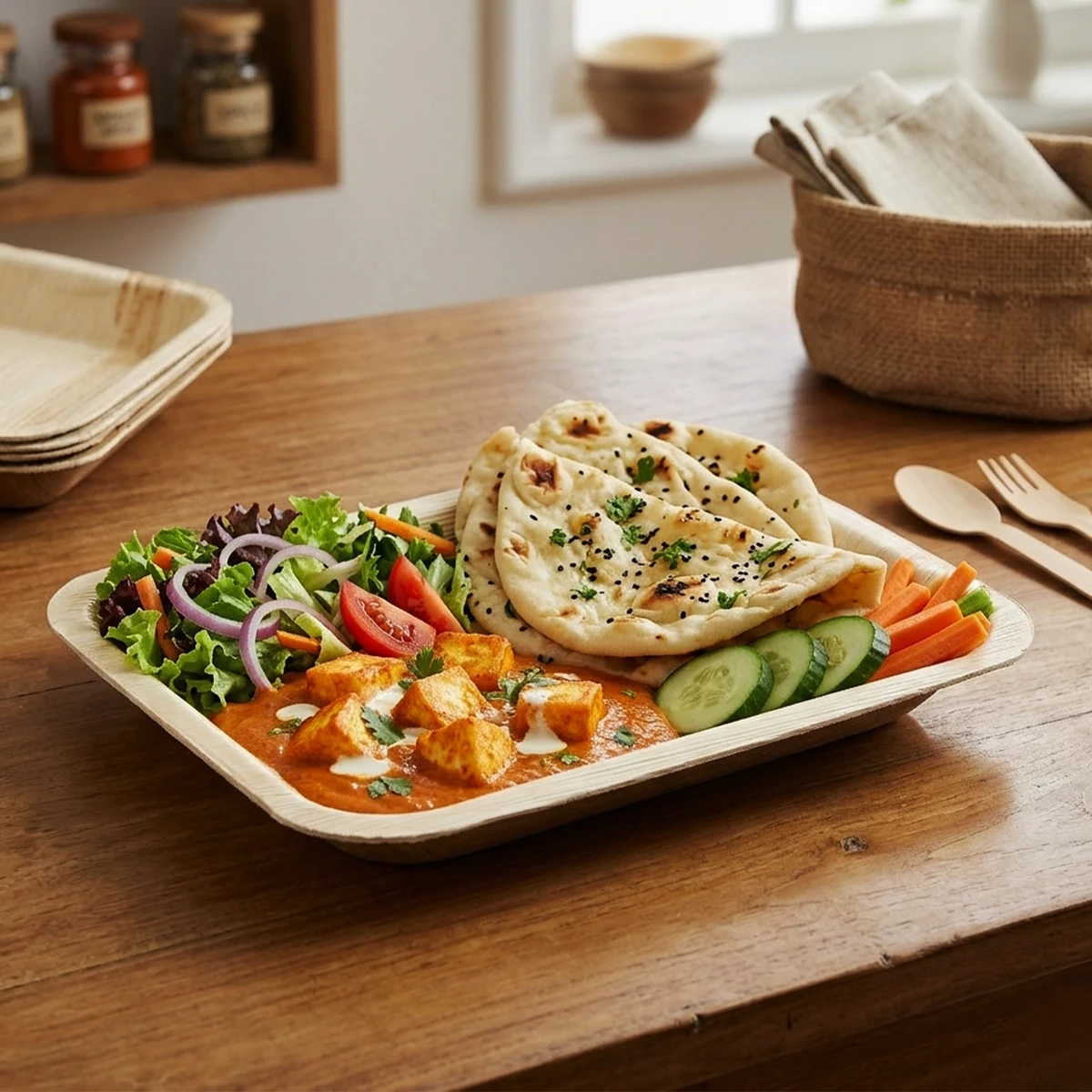
Start with a Trial Order 📦
Experience Foliware's premium areca palm leaf tableware with a minimum order of just 1 carton. Ideal for first-time buyers, distributors, HoReCa businesses, and institutional procurement.
Experience Foliware's premium areca palm leaf tableware with a minimum order of just 1 carton. Ideal for first-time buyers, distributors, HoReCa businesses, and institutional procurement.
The Plastic Waste Management (Amendment) Rules, 2026, notified as G.S.R. 237(E) on 31 March 2026, changed extended producer responsibility mechanics for plastic packaging. They did not change India’s single use plastic prohibition list, which still runs from the 12 August 2021 notification. A caterer buying non plastic tableware gains no new obligation from the amendment, but the separate Solid Waste Management Rules, 2026 do add one.
The Ministry of Environment, Forest and Climate Change notified the Plastic Waste Management (Amendment) Rules, 2026 on 31 March 2026 as G.S.R. 237(E), in the Gazette of India Extraordinary, Part II, Section 3, Sub-section (i), No. 218. The rules came into force on the date of publication. They amend the Plastic Waste Management Rules, 2016, which have now been amended nine times since 2018.
The table below sets out what the amendment does, against what stood before it, and who each change reaches.
| Provision | What the amendment does | Who it reaches |
|---|---|---|
| Rule 3(ga), end of life disposal | Defines it as energy recovery, including co-processing in cement and steel, waste to energy, waste to oil and road construction, and expressly excludes conversion into feedstock chemicals or new plastic, which counts as recycling | Plastic waste processors and the producers buying their certificates |
| Rule 3(qa), recycling | Adds generation of energy alongside transformation into new products | The same |
| Rule 3(uc), seller | New definition covering anyone selling resins, pellets or intermediate material for plastic packaging | Resin traders |
| Rule 11(2), recycled packaging | Requires conformity to IS 14534:2023, a recycled content label, and FSSAI marking where the use is food contact | Anyone placing recycled plastic packaging on the market |
| Rule 12, sub-rules 3A, 3B, 3C | Names the local body, gram panchayat or district level panchayat as the enforcement authority for the rule 4 prohibitions and the packaging provisions | Every food business with premises |
| Schedule II, paragraph 7 | Restates mandatory recycled content by packaging category and minimum reuse for rigid packaging, with a statutory exemption route | Producers, importers and brand owners of plastic packaging |
| Rules 6, 8, 17 and Schedule II paragraphs 12, 13 | Allows verification by a registered environment auditor as well as a designated agency | Obligated entities filing returns |
Read that table against a disposables order and one thing stands out. Every change lands on plastic packaging. None of it lands on the tableware itself unless the tableware is plastic.
No. The prohibition on identified single use plastic commodities still comes from rule 4(2), inserted by the Plastic Waste Management (Amendment) Rules, 2021, notified as G.S.R. 571(E) on 12 August 2021. That sub-rule prohibits the manufacture, import, stocking, distribution, sale and use of the listed items with effect from 1 July 2022. The list includes plates, cups, glasses, cutlery such as forks, spoons and knives, straws, trays, wrapping or packing films around sweet boxes, invitation cards and cigarette packets, plastic or PVC banners less than 100 microns, and stirrers. A second limb covers ear buds with plastic sticks, plastic sticks for balloons, plastic flags, candy sticks, ice cream sticks and polystyrene for decoration.
Two qualifications in the same rule are frequently missed. Rule 4(3) states that the prohibition in sub-rule (2)(b) does not apply to commodities made of compostable plastic, which is why certified compostable cutlery is still sold lawfully. And rule 4(1)(c), as amended in 2021, sets carry bag thickness at 75 microns from 30 September 2021 and 120 microns from 31 December 2022, a separate obligation from the item ban. The practical consequences are set out in what Indian caterers buy after the single use plastic ban.
Nothing in G.S.R. 237(E) touches rule 4. If a supplier tells you the 2026 amendment changed what you may serve food on, ask them to cite the paragraph.
Schedule II, paragraph 7 now carries three tables of mandatory recycled plastic content, one each for producers, importers and brand owners, expressed as a percentage of plastic packaging manufactured, imported or used in the year. Category I, rigid plastic packaging, runs 30 per cent in 2025 to 2026, 40 per cent in 2026 to 2027, 50 per cent in 2027 to 2028 and 60 per cent from 2028 to 2029 onward. Category II, flexible packaging, runs 10, 10, 20 and 20 per cent across the same years. Category III, multilayered packaging, runs 5, 5, 10 and 10 per cent, with the target limited to the weight of the plastic layers. Brand owners using Category I rigid packaging also carry a minimum reuse obligation, rising over the same period and set highest for large drinking water containers.
The exemption matters more to a foodservice buyer than the targets. Where the use of recycled plastic in packaging is not permitted under a law, regulation, rule or mandatory Indian Standard, including anything notified by the Food Safety and Standards Authority of India, the target does not apply. The producer, importer or brand owner claiming that exemption has to submit the applicable instrument in their annual return on the centralised online portal. So a food contact plastic pack is frequently exempt on paper, and the exemption still costs an annual filing.
The instrument that actually changes a caterer’s day is not the plastic amendment. It is the Solid Waste Management Rules, 2026, notified by the Ministry of Environment, Forest and Climate Change on 27 January 2026 under the Environment (Protection) Act, 1986, in force from 1 April 2026, in supersession of the Solid Waste Management Rules, 2016.
Three features of it decide procurement.
Four stream segregation at source is compulsory. Wet waste, dry waste, sanitary waste and special care waste must be separated where they arise. Wet waste is composted or sent for bio-methanation. Dry waste, which the Central Pollution Control Board’s own summary lists as including plastic, paper, metal, glass, wood and rubber, goes to a material recovery facility.
The bulk waste generator definition captures most catering sites. An entity qualifies if it has a floor area of 20,000 square metres or more, or water consumption of 40,000 litres a day or more, or solid waste generation of 100 kilograms a day or more. A hotel, a hospital, a large campus mess, a mall food court and a temple kitchen at festival scale all cross at least one.
The duties are administrative, not just operational. Registration with the local body through a centralised online portal, segregated handover to authorised agencies only, on site processing of wet waste, Extended Bulk Waste Generator Responsibility certificates where on site treatment is not feasible, and an annual return by 30 June.
Confirm the classification of your own site and the applicable state rules with your State Pollution Control Board or Pollution Control Committee and your local body. The Central Pollution Control Board summary is a summary, and state implementation varies.
This is the part no general summary does, and it is where a procurement file either holds up or does not.
The tableware itself. Rule 3(p) of the Plastic Waste Management Rules, 2016 defines plastic as material containing as an essential ingredient a high polymer, and lists the polymer families. An uncoated areca palm leaf article contains none of them, so it is not plastic waste, not plastic packaging, and not within rule 4. No registration, no target, no return. The detailed reasoning, including the cases where it stops being true, is set out in whether EPR under the Indian plastic waste rules reaches leaf tableware.
The packing the tableware arrives in. This is where the plastic net closes. A polythene inner liner, a shrink sleeve, a stretch wrapped pallet and plastic strapping are plastic packaging. Whoever first uses them to pack a commodity is a producer under the Schedule II definition, and a brand owner who sells under a registered label has obligations of their own. Ask what the goods are packed in before you assume you are outside the regime.
The used plate. Under the Solid Waste Management Rules, 2026, a soiled serving article has to go into one of the four streams, and which one decides whether your composting route is available. The Central Pollution Control Board summary lists paper and wood under dry waste and kitchen waste under wet waste. A food soiled uncoated leaf plate sits between those examples rather than squarely in either. Get the classification in writing from your local body before you build a composting claim on it. That single confirmation is worth more than any supplier certificate.
The comparison set. A laminated paper plate, a poly coated board bowl and a plastic lined bagasse container all carry a plastic layer, which puts them inside the plastic definition in a way an uncoated leaf article is not. Where that difference is worth paying for is worked through in areca, bagasse or thermocol compared for Indian buyers.
There is no such document as a Plastic Waste Management Rules 2026 compliance certificate for a leaf plate, because the rules do not reach the product. If a supplier offers one, they are selling you paper for a risk you do not have. What is worth asking for is narrower and checkable: a written material declaration, the composition of the packing materials by weight, and the food contact test reports discussed in FSSAI requirements for food contact tableware sold in India.
The second unhelpful thing: going non plastic does not remove you from waste regulation. It moves you from the plastic rules into the solid waste rules, where a catering site of any size has registration, segregation and return obligations from 1 April 2026 whatever it serves food on.
Does the Plastic Waste Management (Amendment) Rules, 2026 ban any new item? No. The amendment does not touch rule 4, which carries the prohibitions. The identified single use plastic items have been prohibited since 1 July 2022 under rule 4(2), inserted by G.S.R. 571(E) of 12 August 2021. The 2026 amendment changes extended producer responsibility mechanics, definitions and enforcement jurisdiction.
Who enforces the single use plastic ban at my restaurant now? Under new sub-rules 3A, 3B and 3C of rule 12, the local body enforces within an urban local body area, the gram panchayat within its jurisdiction, and the district level panchayat at district level. Where an urban local body and another local authority overlap, the urban local body is the enforcing authority.
Are compostable plastic plates and cutlery still allowed? Rule 4(3) of the Plastic Waste Management Rules, 2016 states that the prohibition in rule 4(2)(b) does not apply to commodities made of compostable plastic. Compostable plastic is defined in rule 3 and carries its own conformity and certification expectations, so ask for the Central Pollution Control Board certification reference before you accept the claim.
Do the recycled content targets apply to food packaging? The targets do not apply where the use of recycled plastic in packaging is not permitted under a law, rule or mandatory Indian Standard, including instruments of the Food Safety and Standards Authority of India. The party claiming the exemption must submit the applicable instrument in its annual return on the centralised online portal.
When do the Solid Waste Management Rules, 2026 start to bite? They were notified on 27 January 2026 and came into effect on 1 April 2026, superseding the 2016 rules. Bulk waste generators register with the local body through a centralised online portal and file an annual return by 30 June. Confirm your site’s status with your local body, because the thresholds are alternatives, not cumulative.
What should I ask a tableware supplier for after these changes? A written declaration of the material the article is made from, the composition and weight of every packing material by component, food contact test reports from an accredited laboratory, and confirmation of who acts as producer or brand owner for any plastic packaging in the consignment. Not a certificate naming the 2026 amendment.
Lane, documentation and destination rules for the markets this article applies to. Each page carries the route, the paperwork set and the quotation route for that destination.
Each link below answers the question this article raises next, whether that is the rule behind a decision, the same question in another destination, or the commercial step that follows.
Send the product, the annual volume and the delivery location, and say what waste route the site uses. For example, 12 inch Reinforced Round Traditional Patravali Meal Plates, 300,000 pieces a year, delivered to a campus catering operation in Bengaluru with an on site composting unit. The quotation comes back with the material declaration and the packing composition by component, which is what your bulk waste generator registration and any local body query will ask for. See supply into the Indian market or send the enquiry .