
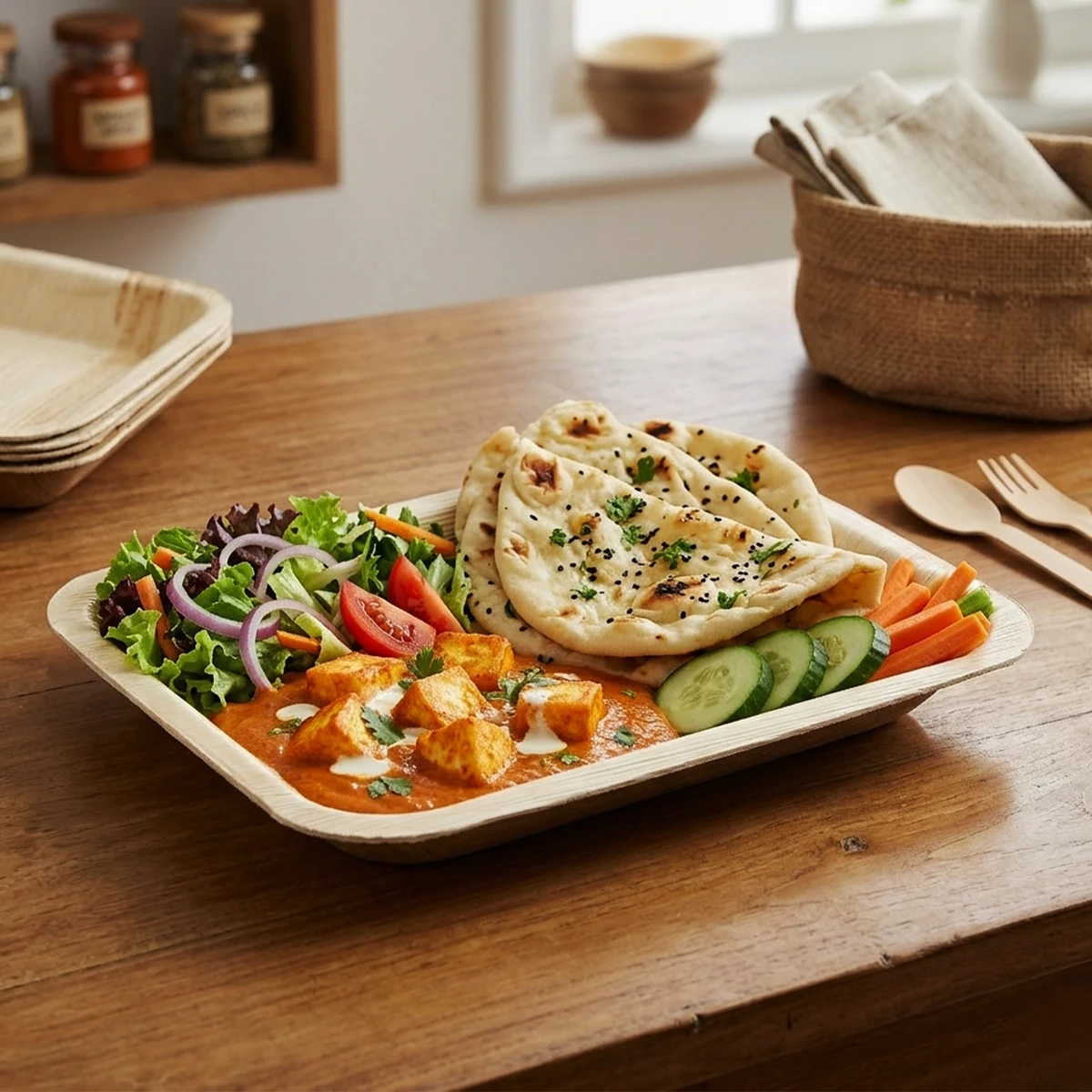
Start with a Trial Order 📦
Experience Foliware's premium areca palm leaf tableware with a minimum order of just 1 carton. Ideal for first-time buyers, distributors, HoReCa businesses, and institutional procurement.
Experience Foliware's premium areca palm leaf tableware with a minimum order of just 1 carton. Ideal for first-time buyers, distributors, HoReCa businesses, and institutional procurement.
Four things set a bulk tableware quotation: the format mix needed,
the volume in cartons, the destination and shipment mode, and how the
timing sits against current production loading. There is no public price
list because one published figure would be wrong for most buyers at
either end of the volume range. Send those four details in one message
and a quotation can be built without a follow-up.
A published per unit or per carton price works for a single SKU,
single destination retail listing. It stops working the moment volume
and destination start moving the number, which is what happens in bulk
export tableware. A price built for a 10 carton domestic order and a
price built for a 500 carton export shipment are genuinely different
numbers, driven by real cost differences, not by opacity. Publishing one
figure would either overstate the small order or understate the large
one, and either way it misleads whoever is reading it.
That is why pricing in this category is quoted against volume and
destination rather than posted as a flat figure. It is not a way of
avoiding the question. It is the only way to answer it correctly.
1. Format mix. Which formats and sizes are needed,
and in what combination. A single format order and a five format range
order are different production and packing runs even at the same total
unit count.
2. Volume. The carton count per format. Volume is
the single largest lever on a quotation because it interacts with
production run size and packing efficiency.
3. Destination and shipment mode. Where the goods
are going, and whether the order moves as an LCL consignment or a full
container. Destination sets the freight and documentation context, and
in several approved markets, the compliance context the shipment needs
to clear. Shipment mode sets how the order is consolidated and against
which lead time it is scheduled.
4. Timing against production loading. When the order
needs to be confirmed and when it needs to be dispatched, set against
what is currently in production. An order that fits comfortably into
existing production loading is quoted differently from one that needs a
dedicated run brought forward.
Every one of these four is something only the buyer can supply. That
is the real reason a quotation needs a message rather than a page
load.
An RFQ carrying all four drivers can usually be quoted without a
reply asking for more information. Use this structure:
Format and size: [Every format and size needed,
listed separately. Example: 9 inch square plate, 12 inch reinforced
round traditional plate, bowl.] Volume: [Carton count
per format, or a covers count if you want it converted. Example: 40
cartons of 9 inch, 20 cartons of 12 inch, 15 cartons of bowl.]
Destination and shipment mode: [City and country, and
whether LCL or a full container is wanted. Example: Dubai, UAE, LCL.]
Timing: [The date the order needs to be confirmed by,
and the date it needs to be delivered by. Example: confirm by 20
October, delivery required by mid November.]
Four fields, each answering one of the four drivers above. A message
built this way is quoted against, at most, one clarifying question
rather than a full back and forth.
Enquiries are acknowledged within 48 business hours, and a quotation
is targeted within one business day of a complete RFQ, meaning one that
already carries all four fields above. An incomplete RFQ still gets a
response, but the first response is a request for whichever field is
missing, which adds a full round trip before pricing can start. Sending
the four fields in the first message is the single change that removes
that round trip.
Why doesn’t Foliware publish a price list? Because
volume and destination move the number by more than a flat list could
reflect accurately. A price set for a small domestic order and a price
set for a full export shipment are different figures, and publishing one
would mislead buyers at the other end of the range.
What information do I need to get a quotation without a back
and forth? Four things: the format mix, the volume in cartons,
the destination and shipment mode, and the timing. Sending all four in
the first message is usually enough to get a quotation back without a
clarifying question.
How fast is a quotation turned around? Enquiries are
acknowledged within 48 business hours. A quotation is targeted within
one business day once the RFQ is complete.
Does order size change how a quotation is built?
Yes. Volume interacts with production run size and packing efficiency,
which is part of why quotations are volume linked rather than fixed per
unit.
Should I request LCL or a full container? That
depends on your volume and your storage capacity at destination. LCL has
a 1 CBM minimum and suits smaller, more frequent orders. A full
container suits buyers consolidating a larger volume into fewer
shipments. State a preference in the RFQ and it will be reflected in the
quotation.
Foliware operational data Response times, LCL minimum,
consolidation ports Internal operational record, confirmed 4 September
2026 Supports: 48 hour acknowledgment, one business day quotation
target, 1 CBM LCL minimum
International Chamber of Commerce Incoterms 2020
https://iccwbo.org/business-solutions/incoterms-rules/incoterms-2020/
Supports: that ICC publishes the Incoterms rules and that Incoterms 2020
is the current edition, used only to attribute the framework referenced
when specifying shipment terms in an RFQ. Not cited for any FOB or CIF
rule text.
Lane, documentation and destination rules for the markets this article applies to. Each page carries the route, the paperwork set and the quotation route for that destination.
Each link below answers the question this article raises next, whether that is the rule behind a decision, the same question in another destination, or the commercial step that follows.
Send the product, the volume and the destination. A quotation follows within one business day.