
Start with a Trial Order 📦
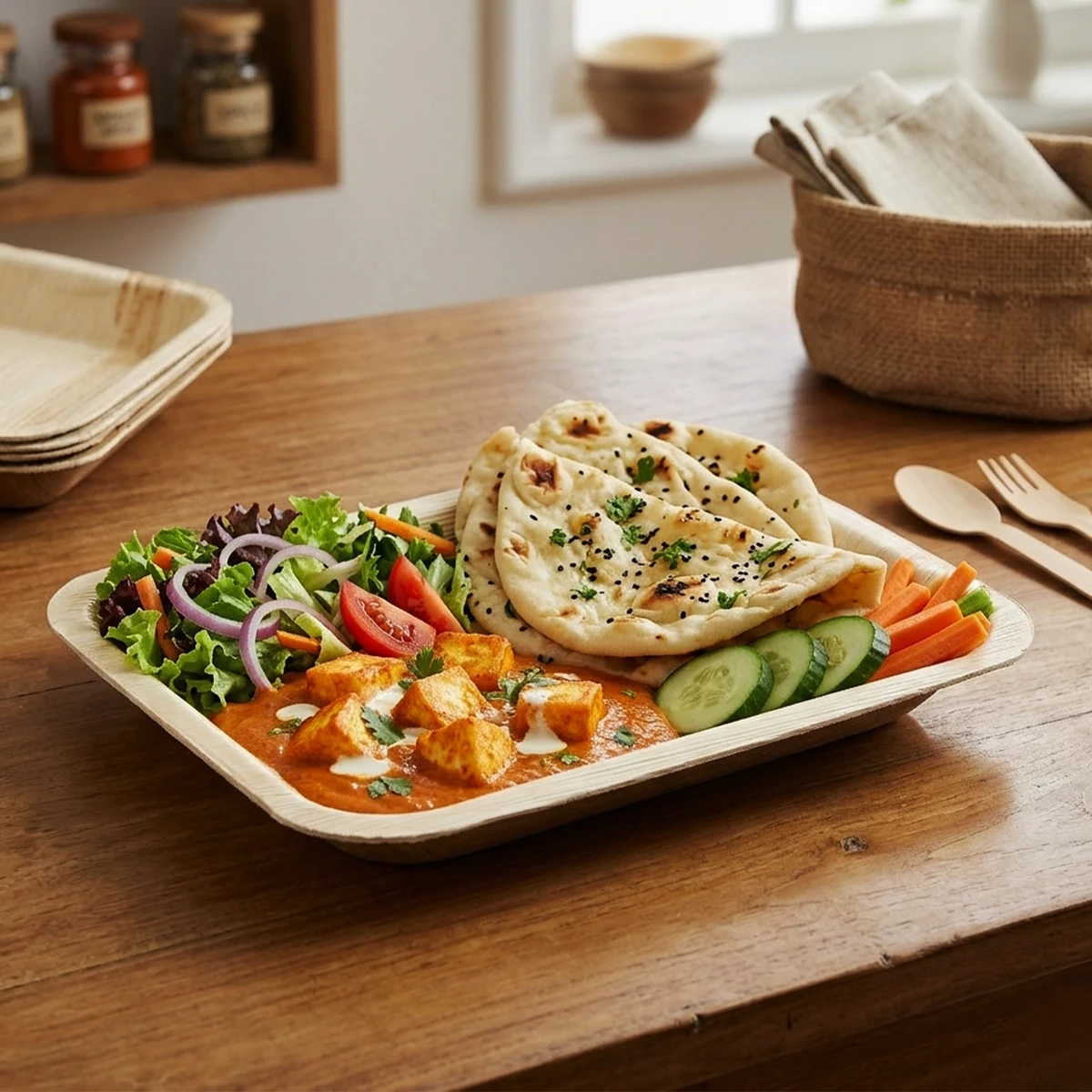
Experience Foliware's premium areca palm leaf tableware with a minimum order of just 1 carton. Ideal for first-time buyers, distributors, HoReCa businesses, and institutional procurement.
Experience Foliware's premium areca palm leaf tableware with a minimum order of just 1 carton. Ideal for first-time buyers, distributors, HoReCa businesses, and institutional procurement.
Directive (EU) 2019/904 bans single-use plastic plates and cutlery, and its definition of plastic excludes natural polymers that have not been chemically modified. An uncoated leaf plate therefore falls outside the ban. The Directive is transposed nationally, so the answer still differs by Member State, and France separately requires reusable tableware for dine-in service regardless of material.
Directive (EU) 2019/904 on the reduction of the impact of certain plastic products on the environment required Member States to transpose it by 3 July 2021. Article 5 requires Member States to prohibit the placing on the market of the single-use plastic products listed in Part B of the Annex, and of products made from oxo-degradable plastic. Part B includes cutlery, plates, straws, beverage stirrers, cotton bud sticks, balloon sticks and expanded polystyrene food and beverage containers and cups.
Plates and cutlery are on the banned list. That is why buyers assume the Directive is a problem for any disposable plate. The definition is what decides it.
Article 3, point (1) defines plastic as “a material consisting of a polymer as defined in point 5 of Article 3 of Regulation (EC) No 1907/2006, to which additives or other substances may have been added, and which can function as a main structural component of final products, with the exception of natural polymers that have not been chemically modified”.
The final clause is the whole argument. Cellulose and lignin in a leaf sheath are natural polymers. If they have not been chemically modified, the material is not plastic for the purposes of the Directive, and a plate made of it is not a single-use plastic product, whatever Part B says about plates.
Outside, on the Commission’s own reading, provided nothing is added that changes the analysis.
The Commission guidelines on single-use plastic products, published as Commission Notice 2021/C 216/01, address the point directly. They confirm that natural polymers that have not been chemically modified are not covered by the Directive because they occur naturally. They go further and address the substrate question that catches most fibre products: “paper- and board-based single-use products made only from paper- and board-based material and without a plastic lining or coating are not to be considered as single-use plastic products”.
The same guidelines set out the reverse case. Where a plastic coating or lining is applied to a paper, board or other substrate, “the final product is considered a composite product composed of more than one material of which one is plastic”, and the product falls within the scope of the Directive.
That gives you a single-question test you can apply to any fibre tableware offer in front of you.
| Product presented to you | Has a plastic lining or coating? | Status under Directive (EU) 2019/904 | What you should ask for |
|---|---|---|---|
| Pressed leaf plate, nothing applied | No | Not a single-use plastic product | Written composition and treatment statement naming the SKU |
| Paper or board plate, PE or PLA lined | Yes | Composite product partly made of plastic, in scope | Confirmation of the coating polymer and coat weight |
| Moulded pulp plate with a barrier coating | Depends on the coating | Turns on whether a plastic lining is present | Coating declaration, not a marketing sheet |
| Board plate described as “plastic free” | Unverified | Unknown until documented | The same composition statement, in writing |
Note what the test does not turn on: compostability, renewability, or how the product is marketed. A certified compostable product with a PLA lining is still a composite product containing plastic for the purposes of the Directive, because PLA is a polymer and a lining is a lining. What a compostability certificate does and does not prove is a separate question, covered in the analysis of what an EN 13432 compostability certificate proves.
Directive (EU) 2019/904 is a directive, not a regulation. It binds Member States as to the result and leaves them the form and methods. That produces three layers of variation that a buyer shipping into more than one country has to plan around.
Layer one: how the national instrument defines plastic. Ireland’s European Union (Single Use Plastics) (No. 2) Regulations 2021, S.I. No. 516 of 2021, made on 8 October 2021, construe “plastic” in accordance with the Directive and expressly include the guidelines published by the Commission. That is a helpful drafting choice for an importer, because it means the Commission’s reasoning about unmodified natural polymers and uncoated fibre products is imported into Irish law directly. Not every Member State drafted it that way. Enforcement in Ireland sits with the Environmental Protection Agency and the relevant local authority.
Layer two: who enforces and how. Germany implemented the market restrictions through the Einwegkunststoffverbotsverordnung, the regulation prohibiting the placing on the market of certain single-use plastic products and products made of oxo-degradable plastic. The German Federal Environment Agency confirms that the banned list includes disposable cutlery and plates, and that single-use paper or cardboard products coated or lined with plastic fall under the definition. The material question is the same as the Commission’s. The enforcement route and the language are German.
Layer three: national rules that go beyond the Directive. This is where a buyer gets caught, and France is the example that matters most.
France restricts single-use plastic items under Article L541-15-10 of the Code de l’environnement, and the French economy ministry’s guidance for businesses lists the dates on which each category became prohibited. Disposable cutlery and plates, including disposable cardboard plates carrying a plastic film, were caught in the 2020 to 2021 wave.
Then France did something the Directive does not require. From 2023, restaurants serving on site must use reusable tableware where the establishment can seat at least 20 covers at a time. The prohibition is on disposable tableware for eating in. It is not a prohibition on plastic.
Read that against a leaf plate and the conclusion is unwelcome but clear. An uncoated leaf plate is not a single-use plastic product under the Directive, and it is not caught by the French single-use plastic restrictions. It is still disposable tableware, so it does not solve a French dine-in operator’s problem. For a fast food chain in France serving meals on site, the compliant answer is reusable service ware, not a better disposable.
Where a leaf plate does remain relevant in France is takeaway, delivery, outdoor catering, festivals, banqueting off site and institutional settings outside the dine-in rule. That is a real and substantial market, and it is a different conversation from the one most suppliers try to have. What French operators actually buy after the AGEC reforms is set out in the guide to what French foodservice operators buy after AGEC.
Say the same thing in the other direction and it is a reason to buy. A buyer in Germany, the Netherlands, Ireland or Sweden supplying events, takeaway or banqueting is not facing a French-style dine-in rule, and an uncoated leaf plate answers the Directive cleanly where a lined board plate does not.
The Directive does not require a conformity document the way Regulation (EU) 2025/40 does. What you need is the ability to answer an enforcement question quickly.
Treat everything in this list as a position to confirm with your own competent authority or legal adviser before you rely on it commercially. National transpositions are amended, and an instrument that was accurate at the time of writing can be superseded.
Are areca leaf plates banned under the EU single-use plastics rules? No. Directive (EU) 2019/904 excludes natural polymers that have not been chemically modified from its definition of plastic, and the Commission guidelines confirm that fibre-based single-use products without a plastic lining or coating are not single-use plastic products. Confirm the position in each destination with the national competent authority.
What if the plate has a compostable PLA coating? Then it is a composite product containing plastic. The Commission guidelines state that where a plastic coating or lining is applied to a substrate, the final product falls within the Directive. Compostability does not remove a polymer from the definition.
Can I sell leaf plates to a French restaurant? For dine-in service in an establishment seating 20 or more at a time, French rules require reusable tableware, so a disposable plate of any material does not meet the requirement. Takeaway, delivery, events and off-site catering are a different position. Confirm the current rule with a French adviser before you quote.
Does the Directive still matter now that PPWR applies? Yes. Directive (EU) 2019/904 and Regulation (EU) 2025/40 are separate instruments with separate tests and separate obligation holders. Satisfying one does not satisfy the other.
Who enforces the single-use plastics rules on an importer? The national enforcement body in the Member State where the goods are placed on the market. In Ireland that is the Environmental Protection Agency together with the relevant local authority. In Germany it is enforced under the national prohibition regulation. Confirm the body for each of your destinations.
Is a supplier’s word that the product is plastic free enough for an enforcement officer? No. Ask for a composition and treatment statement naming the SKU and stating explicitly that no lining or coating is applied. An explicit negative is evidence. Silence is not.
Does the Directive apply in Norway? Norway is not an EU Member State and applies EU instruments through the European Economic Area framework on its own timetable. Confirm the position with the Norwegian competent authority rather than assuming the EU position transfers.
Lane, documentation and destination rules for the markets this article applies to. Each page carries the route, the paperwork set and the quotation route for that destination.
Each link below answers the question this article raises next, whether that is the rule behind a decision, the same question in another destination, or the commercial step that follows.
Send an enquiry naming the product, the volume and the destination, for example 25,000 units of the Reinforced Round Traditional Patravali Meal Plate, 12 inch round, delivered Dublin, and say which national transposition applies and whether the end use is dine-in, takeaway or event catering. That last line changes the answer in France and it changes which SKUs are worth quoting. Foliware India LLP will return the composition and treatment statement with the quotation.