
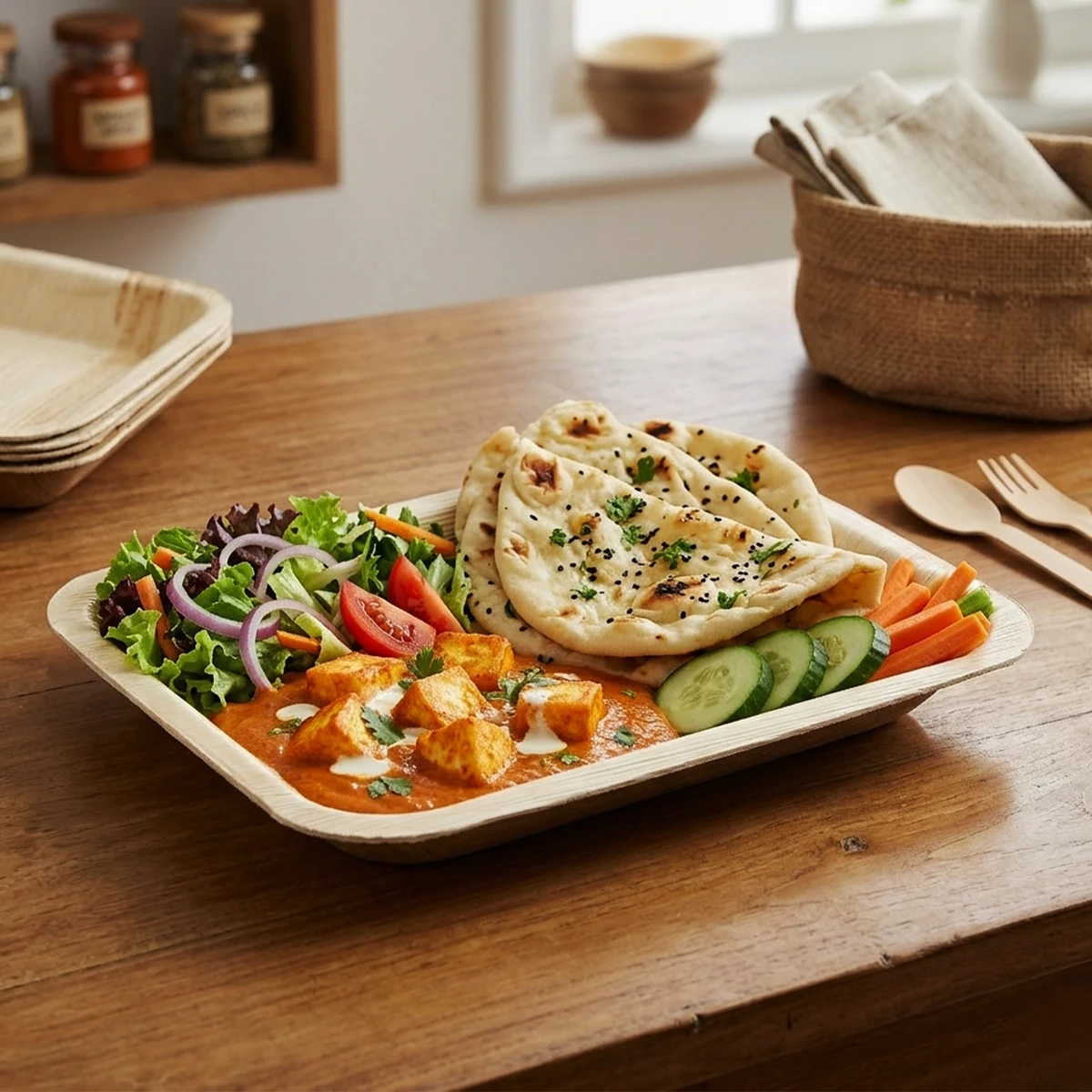
Start with a Trial Order 📦
Experience Foliware's premium areca palm leaf tableware with a minimum order of just 1 carton. Ideal for first-time buyers, distributors, HoReCa businesses, and institutional procurement.
Experience Foliware's premium areca palm leaf tableware with a minimum order of just 1 carton. Ideal for first-time buyers, distributors, HoReCa businesses, and institutional procurement.
The Food Safety and Standards Authority of India regulates tableware indirectly, through the food business operator who serves food on it. Schedule 4 of the Licensing and Registration Regulations requires disposable serving plates and cutlery to be of food grade material and dyes. The Packaging Regulations, 2018 require a certificate of conformity from a NABL accredited laboratory for materials in direct food contact. No Indian Standard covers areca leaf tableware.
A common misunderstanding costs Indian buyers weeks. There is no FSSAI licence for a tableware manufacturer as such. FSSAI licenses and registers food business operators. A company that forms leaf sheath into plates is not carrying on a food business, and it does not appear on the FSSAI register as a tableware maker.
The obligation lands on you, the caterer, hotel, canteen contractor, cloud kitchen or food court operator. If a food safety officer inspects, they inspect your premises against your licence conditions, and the tableware is evidence in your file rather than a licensable article in its own right.
That has a direct procurement consequence. You cannot discharge your duty by asking a supplier for their FSSAI number. You discharge it by holding the evidence that the material you serve on is food grade, which means test reports and a declaration, not a licence.
The Food Safety and Standards (Licensing and Registration of Food Businesses) Regulations, 2011 carry Schedule 4, the good hygiene and good manufacturing practice requirements. Part V applies to food business operators engaged in catering or food service operations, and FSSAI’s own guidance document for the catering sector, issued 19 January 2018 and built on Parts II and V of Schedule 4, sets out what that means in practice.
Two clauses decide a tableware specification.
On serving items, the guidance states that disposable serving plates, cutlery, serving spoons and similar items shall be of food grade quality, and that these items should be stored in clean containers to avoid contamination. The Schedule 4 text puts the same obligation as disposable serving plates, cutlery and other items such as straws and stirrers being clean, free from contamination, and made from food grade material and dyes only.
On wrapping, the guidance states that any form of newspaper or printed paper that is not food grade should not be used to serve or pack food, and that only food grade packaging materials shall be used.
Part V covers a wider set of operations than most buyers realise. It is written for eating houses, restaurants and hotels, snack bars, canteens and messes in schools, colleges, offices and institutions, food service at religious places, rail and flight catering, hospital catering and event catering. If you run any of those, clause 2.7.7 is your clause, and it applies whether the plate came from a national distributor or a local market.
The Food Safety and Standards (Packaging) Regulations, 2018, notified on 24 December 2018 under File No. 1-95/Stds/Packaging/SP(L&C/A)/FSSAI-2017 and amended on 25 January 2022, define food grade as material made of substances which are safe and suitable for their intended use, and which shall not endanger human health or result in an unacceptable change in the composition or organoleptic characteristics of the food.
Regulation 3(2) extends that to any material which comes into direct contact with food, or is likely to, used for packaging, preparation, storing, wrapping, transportation and sale or service of food. The words “or service of food” are what bring a serving plate inside the regulation’s general requirements.
The specific requirements then run by material. Schedule I lists Indian Standards for paper and board. Schedule II lists them for metals and alloys. Schedule III lists them for plastics. There is no schedule for plant fibre, leaf or bamboo articles.
Regulation 3(1) supplies the answer for a material with no Indian Standard: where Indian Standards are not available, relevant International Standards may be complied with. So the compliance route for an areca leaf plate is the general requirements plus analytical evidence, not conformity to a product standard that does not exist.
We could not identify a Bureau of Indian Standards product standard covering areca leaf tableware. If a supplier quotes one, ask for the IS number and check it against the BIS catalogue before you accept it.
Regulation 3(14) of the Packaging Regulations, 2018 states that every food business operator shall obtain the certificate of conformity issued by a NABL accredited laboratory against these regulations for the packaging material which comes into direct contact with food, or layers likely to come into contact with food, to be used. NABL is the National Accreditation Board for Testing and Calibration Laboratories.
Read that carefully, because three things follow.
The duty is yours, not the manufacturer’s. The regulation names the food business operator. A supplier can hand you the test reports that make the certificate obtainable. The certificate obligation sits with you.
Accreditation is the thing to verify, not the letterhead. A test report from an unaccredited laboratory does not satisfy a regulation that names NABL accreditation. Ask for the laboratory’s NABL certificate number and scope, and check that the tests you were given fall inside the accredited scope.
Reports go stale. A report is evidence about a batch and a period, not a permanent property of a material. Agree the retest interval in the supply contract rather than accepting a report dated three years ago. Which simulants and conditions a plant fibre article should actually be tested against is covered in migration testing for plant fibre tableware.
Foliware India LLP uses NABL accredited laboratory testing on production batches and supplies laboratory reports as part of a standing export document set alongside the commercial invoice, packing list, certificate of origin and phytosanitary certificate. Ask for the reports against the specific SKU you are buying, not a generic file.
The following is what to put in an RFQ so that the answers come back comparable and your Schedule 4 file is complete, alongside the wider HORECA buyer’s specification sheet. Every line is a document or a measurable fact rather than an adjective.
| What to ask for | Why it is in the file | What a weak answer looks like |
|---|---|---|
| Written material declaration naming every material in the article | Establishes food grade status and the absence of coatings, binders and dyes | “100 percent natural” with no composition statement |
| Test reports from a NABL accredited laboratory, against the SKU | Supports the regulation 3(14) certificate of conformity | Reports for a different size or an unnamed product |
| The laboratory’s NABL accreditation number and scope | Confirms the accreditation the regulation names | A report on plain letterhead |
| Declared service conditions with time and temperature limits | Your hot hold and reheat steps have to sit inside them | “Suitable for hot food” |
| Declaration that no dyes, inks or printing touch the food contact surface | Schedule 4 requires food grade material and dyes only | Silence |
| Food safety management certification of the manufacturing site | Evidence the process, not just the batch, is controlled | A certificate in a trading company’s name |
| Batch traceability and retest interval | Lets you close out a complaint and keep reports current | No batch coding |
Foliware operates to ISO 22000:2018 and ISO 9001:2015, which covers the food safety management line above. What ISO certification does and does not prove about an individual consignment is a separate question, and it is worth being clear that a system certificate is not a test result.
In 2026 FSSAI issued a draft amendment to the Packaging Regulations, 2018 proposing definitions for food contact material, non-intentionally added substances and food packaging. It is a draft. It has been circulated for comments and it is not in force.
Do not specify against a draft, and do not accept a supplier claim built on one. Check the current status on FSSAI’s draft notifications page before your next tender, because if the definitions are finalised in their proposed form they would describe a serving article as a food contact material directly rather than by extension, which is a cleaner position than the one the current text gives you.
A leaf plate has a real advantage in this file: a single uncoated plant material with no coating, lamination, ink or added dye gives you a short composition statement and a simple test set. That is a genuine procurement benefit.
It is not a free pass. A natural material carries batch variation, it has real service limits on hot and wet holding, and it needs the same declared conditions and the same current test reports as anything else. Where a specification demands an ovenable container, a long hot hold, or a liquid tight seal, a different material may be the right answer, and it is cheaper to establish that at specification stage than at a service failure. Areca, bagasse or thermocol compared for Indian buyers sets out where each one wins.
Does a tableware supplier need an FSSAI licence? FSSAI licenses food business operators. A manufacturer of disposable tableware is not carrying on a food business, so there is normally no FSSAI licence covering the article itself. The obligation to use food grade serving items sits on the caterer, hotel, canteen or kitchen operating under an FSSAI licence or registration.
Which FSSAI rule says disposable plates must be food grade? Schedule 4 of the Food Safety and Standards (Licensing and Registration of Food Businesses) Regulations, 2011, in the part applying to catering and food service operations, requires disposable serving plates, cutlery and similar items to be clean, free from contamination and made from food grade material and dyes only. FSSAI’s catering sector guidance document restates it.
Is there an Indian Standard for areca leaf plates? We could not identify a Bureau of Indian Standards product standard covering areca leaf tableware, and the Packaging Regulations schedules list Indian Standards only for paper and board, metals and plastics. Regulation 3(1) provides that where Indian Standards are not available, relevant International Standards may be complied with.
What is the NABL certificate of conformity and who obtains it? Regulation 3(14) of the Food Safety and Standards (Packaging) Regulations, 2018 requires every food business operator to obtain a certificate of conformity from a NABL accredited laboratory for packaging material in direct contact with food. The duty is on the food business operator. The supplier’s role is to provide test data against the specific product.
Can I rely on my supplier’s ISO 22000 certificate instead of test reports? No. ISO 22000:2018 is a food safety management system certification covering how a site controls its process. It is not a test result for a batch of product, and it does not substitute for the analytical evidence behind a certificate of conformity. Ask for both and understand what each one proves.
Does the 2026 draft packaging amendment change what I must do today? No. A draft circulated for comments has no legal effect until it is notified. Specify against the Packaging Regulations, 2018 as they currently stand, and check FSSAI’s draft notifications page before your next tender cycle so that a change does not reach you after a contract is signed.
Are printed or dyed disposable plates allowed? Schedule 4 requires disposable serving items to be made from food grade material and dyes only, and FSSAI’s catering guidance states that printed paper which is not food grade should not be used to serve or pack food. If a plate carries printing, get written confirmation that the ink is food grade and does not contact the food surface.
Lane, documentation and destination rules for the markets this article applies to. Each page carries the route, the paperwork set and the quotation route for that destination.
Each link below answers the question this article raises next, whether that is the rule behind a decision, the same question in another destination, or the commercial step that follows.
Send the product, the annual volume, the delivery location and the service conditions the item has to survive. For example, 12 inch Reinforced Round Traditional Patravali Meal Plates, 250,000 pieces a year, delivered to a contract catering operation in Hyderabad, hot rice and sambar held to 65 degrees Celsius for up to 90 minutes. The reply comes back with the material declaration, the NABL accredited laboratory reports against that SKU and the declared service limits, which is the evidence your Schedule 4 file needs. See supply into the Indian market or send the enquiry .