
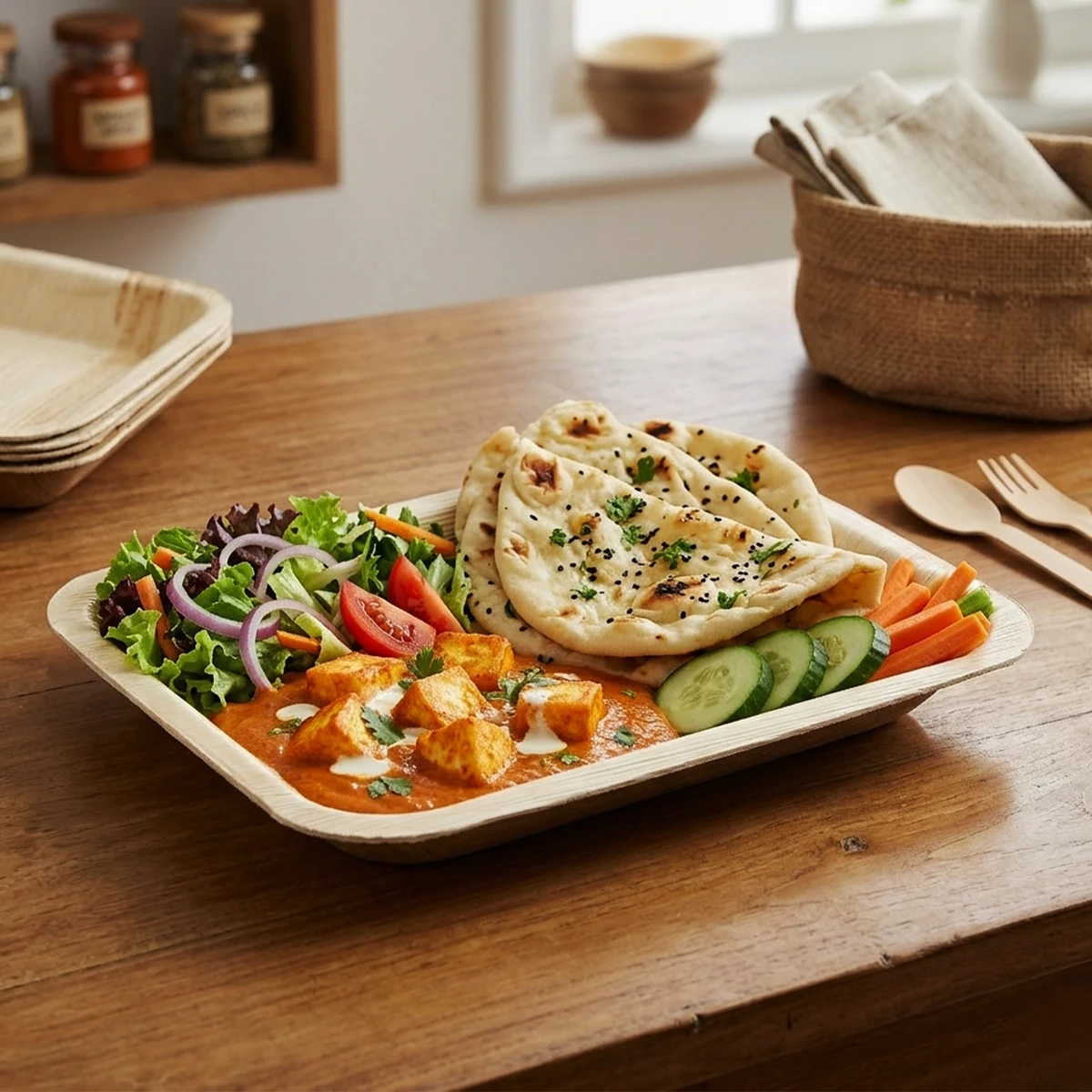
Start with a Trial Order 📦
Experience Foliware's premium areca palm leaf tableware with a minimum order of just 1 carton. Ideal for first-time buyers, distributors, HoReCa businesses, and institutional procurement.
Experience Foliware's premium areca palm leaf tableware with a minimum order of just 1 carton. Ideal for first-time buyers, distributors, HoReCa businesses, and institutional procurement.
Commission Regulation (EU) No 10/2011 sets the EU migration testing system, and it applies to plastics, not to plant fibre. For a leaf or fibre plate the legal test is Article 3 of Regulation (EC) No 1935/2004 plus national provisions, and the 10/2011 simulant system is used as method rather than as law. That distinction decides how you write the test brief.
Regulation (EU) No 10/2011 states in Article 1 that it is a specific measure within the meaning of Article 5 of Regulation (EC) No 1935/2004, and its Article 2 scope is plastic materials and articles: articles made exclusively of plastics, plastic multi-layer materials, printed or coated plastics, plastic gaskets and plastic layers in multi-material multi-layer materials. A pressed areca leaf plate is none of those things.
What governs it instead is the framework. Article 3 of Regulation (EC) No 1935/2004 requires that materials and articles do not transfer their constituents to food in quantities which could endanger human health, bring about an unacceptable change in the composition of the food, or bring about a deterioration in its organoleptic characteristics. Article 6 preserves national provisions where there is no EU specific measure, and the European Commission confirms that national legislation exists in most Member States and differs between them.
The honest framing for a plant fibre test programme follows from that. You are not testing for pass or fail against a harmonised limit, because none applies to the material. You are building evidence for an Article 3 assessment using the most credible available methodology, which happens to be the one written for plastics.
Two consequences follow. First, the numerical limits in Regulation (EU) No 10/2011, including the overall migration limit of 10 milligrams per square decimetre of food contact surface in Article 12 and the generic specific migration limit of 60 milligrams per kilogram in Article 11, are reference points rather than the legal threshold for your product. Second, the organoleptic limb of Article 3 is the one most often missing from a laboratory report. A plate that transfers taste or odour to food fails Article 3 even if every migration number is low.
Annex III of Regulation (EU) No 10/2011 sets the food simulant list. These are the six substances a laboratory uses, whatever the material in front of it.
| Simulant | Composition | Food types it stands in for |
|---|---|---|
| A | Ethanol 10 percent by volume | Hydrophilic foods, aqueous and non-acidic |
| B | Acetic acid 3 percent by weight per volume | Acidic foods below pH 4.5 |
| C | Ethanol 20 percent by volume | Foods with a modest alcohol or organic content |
| D1 | Ethanol 50 percent by volume | Oil in water emulsions, dairy, alcoholic products above 20 percent |
| D2 | Any vegetable oil containing less than 1 percent unsaponifiable matter | Fatty foods, free fat on the surface |
| E | Poly(2,6-diphenyl-p-phenylene oxide), particle size 60 to 80 mesh, pore size 200 nanometres | Dry foods |
For foodservice tableware, most real use cases reduce to a small set. A curry or stew is aqueous with fat and acid, which usually means A or B plus D2. A dry snack is E. A salad with vinaigrette is B and D2. A hot rice meal is A at elevated temperature. Decide which your customers actually serve before agreeing a test matrix, because a test in D2 alone tells you nothing about a market whose main dish is aqueous.
Migration is a transport process. More time and more heat move more material, so a test run at ambient for two hours is not evidence about a plate holding a hot curry for forty minutes under a lamp.
The European Union Reference Laboratory for Food Contact Materials addresses exactly this problem. Its technical guidelines on testing conditions for kitchenware articles, published by the Joint Research Centre in 2023 as report JRC134290, note that kitchenware is typically placed in contact with food at home, so defining the worst foreseeable conditions of use is a challenge. The EURL and the National Reference Laboratories of the network agreed a set of contact temperatures and contact times to answer it. The guidelines cover paper and board as well as plastics, metals, silicone and rubber, which makes them the closest available reference point for a fibre article.
Use that as your anchor, then be explicit about your own worst case: the hottest dish served on the plate, held for the longest period it is realistically held, with the most aggressive food chemistry in the range. Write that sentence down before you contact a laboratory. It is the most useful line in the brief.
Run these seven steps in order. Each depends on the one above it, and skipping step one is why reports come back useless.
Steps 6 and 7 are where reports become non-comparable between suppliers. If you are tendering across leaf, pulp and board, issue the same brief to every supplier or commission the tests yourself. The way to hold the rest of that comparison steady is set out in the guide to running a like-for-like tender between leaf, pulp and board suppliers.
For a material with no EU specific measure, the destination market decides what else the report addresses.
| Market | What to reference in the brief |
|---|---|
| Netherlands | The Warenwetregeling verpakkingen en gebruiksartikelen designates materials including hout en kurk, wood and cork, and requires a written declaration at all stages of the trade chain except retail. The test file has to support that declaration |
| Germany | The BfR Recommendations are not binding legal standards, but the Bundesinstitut für Risikobewertung states that they represent the current state of science and technology for fulfilling Article 3(1)(a) of Regulation (EC) No 1935/2004. Ask whether one covers the material and reference it |
| France and Sweden | Confirm the applicable national provisions with the competent authority before finalising the brief, because they differ from the Dutch and German positions |
Whatever the market, have your own legal adviser or competent authority confirm the requirement before you rely on a report commercially. A laboratory answers the question you asked, not the question you should have asked.
Two honest observations from the buying side.
Over-testing is common on dry service. If your customer serves dry snacks at ambient temperature on a plate used once and binned, a full six-simulant matrix at elevated temperature answers a question nobody asked. Simulant E and a sensory assessment may be proportionate.
Under-testing is common on organoleptics and on hot fatty service. Buyers commission overall migration in a single simulant, get a low number, and stop. The two failure modes an end user actually notices are taste transfer and softening under hot wet food, and neither is captured by a single ambient overall migration figure. A protocol that puts the real dish on the real plate is the cheap complement to a laboratory report, and it is set out in the guide to what to test when the sample carton arrives.
There is also a case for not commissioning anything yet. At sample stage with three suppliers and no volume commitment, run the practical evaluation first, shortlist to one, then commission the test against that supplier’s article. Test reports are article-specific, so paying for three is usually two too many. Getting the samples in to do that is covered in the guide to getting samples to Europe.
Does Regulation (EU) 10/2011 apply to areca leaf plates? No. Article 2 of Commission Regulation (EU) No 10/2011 scopes it to plastic materials and articles. A plant fibre plate is governed by Article 3 of Regulation (EC) No 1935/2004 and by national provisions preserved under Article 6. The 10/2011 simulants are used as methodology, not as the governing law.
Which simulants should I ask for on a plate for hot curry? Typically simulant A for the aqueous phase and simulant D2 for the fat, with simulant B instead of A if the dish is below pH 4.5. Set the contact temperature and time from the hottest and longest real service you can identify, and say so in the brief.
What overall migration limit does a leaf plate have to meet? There is no harmonised limit for the material. The 10 milligrams per square decimetre figure in Article 12 of Regulation (EU) No 10/2011 is the plastics limit and is widely used as a reference point. Treat a result as evidence for an Article 3 assessment and confirm the position with your competent authority.
Does the test report have to cover taste and odour? Article 3 of Regulation (EC) No 1935/2004 includes deterioration of the organoleptic characteristics of the food. A report with no sensory assessment leaves that limb unanswered, so specify it in the brief rather than assuming it.
Which laboratory should I use? One accredited for the specific method rather than generally, ideally with experience of non-plastic fibre articles. The European Union Reference Laboratory for Food Contact Materials coordinates a network of National Reference Laboratories, and your national laboratory is a good starting point for identifying competent testing houses.
Can the Indian manufacturer commission the test? Yes, and Foliware India LLP can arrange testing against a brief you write. A buyer-written brief is worth more than a supplier-chosen one, because the conditions then match your use case. Agree who pays and who owns the report before the sample ships.
How does this relate to the PPWR PFAS evidence? It does not replace it. PFAS limits under Regulation (EU) 2025/40 are a separate requirement with a separate test cascade, set out in the guide to PFAS limits and substances of concern under PPWR. A migration report does not answer it.
Lane, documentation and destination rules for the markets this article applies to. Each page carries the route, the paperwork set and the quotation route for that destination.
Each link below answers the question this article raises next, whether that is the rule behind a decision, the same question in another destination, or the commercial step that follows.
Send an enquiry naming the product, the volume and the destination, for example 35,000 units of the Reinforced Round Traditional Patravali Meal Plate, 12 inch round, delivered Le Havre, and add the food types and the maximum contact temperature and time your customers use. Those lines turn a generic test into a report your quality team can rely on, and they populate the conditions of use field in the declaration of compliance .