
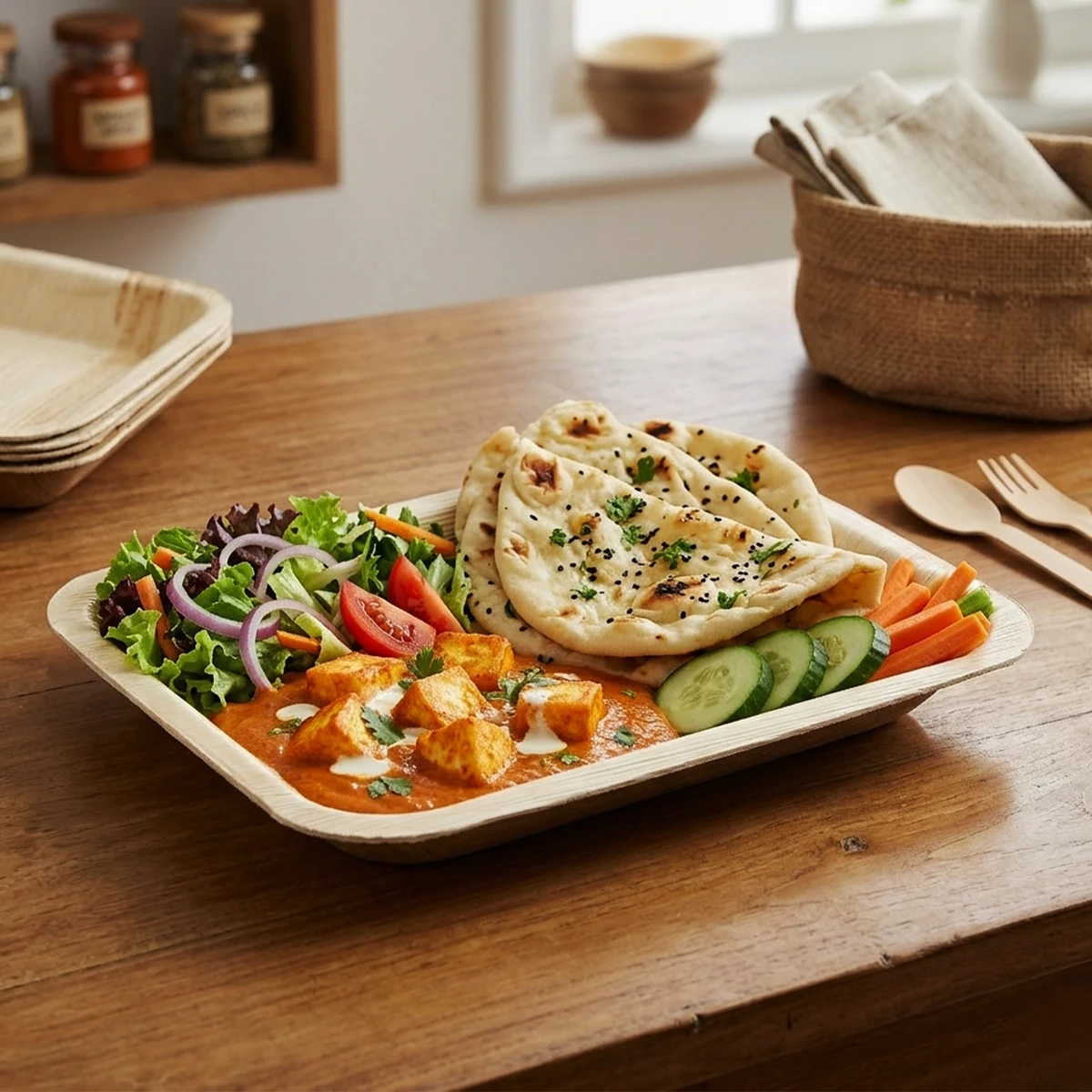
Start with a Trial Order 📦
Experience Foliware's premium areca palm leaf tableware with a minimum order of just 1 carton. Ideal for first-time buyers, distributors, HoReCa businesses, and institutional procurement.
Experience Foliware's premium areca palm leaf tableware with a minimum order of just 1 carton. Ideal for first-time buyers, distributors, HoReCa businesses, and institutional procurement.
Dutch packaging extended producer responsibility begins with a weight, not a form. Producers and importers placing more than 50,000 kilogrammes of packaging a year on the Dutch market must register with Verpact, which operates Afvalfonds Verpakkingen, and file an annual declaration by 1 April for the previous calendar year. Below that weight there is generally no filing or payment, but you must still prove you are below it.
Germany asks you to register first and work out the money afterwards. The Netherlands asks the opposite question: how many kilogrammes of packaging did your company put on the Dutch market last year? Everything else follows from the answer.
The legal basis is the Besluit beheer verpakkingen 2014, the Dutch packaging management decree, together with the Afvalbeheerbijdrageovereenkomst Verpakkingen 2023-2027, the waste management contribution agreement that gives the arrangement effect. Afvalfonds Verpakkingen collects the afvalbeheerbijdrage, the waste management contribution, and it is priced by material and packaging type.
Importing counts. Dutch government guidance is explicit that a business bringing goods into the Netherlands and removing more than 50,000 kg of packaging a year is in scope, as is a business selling to Dutch consumers from abroad. So a distributor importing areca leaf tableware from India is looking at the corrugated cartons, the inner bags, the tape, the labels, the stretch wrap and the pallets, not at the plates. The Reinforced Round Traditional Patravali Meal Plate is the product; what it travels in is the packaging.
This is arithmetic a buyer can run before the first container is booked, and it is worth running because the answer decides which of two completely different compliance regimes you are in.
Work per stock keeping unit, then add the SKUs together.
Two things fall out of doing this properly. First, the pallet and wrap are frequently the larger share for a light, bulky product, and a buyer who only counted cartons can sit on the wrong side of 50,000 kg without knowing it. Second, the same numbers are what every other European scheme will ask you for, so the exercise is not Netherlands specific work. The list to send a supplier, and the wording that gets it back in a usable form, is in the supplier data you need before you can file an EPR return. Container level volumetrics that feed the same model sit in asking a supplier for container loading data.
If you are re-exporting from a Dutch warehouse rather than selling into the Netherlands, the calculation changes, and that scenario is covered in the Netherlands as an EU distribution hub.
Being below 50,000 kg is not the same as having nothing to do. Dutch guidance is that a company under the threshold must document the calculation showing it falls below, and that quantities can be audited.
In practice that means a file containing the per component weights you used, the packing specification they came from, the unit volumes for the year, and the arithmetic. Verpact’s policy requires records to be kept for seven calendar years, organised so that an inspection can follow the design and operation of the administration. A spreadsheet with no source documents behind it is not that file.
The unhelpful but accurate version: the work needed to prove you are under the threshold is most of the work needed to declare if you are over it. Build the file once.
The Dutch cycle is not a single annual filing. It is an estimate, a set of payments against that estimate, and then a reconciliation.
| Stage | What it is | Timing |
|---|---|---|
| Opgaaf | Your estimate of the packaging quantities you will place on the Dutch market in the current calendar year, entered in PackTool | Before and during the year it relates to; Verpact asks declarants to check it remains representative and to adjust it themselves in PackTool if circumstances change |
| Advance payments | Instalments toward the contribution, calculated from the opgaaf | During the year |
| Aangifte | The final annual declaration of actual quantities placed on the Dutch market in the previous calendar year, signed and submitted | Before 1 April of the following calendar year |
| Reconciliation | The difference between what the estimate produced and what the declaration shows | After the aangifte |
The consequence for a first year importer is that the cash effect is front loaded against a forecast you make before you have any history. Under-forecast and you take a correction. Over-forecast and you have funded the scheme in advance. Neither is fatal, but a finance team that was told “an annual EPR filing” and budgeted for a single payment in year two will be surprised in year one.
Since 12 August 2026 the producer definition in Regulation (EU) 2025/40, the Packaging and Packaging Waste Regulation, applies. Verpact’s guidance for the 2026 cycle is that responsibilities were unchanged until 11 August 2026 and that the new producer definition applies from 12 August 2026, so a 2026 opgaaf made under the old rules may no longer describe your position. Check it rather than assuming it rolled over.
Single-use plastic packaging does not benefit from the 50,000 kg exemption. A business distributing SUP items such as drink cans, plastic beverage bottles or other single-use plastic packaging must register with Verpact regardless of quantity.
For an untreated leaf product this usually turns on the transit materials rather than the product. Polythene inner bags, shrink film and stretch wrap are the components to check. Ask your supplier to state the plastic components separately by weight and confirm whether any of them fall within the Dutch SUP definitions, and put the answer to Verpact in writing rather than deciding it yourself.
Dutch government guidance describes a refund route for businesses that export packaged products, subject to conditions including a minimum annual export volume. For an operator using Rotterdam as an entry point and shipping onward into Germany, France or the Nordics, that is potentially material, because contributions paid on packaging that leaves the Netherlands should not be carried twice.
Do not model a refund from a summary. The conditions, the evidence standard and the current minimum should come from Verpact directly, and a tax adviser or customs broker should confirm how the claim interacts with your VAT and customs position before you build it into a landed cost. The wider model is set out in building a landed cost model for a first container into Rotterdam or Hamburg.
Do I register with Verpact or with Afvalfonds Verpakkingen? They are the same organisation for this purpose. Afvalfonds Verpakkingen operates under Verpact, and registration and declaration are handled through Verpact’s PackTool system.
Is the 50,000 kg threshold measured on the product or the packaging? On the packaging. Plates, cutlery or bowls are the product. Cartons, liners, tape, labels, stretch film and pallets are the packaging, and only those weights count toward the threshold.
I am under 50,000 kg. Do I need to tell anyone? Generally there is no obligation to file or pay below the threshold, but you must be able to show the calculation that puts you below it, and quantities can be audited. Keep the per component weights, the packing specification and the volume figures for seven calendar years.
When is the Dutch annual declaration due? The aangifte must be correctly and completely submitted, signed digitally, before 1 April of the calendar year following the one it reports on.
Does my Indian supplier register in the Netherlands? Not in the ordinary structure. The obligation sits with the party placing the packaging on the Dutch market, which is the Dutch importer or the foreign seller selling directly to Dutch customers. An exporter selling to a Dutch importer is not that party. The full decision tree is in who registers for EPR when you import from India.
Does the Netherlands require a mark on the pack the way France does? No. There is no Dutch equivalent of the Triman and Info-tri obligation. Dutch compliance is a registration and declaration exercise, which is why the French requirement catches buyers who assume the two markets work the same way.
Lane, documentation and destination rules for the markets this article applies to. Each page carries the route, the paperwork set and the quotation route for that destination.
Each link below answers the question this article raises next, whether that is the rule behind a decision, the same question in another destination, or the commercial step that follows.
Send an enquiry naming the product, the annual volume and the Dutch delivery point: for example, the Reinforced Round Traditional Patravali Meal Plate, 60,000 pieces for Rotterdam. Include the expected annual tonnage you intend to place on the Dutch market, or tell us you need the component weights to work it out, and the quotation will come back with carton, liner, wrap and pallet weights listed separately so the threshold calculation can be run before you commit. See export capability for the Dutch market or send the RFQ .