
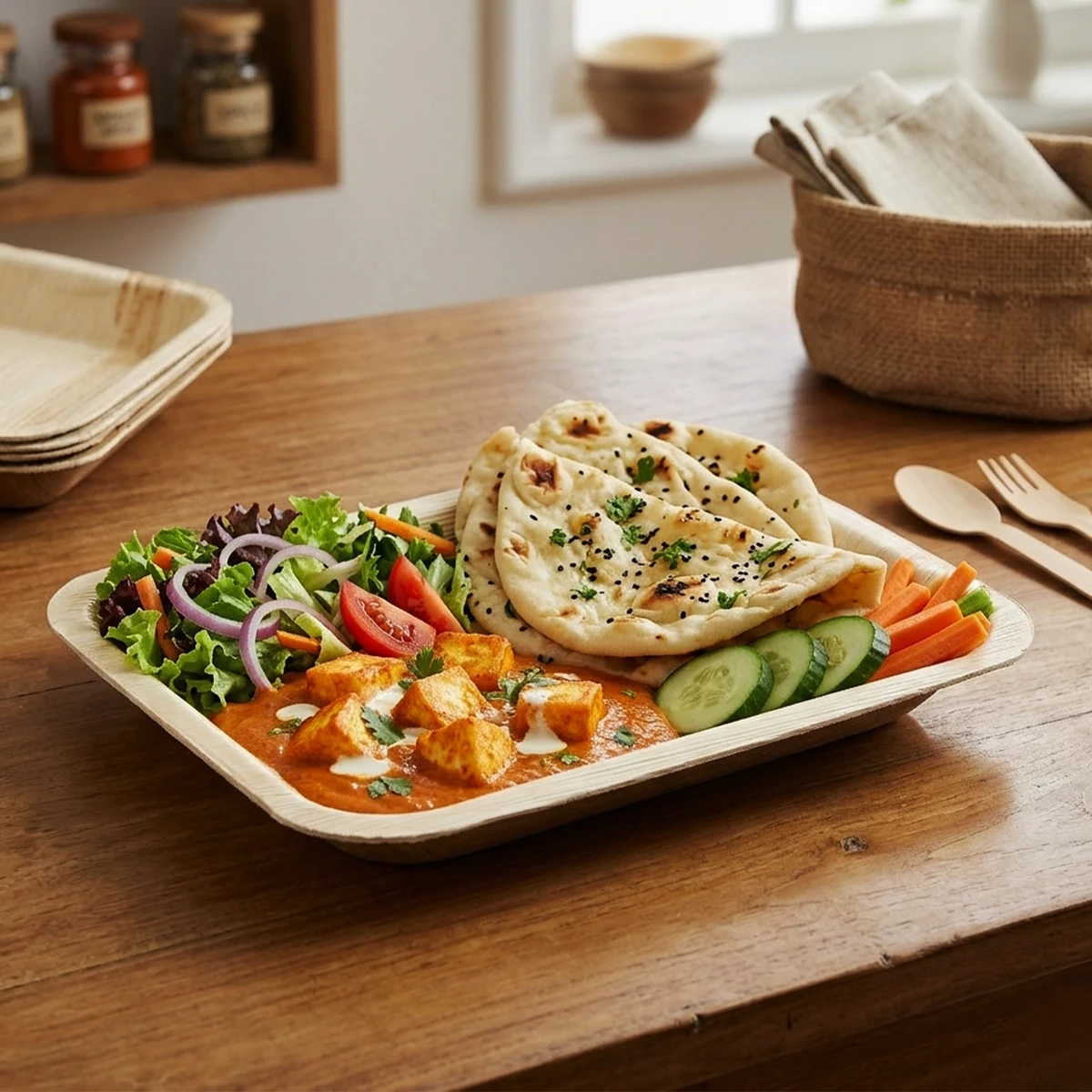
Start with a Trial Order 📦
Experience Foliware's premium areca palm leaf tableware with a minimum order of just 1 carton. Ideal for first-time buyers, distributors, HoReCa businesses, and institutional procurement.
Experience Foliware's premium areca palm leaf tableware with a minimum order of just 1 carton. Ideal for first-time buyers, distributors, HoReCa businesses, and institutional procurement.
A phytosanitary certificate confirms a plant-derived consignment
meets the importing country’s plant health requirements. It does not
certify food safety, product quality or manufacturing standards.
Requirement varies by destination. Australia’s biosecurity system
evaluates plant products against conditions set per commodity, so buyers
there must confirm the current position rather than assume one. It is
applied for through India’s plant quarantine authority before shipment,
once the consignment is packed.
A phytosanitary certificate is a plant health document. It states
that a consignment of plant-derived material has been inspected and
meets the importing country’s requirements for pests, disease and plant
health risk. That is the entire scope of what it covers.
It does not attest to food safety. It does not confirm the product
meets a food contact material standard. It does not indicate anything
about manufacturing quality, hygiene practice, or test results for
microbiological or heavy metal content. Those are separate
certifications and declarations, covered elsewhere in Foliware’s
documentation, and a phytosanitary certificate is not a substitute for
any of them.
| Destination | Position | Basis |
|---|---|---|
| UAE and GCC | Not confirmed either way by a verified source | Confirm with the importer’s customs and plant health authority before assuming a position |
| UK | Not confirmed either way by a verified source | Confirm with the importer’s plant health authority before assuming a position |
| Ireland | Not confirmed either way by a verified source | Confirm with the importer’s plant health authority before assuming a position |
| Australia | Confirmed as a live regulatory area. Plant-derived products for human consumption are assessed under a dual legislative basis, with the specific conditions for a given commodity determined in Australia’s biosecurity import conditions system |
DAFF, importing plant products for human consumption; BICON |
| Germany | Not confirmed either way by a verified source | Confirm with the importer’s plant health authority before assuming a position |
| Netherlands | Not confirmed either way by a verified source | Confirm with the importer’s plant health authority before assuming a position |
| France | Not confirmed either way by a verified source | Confirm with the importer’s plant health authority before assuming a position |
| Sweden | Not confirmed either way by a verified source | Confirm with the importer’s plant health authority before assuming a position |
| Denmark | Not confirmed either way by a verified source | Confirm with the importer’s plant health authority before assuming a position |
| Norway | Not confirmed either way by a verified source | Confirm with the importer’s plant health authority before assuming a position |
Australia stands apart in this table not because the other nine
destinations are confirmed to have no requirement, but because Australia
is the only one where a specific, sourced regulatory position exists.
Silence in the other rows means the position has not been located in a
verifiable source, not that it has been checked and ruled out.
The Department of Agriculture, Fisheries and Forestry’s framework for
importing plant products for human consumption sits on two pieces of
legislation working together, and it does not set one blanket rule for
all plant-derived goods. The specific import conditions attached to a
given commodity are determined inside BICON, Australia’s biosecurity
import conditions system, on a commodity by commodity basis.
This means the correct way to answer whether areca leaf tableware
needs a phytosanitary certificate into Australia is to look up the
commodity in BICON at the time of shipment, not to reason from what a
similar plant material required previously, and not to assume the answer
stays fixed once checked. Import conditions in a commodity by commodity
system can be updated, so a position confirmed for an earlier shipment
is a starting point for the next one, not a permanent answer.
In India, a phytosanitary certificate is applied for through the
plant quarantine authority once the consignment is packed and ready for
inspection. The certificate follows inspection of the actual physical
consignment, not the product specification on paper, which is why it is
arranged per shipment rather than obtained once and reused across
multiple orders.
This has a practical consequence for timing. Because the certificate
depends on inspecting the packed goods, it sits late in the shipment
cycle, after production and packing are complete and before the goods
leave for the port. Buyers in a market where this certificate applies
should factor that step into their expected lead time rather than assume
it runs in parallel with production from day one.
Of Foliware’s ten approved export markets, only Australia has a
specific, sourced position on phytosanitary requirements for
plant-derived products, and even that position is determined per
commodity rather than fixed. For UAE and GCC, UK, Ireland, Germany,
Netherlands, France, Sweden, Denmark and Norway, no verified source
confirms a phytosanitary requirement for this product either way.
Buyers in those nine markets should raise the question with their own
import compliance contact or customs broker before their first order,
rather than treating the absence of a stated requirement here as
confirmation that none exists. This article states what has been
verified and is explicit about what has not, rather than filling the gap
with an assumption in either direction.
Does every export destination require a phytosanitary
certificate for areca leaf tableware? No. It is confirmed as a
live requirement only for Australia among Foliware’s approved markets,
and even there the specific position is determined per commodity. The
other nine markets have no verified position either way.
What does a phytosanitary certificate actually
certify? Plant health only: that the consignment meets the
importing country’s requirements for pests and disease risk in
plant-derived material. It does not cover food safety, food contact
suitability or manufacturing quality.
Why is Australia different? Australia’s biosecurity
framework for plant-derived products for human consumption determines
import conditions per commodity inside its BICON system, rather than
applying one rule to all plant material. That makes Australia’s position
both confirmed to exist and specific enough that it must be checked at
the time of shipment.
Who applies for the certificate? India’s plant
quarantine authority, applied for once the consignment is packed and
ready for inspection. It is arranged per shipment, since the certificate
follows inspection of the actual goods.
If my destination is not Australia, do I need to worry about
this at all? Raise it with your own import compliance contact
before your first order. The absence of a confirmed requirement in the
source material is not the same as a confirmed absence of one.
Department of Agriculture, Fisheries and Forestry, Australia
Food, drink and supplements, importing plant products for human
consumption
https://www.agriculture.gov.au/biosecurity-trade/import/goods/plant-products/importing-plant-products-for-human-consumption
Supports: the dual legislative basis for importing plant-derived
products into Australia
Australian Government, DAFF Welcome to BICON
https://bicon.agriculture.gov.au/ Supports: that BICON is the official
system determining specific import conditions for a given commodity,
cited to explain why Australia’s position is checked per commodity
rather than assumed fixed
Lane, documentation and destination rules for the markets this article applies to. Each page carries the route, the paperwork set and the quotation route for that destination.
Each link below answers the question this article raises next, whether that is the rule behind a decision, the same question in another destination, or the commercial step that follows.
Send the product, the volume and the destination. A quotation follows within one business day.