
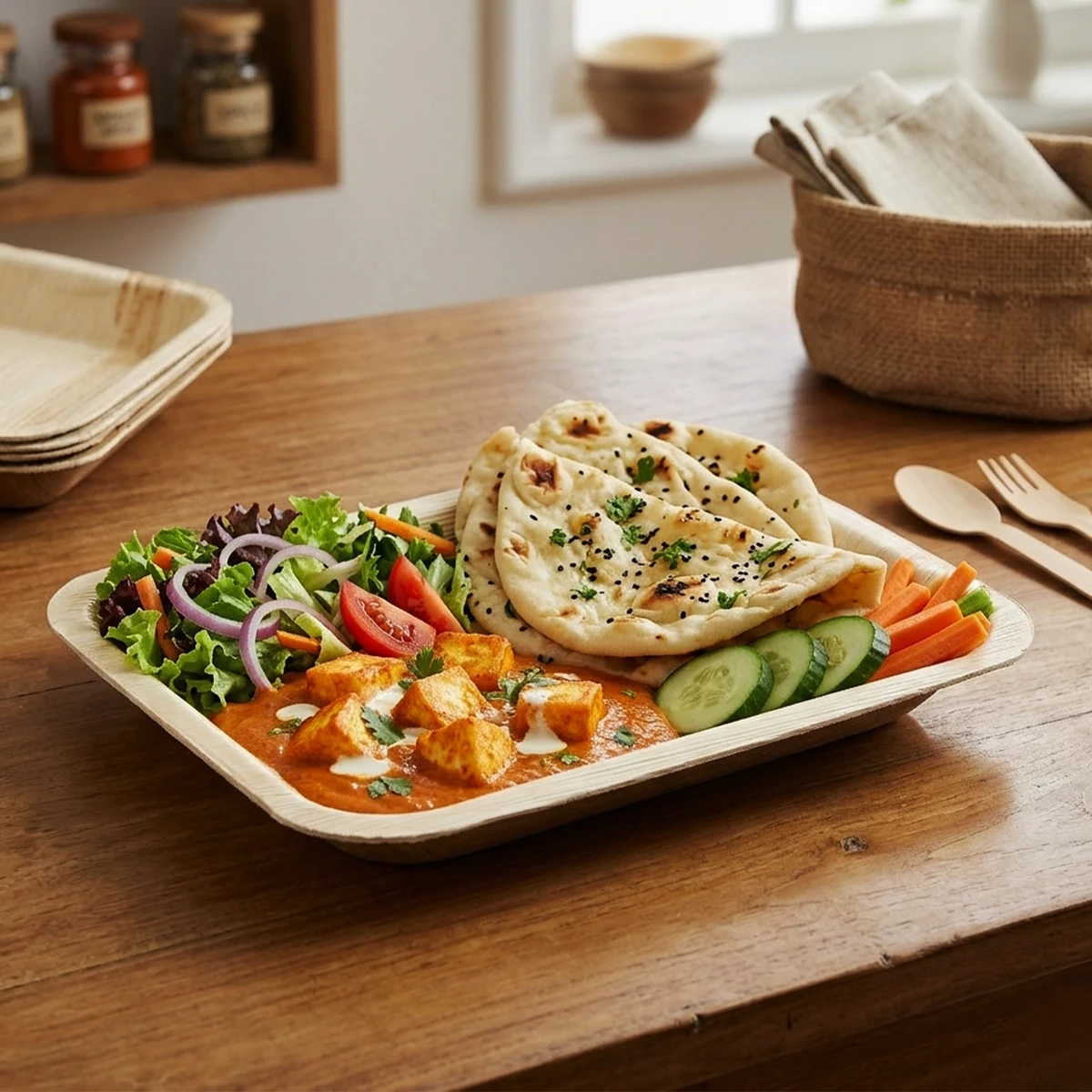
Start with a Trial Order 📦
Experience Foliware's premium areca palm leaf tableware with a minimum order of just 1 carton. Ideal for first-time buyers, distributors, HoReCa businesses, and institutional procurement.
Experience Foliware's premium areca palm leaf tableware with a minimum order of just 1 carton. Ideal for first-time buyers, distributors, HoReCa businesses, and institutional procurement.
LCL, less than container load, means your shipment shares vessel
space with other consignments and is charged by the cubic metre it
occupies. FCL, full container load, means you pay for the whole
container regardless of how full it is. There is no fixed volume at
which one becomes better than the other; it depends on your shipment’s
CBM against your forwarder’s FCL rate on your specific lane. Foliware’s
LCL minimum is 1 CBM.
There is no single government or standards body that defines LCL and
FCL as legal terms. They are trade practice: LCL is a shared container
where your goods are consolidated with other shippers’ cargo and charged
by volume, and FCL is a container booked exclusively for your shipment
and charged as a flat unit regardless of how much of it you actually
fill.
Because these are practice terms rather than regulated ones, the
exact minimum and pricing structure varies by forwarder and by lane.
Foliware’s own LCL minimum is 1 CBM, meaning a shipment below that
volume is not offered as a standalone consolidated booking.
The variable that matters here is cubic metres, not the number of
cartons, the number of formats, or the value of the order. Two orders of
identical value can occupy very different volumes depending on what is
in them, and freight in both LCL and FCL is priced against space, not
against value. This is why the decision method below starts and ends
with CBM.
Work this out once your forwarder has confirmed the carton dimensions
for your order, since those figures vary by format and are not fixed
across the whole range.
This method works the same way whether your order is one format or
several. What changes with more formats is only the total CBM you are
summing in step 3.
LCL cost is driven by the volume you occupy, consolidation handling
charges at both the origin and destination ports, and the forwarder’s
minimum chargeable volume, which is why very small shipments are quoted
at a floor rather than at their literal CBM. Foliware’s own minimum of 1
CBM exists for the same reason: below that volume, consolidation
handling costs more relative to the shipment than it is worth
arranging.
FCL cost is a fixed block: you pay for the container whether it is
half full or completely full. There is no consolidation handling charge
at either end, because nobody else’s cargo shares the space, but the
fixed cost means FCL only wins on a per-unit basis once your CBM is high
enough to spread that fixed cost thinly.
ISO 668:2020 is the international standard that classifies freight
containers and sets their external dimensions and ratings. It confirms
what a 20 foot or 40 foot container actually is as a physical unit. It
does not set pricing, and it does not tell you how many cartons of any
given product fit inside one, since that depends on the carton’s own
dimensions and how it stacks, figures that vary by product and are
confirmed with your forwarder rather than assumed from a standard.
A few practical signals tend to show up before the CBM math is even
run.
Your orders now regularly include more than one format, and the
combined CBM across formats is climbing even though no single format’s
volume looks large on its own.
Your forwarder’s LCL quote is coming back with a minimum-charge note
attached rather than a volume-based figure, which usually means your
shipment is close to where the flat FCL rate starts to compete.
You are placing orders often enough that the consolidation handling
time at origin, waiting for a shared vessel slot, is now the longest
part of your lead time rather than production itself.
None of these signals replaces running the actual CBM comparison.
They are the cue to ask your forwarder for both quotes side by side
rather than defaulting to whatever mode you used last time.
Ask for three things together: your shipment’s confirmed CBM based on
final carton dimensions, an LCL quote for that CBM, and an FCL quote for
the same destination. A forwarder who only offers one of these has not
actually shown you the decision, only one side of it.
What does LCL mean? Less than container load. Your
shipment shares a container with other shippers’ cargo and is charged by
the volume it occupies, in cubic metres.
What does FCL mean? Full container load. You book
and pay for an entire container, regardless of how much of it your
shipment actually fills.
What is Foliware’s LCL minimum? 1 CBM. A shipment
below that volume is not offered as a standalone consolidated
booking.
How do I calculate my shipment’s CBM? Multiply each
carton’s length, width and height in centimetres, divide by 1,000,000 to
get cubic metres per carton, then multiply by the number of cartons in
your order.
Is there a fixed CBM at which I should switch to
FCL? No. The crossover point depends on your forwarder’s rate
card and the specific lane you are shipping on. Ask for an LCL and an
FCL quote for the same CBM and compare them directly rather than
applying a general rule.
Which consolidation ports does Foliware use? Chennai
and Nhava Sheva, JNPT.
ISO ISO 668:2020 Series 1 freight containers, classification,
dimensions and ratings https://www.iso.org/standard/76912.html Supports:
the official classification and external dimensions of 20 and 40 foot
containers, cited to confirm what these container types are, not how
much of any product fits inside one
Foliware operational data Consolidation and minimum order
Internal operational record, confirmed 4 September 2026 Supports: the 1
CBM LCL minimum and the Chennai and Nhava Sheva (JNPT) consolidation
ports
Lane, documentation and destination rules for the markets this article applies to. Each page carries the route, the paperwork set and the quotation route for that destination.
Each link below answers the question this article raises next, whether that is the rule behind a decision, the same question in another destination, or the commercial step that follows.
Send the product, the volume and the destination. A quotation follows within one business day.