
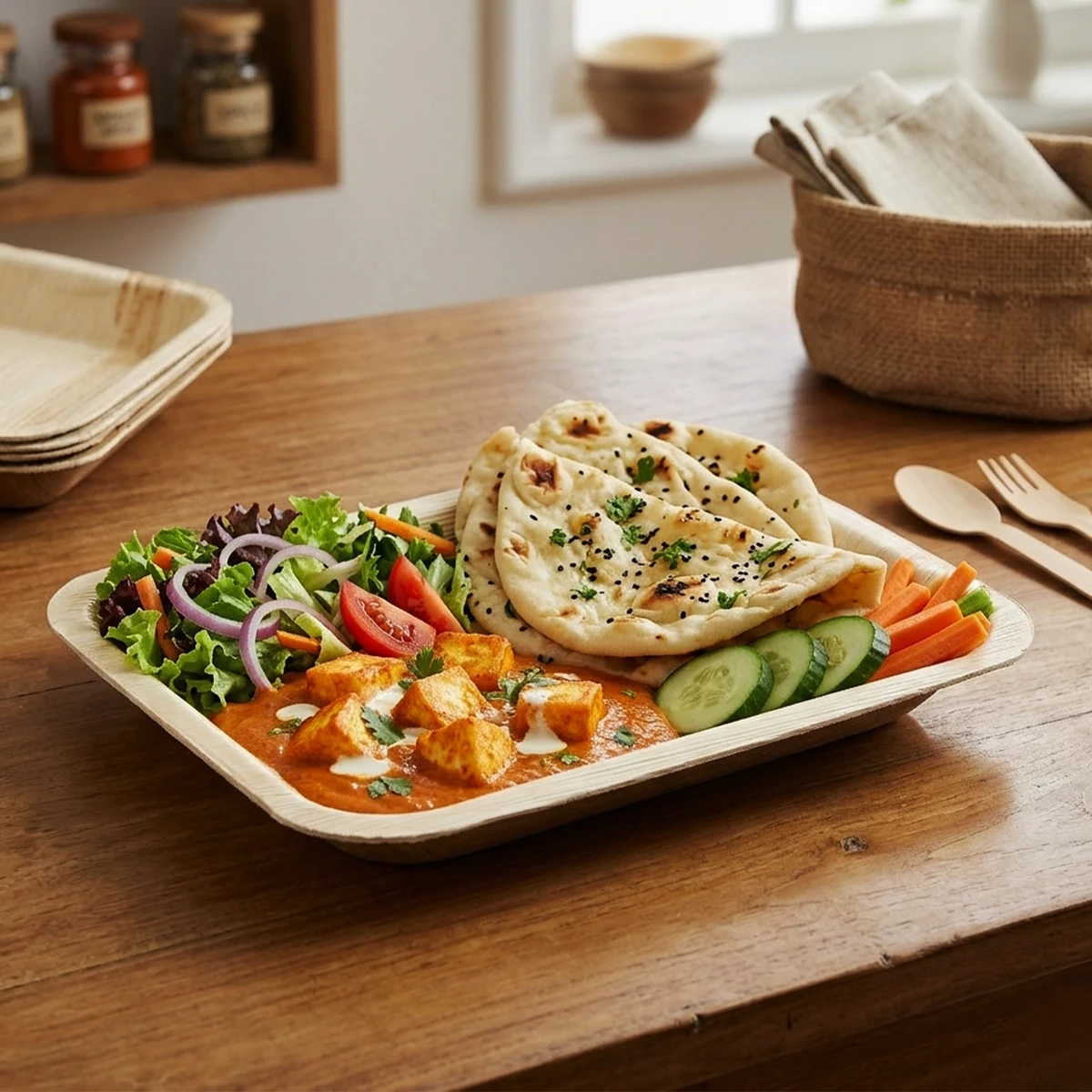
Start with a Trial Order 📦
Experience Foliware's premium areca palm leaf tableware with a minimum order of just 1 carton. Ideal for first-time buyers, distributors, HoReCa businesses, and institutional procurement.
Experience Foliware's premium areca palm leaf tableware with a minimum order of just 1 carton. Ideal for first-time buyers, distributors, HoReCa businesses, and institutional procurement.
Note. Single use plastics
classification and food contact rules can change. Confirm current
requirements with the Netherlands Enterprise Agency and the European
Commission’s food contact materials guidance before you ship.
Tableware entering the Netherlands sits under two separate
frameworks: Dutch rules on single use plastics, which set banned items,
pictogram marking and waste fee obligations depending on material
composition, and the EU’s food contact materials framework, supported by
a declaration of compliance. A third question, distinct from both, is
what happens on paperwork once goods clear in the Netherlands and move
on to another EU country for sale, which depends on where the goods are
ultimately placed on the market rather than where they entered.
A container clearing in Rotterdam is not necessarily destined to be
sold in the Netherlands. For many distributors, the Netherlands is where
the goods enter the EU, and another member state, or several, is where
they are actually sold. That distinction runs through everything else in
this article, because Dutch rules govern what happens if goods are
placed on the Dutch market, and a different member state’s rules govern
what happens once goods move there instead.
The Netherlands Enterprise Agency sets out the country’s rules on
single use plastics, covering which items are banned outright, which
items carry a pictogram marking requirement, and which are subject to a
waste management fee. These rules apply based on what an item is made of
and whether it is defined as a single use plastic product under the
applicable definition, not based on a product’s category alone.
That distinction matters directly for a plant fibre article. A
tableware item made from pressed plant fibre, without a plastic coating
or lining, is assessed against the same material definition as any other
item, and whether it falls inside or outside the single use plastics
rules is a classification question tied to the actual material
composition of the specific product. That classification is the
importer’s own compliance exercise to confirm, working from the
product’s material specification, not something a general article about
the category can settle in advance.
Separately from single use plastics rules, any tableware intended to
touch food is assessed under the EU’s food contact materials framework,
anchored in Regulation (EC) No 1935/2004, which sets general safety
requirements for food contact materials across member states including
the Netherlands. A manufacturer supports this with a declaration of
compliance, backed by testing, stating that the material meets those
requirements for its intended use.
This is a separate question from the single use plastics
classification above. A product can need to satisfy both, one addressing
whether it is safe to touch food, the other addressing whether its
material composition brings it inside single use plastics obligations,
and neither answer determines the other.
Once import formalities are completed and duty and VAT obligations
are settled at the point of entry, goods are generally in free
circulation within the EU, meaning they can move on to another member
state without repeating the same customs entry process at each internal
border. That is the practical reason the Netherlands, and Rotterdam
specifically, functions as a gateway lane for goods destined across the
wider EU market rather than only for Dutch domestic sale.
Free circulation is a customs status, though, not a blanket answer to
every other obligation. Several of the rules covered elsewhere in this
series, packaging registration obligations and single use plastics
classification among them, are assessed at the level of the member state
where goods are actually placed on the market, not the member state
where they physically cleared customs. A distributor who imports through
the Netherlands and sells into, for example, Germany or France should
expect that country’s own packaging and single use plastics rules to
apply to that sale, separately from whatever applied to the Dutch entry
itself. Clearing customs in Rotterdam settles the customs question. It
does not settle every market specific compliance question further down
the distribution chain.
The document set that travels with the shipment itself, a commercial
invoice and packing list at dispatch, and a certificate of origin where
required, does not change based on which EU country the goods are
ultimately sold into. What does change, member state by member state, is
the compliance documentation tied to the destination sale: which single
use plastics classification applies, and which country’s packaging
registration obligation the seller of record needs to satisfy. A
distributor planning onward EU distribution should map that out per
destination country rather than assuming a Dutch entry answers the
question for the whole EU market.
Do Dutch single use plastics rules apply to plant fibre
tableware? It depends on the specific product’s material
composition. The rules apply based on whether an item is defined as a
single use plastic product, and a pressed plant fibre item without a
plastic coating is assessed against that same definition rather than
assumed to be inside or outside it by category.
What is required for food contact suitability in the
Netherlands? The EU’s food contact materials framework,
anchored in Regulation (EC) 1935/2004, sets the general safety
requirements. A declaration of compliance backed by testing is the
standard way a manufacturer supports this.
If my goods clear customs in Rotterdam, are they compliant
everywhere in the EU? Customs clearance and free circulation
status address the customs question, not every other market rule. Single
use plastics classification and packaging registration obligations are
generally assessed at the level of the country where goods are actually
placed on the market, which may not be the Netherlands.
Does Foliware handle single use plastics classification for
the destination country? No. Classification and registration
obligations sit with the importer or distributor placing the goods on a
given national market. Foliware supplies the material specification and
the food contact declaration a distributor needs to make that
assessment.
Is Rotterdam faster than other EU entry points? This
article does not make a claim about transit times or throughput.
Rotterdam’s relevance here is its role as an entry point with onward
connections into the wider EU market, not a specific speed or capacity
figure.
Netherlands Enterprise Agency, business.gov.nl Rules for
single-use plastics
https://business.gov.nl/regulations/rules-single-use-plastics/ Supports:
banned items, pictogram marking and waste fee obligations under Dutch
single use plastics rules
European Commission Legislation, Food contact materials
https://food.ec.europa.eu/food-safety/chemical-safety/food-contact-materials/legislation_en
Supports: the structure of the EU food contact materials framework
applicable to tableware entering the Netherlands
EUR-Lex Regulation (EC) No 1935/2004 on materials and articles
intended to come into contact with food
https://eur-lex.europa.eu/eli/reg/2004/1935/2021-03-27 Supports: that
Regulation (EC) 1935/2004 is the primary legal text setting general food
contact material safety requirements across the EU
Lane, documentation and destination rules for the markets this article applies to. Each page carries the route, the paperwork set and the quotation route for that destination.
Each link below answers the question this article raises next, whether that is the rule behind a decision, the same question in another destination, or the commercial step that follows.
Send the product, the volume and the destination. A quotation follows within one business day.