
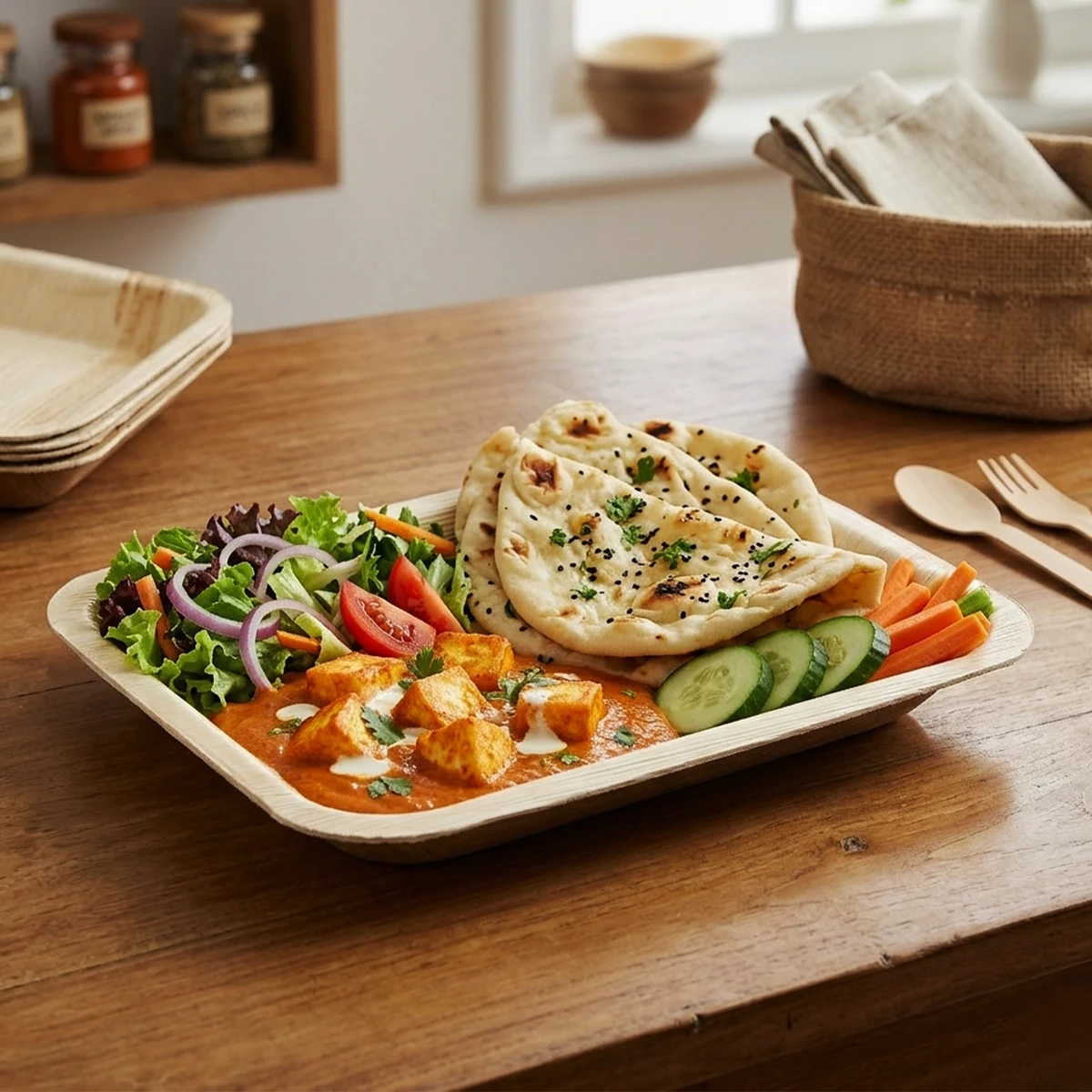
Start with a Trial Order 📦
Experience Foliware's premium areca palm leaf tableware with a minimum order of just 1 carton. Ideal for first-time buyers, distributors, HoReCa businesses, and institutional procurement.
Experience Foliware's premium areca palm leaf tableware with a minimum order of just 1 carton. Ideal for first-time buyers, distributors, HoReCa businesses, and institutional procurement.
FOB and CIF differ in who arranges and pays for the main sea freight
and marine insurance, not in who is responsible for the goods at origin.
Under FOB, your own forwarder takes over once the goods are loaded at
the Indian port. Under CIF, Foliware’s forwarder handles freight and
insurance through to the destination port. First-time importers usually
start with CIF for simplicity and move to FOB once they have a forwarder
relationship they trust.
FOB and CIF are both Incoterms, the standard trade terms the
International Chamber of Commerce publishes and periodically revises,
with Incoterms 2020 the current edition. What they change is where the
handover point sits between exporter and importer, and who arranges and
pays for freight and insurance up to that point. Quality risk,
production risk and export compliance sit with Foliware in both cases,
right up to the point the goods are handed over.
| Stage | Under FOB | Under CIF |
|---|---|---|
| Production and packing | Foliware, cost and risk | Foliware, cost and risk |
| Inland transport to the Indian port | Foliware arranges, cost included by Foliware | Foliware arranges, cost included by Foliware |
| Export customs clearance | Foliware, using its Importer Exporter Code | Foliware, using its Importer Exporter Code |
| Loading onto the vessel | Foliware arranges; risk transfers to the buyer once goods are on board |
Foliware arranges; risk transfers to the buyer once goods are on board |
| Main sea freight | Buyer’s forwarder books and pays | Foliware’s forwarder books; cost is built into the buyer’s price |
| Marine insurance | Buyer arranges separately, if wanted | Foliware arranges as part of the shipment |
| Destination port charges | Buyer’s forwarder handles | Buyer’s forwarder handles |
| Import customs clearance | Buyer, through their own broker | Buyer, through their own broker |
| Inland transport to buyer’s warehouse | Buyer arranges | Buyer arranges |
The rows that differ are the middle three: main freight, insurance
and who books the vessel. Everything before loading and everything after
the destination port is the same shape under either term.
FOB gives the buyer control of freight. You choose the carrier,
negotiate the freight rate directly, and consolidate with other
suppliers on the same vessel if that suits your logistics setup. The
cost of that control is that you are managing a forwarder relationship
on the export side of a transaction, in a country where you may not have
one yet.
CIF gives the buyer simplicity. One price from Foliware covers goods,
freight and insurance to the destination port, and you are dealing with
a single quoted figure rather than coordinating a second vendor on the
other side of the world for your first order.
Neither term changes who is responsible for the condition of the
goods when they are packed, or who clears export customs in India. Those
stay with Foliware regardless of which term you choose.
A first order is usually also the first time a buyer is dealing with
an unfamiliar exporter, an unfamiliar country’s export process and,
often, an unfamiliar product category. Reducing the number of unknowns
to manage in parallel is a reasonable choice, and CIF does that by
folding freight and insurance into a single quoted relationship with the
supplier you are already vetting.
FOB becomes the more efficient choice once you already run a
forwarder relationship on lanes into your market, whether from other
suppliers or other product categories. At that point, booking your own
freight usually costs less than paying it through the exporter’s
forwarder, and you gain visibility into the shipment from the moment it
leaves port rather than only from the moment it clears at
destination.
It also makes sense once volume grows to the point where you are
consolidating shipments from more than one supplier onto the same
vessel, since that consolidation only works if you are the one booking
the freight.
Incoterms 2020, published by the International Chamber of Commerce,
is the reference framework FOB and CIF sit inside. The full rule text
that defines the precise transfer points and obligations sits in ICC’s
published Incoterms 2020 rules themselves, which this article does not
reproduce. What is described above is the operational shape of each term
as it plays out on a shipment, not a substitute for reading the rule
text or asking your forwarder to confirm the exact transfer point named
on your bill of lading.
If this is your first international order in this category and you do
not already have a forwarder relationship on the lane, CIF removes a
variable you do not need to manage yet. If you already ship from other
suppliers into the same destination, ask whether adding this shipment to
your existing FOB arrangement is more efficient than a separate CIF
quote. Either way, state your preferred term when you enquire so the
quotation reflects it correctly.
What is the main difference between FOB and CIF? Who
arranges and pays for the main sea freight and marine insurance. Under
FOB, the buyer’s forwarder takes over at the port of loading. Under CIF,
the exporter’s forwarder handles freight and insurance through to the
destination port.
Does CIF mean Foliware is responsible for the goods until
they reach me? No. Foliware arranges and pays for freight and
insurance under CIF, but risk transfers to the buyer once the goods are
loaded onto the vessel, the same transfer point as under FOB. CIF
changes who pays and arranges transport, not who carries risk in
transit.
Which term is cheaper? Neither is inherently
cheaper. FOB can cost less once you have your own competitive freight
rate; CIF folds the cost into one quoted figure. The comparison only
means something once you have an actual freight quote to compare against
the CIF landed figure.
Can I choose FOB on my first order? Yes, if you
already have a forwarder who can take the shipment from the Indian port
of loading. If you do not, CIF avoids needing to arrange that
relationship before your first shipment moves.
Where do I find the exact legal definition of FOB and
CIF? In the Incoterms 2020 rules published by the International
Chamber of Commerce. This article describes how each term plays out
operationally on a shipment; it does not reproduce the rule text
itself.
International Chamber of Commerce Incoterms 2020
https://iccwbo.org/business-solutions/incoterms-rules/incoterms-2020/
Supports: that ICC publishes the Incoterms rules and that Incoterms 2020
is the current edition. Not cited for the FOB or CIF rule text itself,
which sits in ICC’s paid publication.
DGFT, Government of India DGFT trade services portal
https://www.dgft.gov.in/CP/ Supports: that the Importer Exporter Code is
mandatory for Indian export and is used in export customs
clearance
Foliware operational data Export process Internal operational
record, confirmed 4 September 2026 Supports: that Foliware arranges
inland transport to the Indian port and handles export customs clearance
under both FOB and CIF
Lane, documentation and destination rules for the markets this article applies to. Each page carries the route, the paperwork set and the quotation route for that destination.
Each link below answers the question this article raises next, whether that is the rule behind a decision, the same question in another destination, or the commercial step that follows.
Send the product, the volume and the destination. A quotation follows within one business day.